






TLDR
- UNI jumped roughly 15% in 24 hours, outperforming Bitcoin (+4.7%) and Ether (+8.5%)
- A governance proposal would expand Uniswap’s fee switch to eight additional chains
- The change could add ~$27 million in annualized revenue on top of ~$34 million already generated
- Uniswap has already burned over $5.5 million worth of UNI since the fee switch launched late last year
- Q1 2026 gross profit hit ~$3.12 million, compared to effectively zero in prior periods
Uniswap’s UNI token surged roughly 15% in 24 hours on February 26, 2026, outpacing the broader crypto market as traders reacted to a governance proposal that could reshape how the protocol collects revenue.
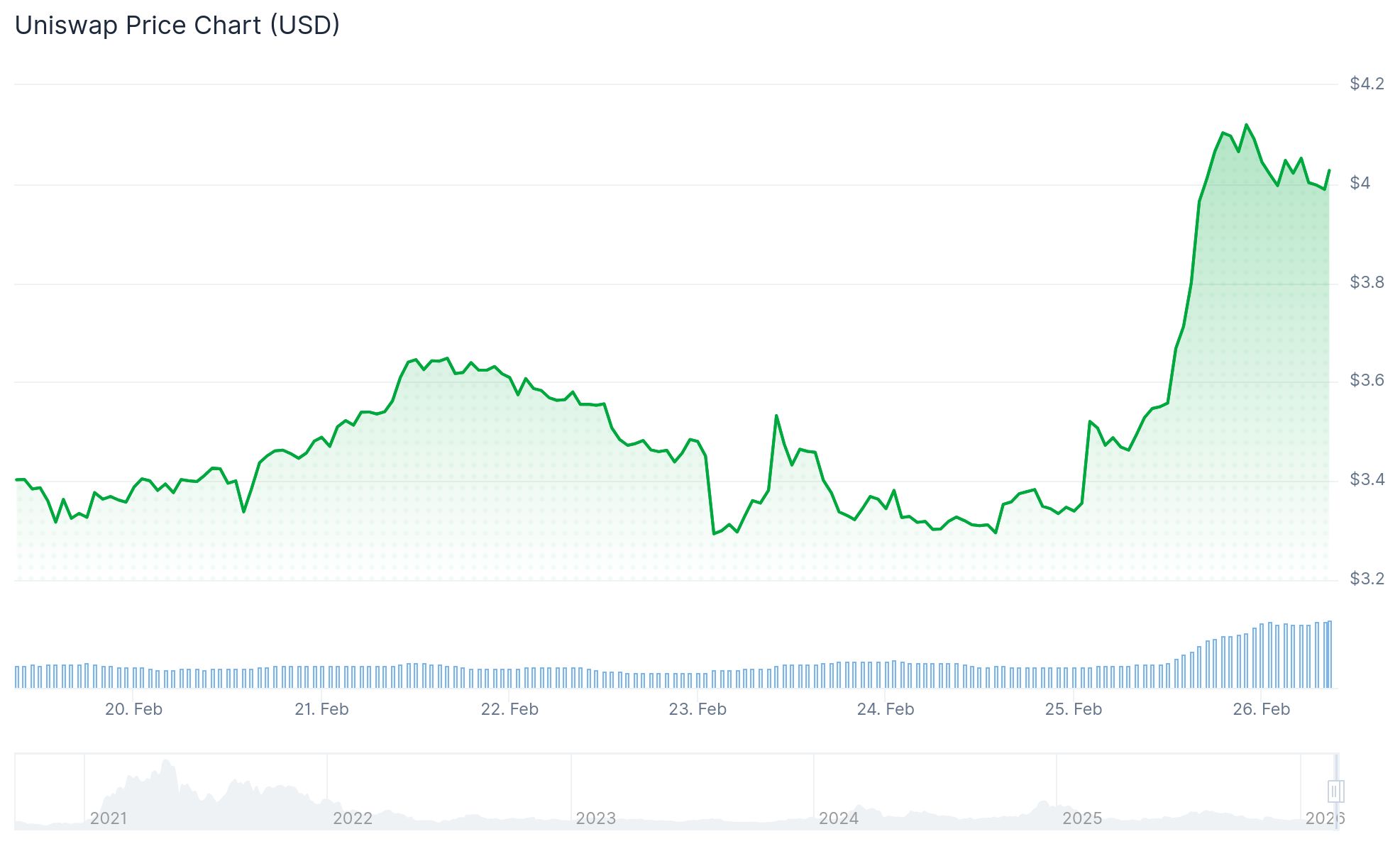
Bitcoin gained around 4.7% over the same period, while Ether rose about 8.5%. UNI’s move was one of the stronger performances among major tokens.
The catalyst was a governance vote to expand Uniswap’s fee switch to eight additional blockchain networks, including several layer-2 chains.
The fee switch is a mechanism that redirects a share of trading fees away from liquidity providers and into the protocol treasury. That revenue is then used for UNI token buybacks and burns.
The proposal would also replace the current pool-by-pool fee activation model with a tier-based v3 system, applying protocol fees across all liquidity pools by default.
A new tool called the v3OpenFeeAdapter would make fee collection automatic for all new v3 pools, removing the need for governance to approve each one individually.
Estimates suggest the expansion could generate roughly $27 million in additional annualized revenue, on top of the approximately $34 million already being captured and used to burn UNI.

A single governance decision is about to add $27M in annualized revenue to Uniswap.
Since the first UNIfication proposal passed, collected protocol fees have already enabled $5.5M+ in UNI burns ($34M annualized). So, what kind of impact could expanding this to eight additional… pic.twitter.com/GjEJbJ0S8b
— Entropy Advisors (@EntropyAdvisors) February 25, 2026
Fee Switch Already Burning Millions
Since the fee switch first launched in late 2025, Uniswap has burned more than $5.5 million worth of UNI, implying an annualized burn rate of around $34 million at current trading levels.
In Q1 2026, Uniswap recorded approximately $3.12 million in gross profit according to DeFi Llama data, compared to effectively zero in earlier periods.
The governance vote is split into two separate onchain votes due to transaction size limits.
Price Action and Technical Levels
UNI climbed to intraday highs above $4.00 during the session, with daily trading volume spiking around 62%.
Despite the daily gain, UNI remains negative over the past week, month, and year-to-date. The token is still trading below its 50-day, 100-day, and 200-day simple moving averages.
$UNI/USDT is currently holding a key support zone. Price has bounced from this area multiple times in the past, which makes it an important level to watch. Ideally, we should see another reaction from here.
However, if this zone fails to hold, it could open the door for a deeper… pic.twitter.com/9CElQgRihI
— UniChartz (@UniChartz) February 22, 2026
The daily RSI sits around 56, with room to move higher before reaching overbought territory. The MACD histogram shows fresh bullish momentum, with $3.20 identified as a potential local bottom.
Bollinger Bands place UNI above the upper band at $3.81. A break above the 50-day SMA would put the 100-day SMA near $5.09 in focus.
Key support levels sit at $3.48 and $3.00 on the downside.
BlackRock recently purchased UNI tokens as part of a plan to use Uniswap to facilitate trading of its BUIDL tokenized Treasury fund.
Open interest in UNI is rising and funding rates are positive, according to data from Coinglass.


