






TLDR
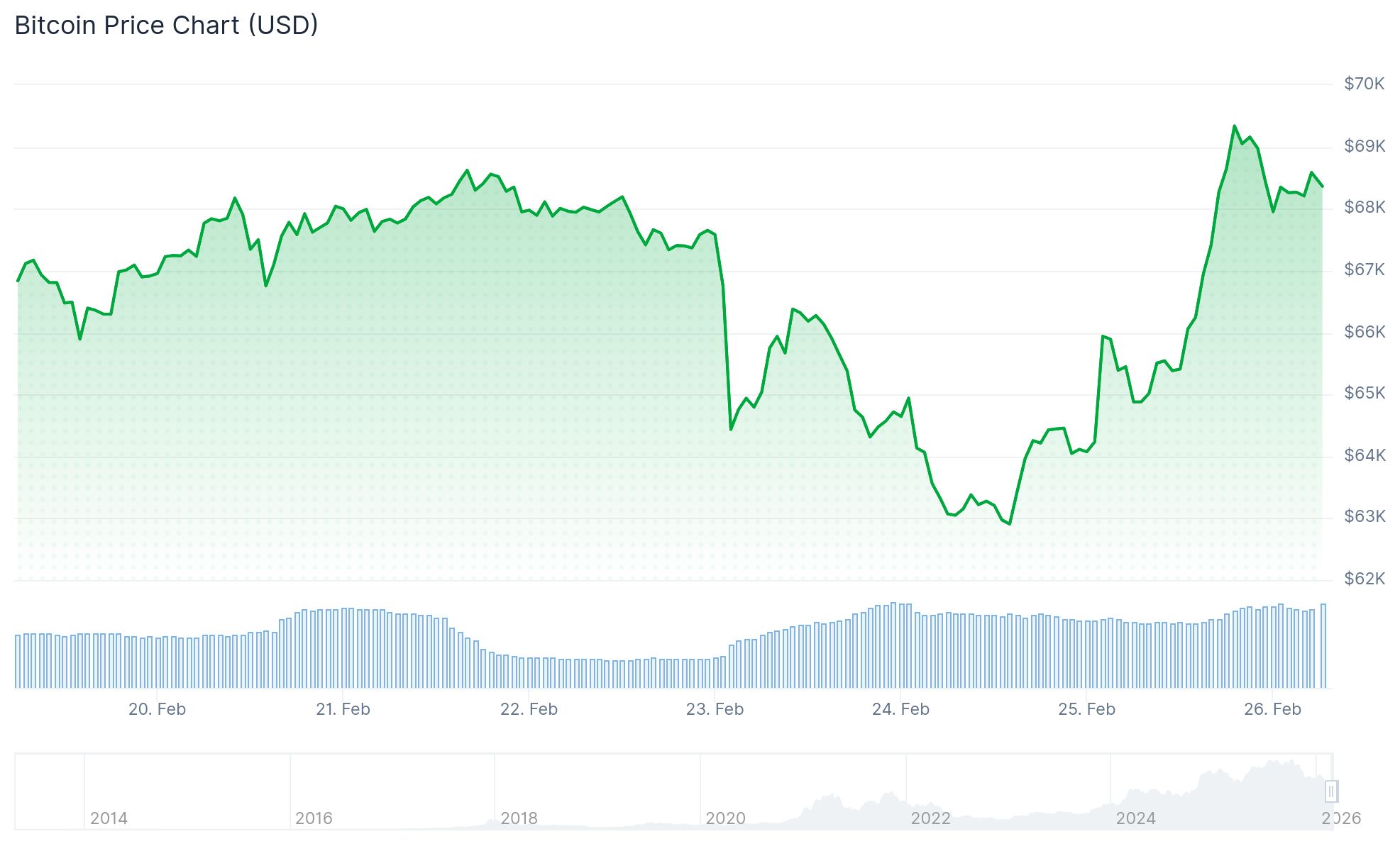
- Stifel Financial predicts Bitcoin could fall to $38,000, a 43% drop from current levels around $65,000
- The call is based on a 15-year trendline connecting the bottom of every major Bitcoin crash since 2010
- Bitcoin’s correlation with the Nasdaq 100 is now 0.78, meaning it moves more like a tech stock than a hedge
- U.S. spot Bitcoin ETFs have seen $3.8 billion in outflows over five weeks, including $2.1 billion from BlackRock’s IBIT
- Bulls counter with targets ranging from $170,000 (JPMorgan) to $250,000 (Tom Lee at Fundstrat)
Stifel Financial, a 136-year-old investment bank, says Bitcoin could fall to $38,000. That would be a 43% decline from its current price near $65,000, and a 70% drop from the October 2025 peak of $126,000.
The call comes from Stifel’s chief equity strategist, Barry Bannister. His team drew a trendline through the lowest point of every major Bitcoin crash since 2010 and extended it forward.
The crashes in 2011, 2015, 2018, and 2022 each had different depths, but the floors kept rising over time. That upward-sloping line, when extended to today, lands at $38,000.
Bitcoin dropped 93% in 2011, 84% in 2015, and 83% in 2018. The 2022 crash stopped at around $15,500. Each time, long-term holders bought in at higher levels, raising the floor.
Stifel is not calling this a definitive crash. The firm says the conditions that stopped previous crashes from going deeper are not showing up yet.
Bitcoin Acting More Like a Tech Stock
Bitcoin was once seen as a hedge against a weakening dollar. That relationship has changed.
The Dollar Index dropped nearly 10% in 2025 and another 1% in early 2026, yet Bitcoin fell alongside it instead of rising. Bannister calls this the “Benjamin Button” problem.

Bitcoin’s correlation with the Nasdaq 100 now sits at 0.78. When tech stocks sell off, Bitcoin tends to sell off with them.
The Fed cut rates modestly in December 2025 but kept a hawkish tone. Kevin Warsh’s nomination as Fed Chair points to restrictive policy continuing through 2027. Global M2 money supply is also contracting, reducing the pool of speculative money in markets.
U.S. spot Bitcoin ETFs have logged $3.8 billion in outflows over five weeks. BlackRock’s IBIT alone lost $2.1 billion during that period.
The CLARITY Act, which would have given institutional investors more regulatory certainty, stalled in January after Coinbase withdrew support over stablecoin yield provisions.
What Bitcoin Bulls Are Saying
Not everyone agrees with Stifel’s outlook. JPMorgan sees Bitcoin reaching $170,000 within 6 to 12 months, based on a comparison with gold on a volatility-adjusted basis.
Analyst Nikolaos Panigirtzoglou says Bitcoin is trading roughly $68,000 below fair value relative to gold. He describes it as a mechanical exercise rather than a firm forecast.
Tom Lee at Fundstrat is targeting $200,000 to $250,000 by end of 2026. He points to the April 2024 halving, which historically leads to a price peak 12 to 18 months later.
Arthur Hayes, former BitMEX CEO, also expects Bitcoin to pass $200,000, citing what he sees as stealth quantitative easing from the Fed through Reserve Management Purchases.
Previous bearish calls have overshot before. In 2022, analysts warned of $10,000, but Bitcoin bottomed at $15,760.
Stifel identifies $54,000 as the key breakdown level. A fall through that price could open the path to $45,000, and then $38,000. A move above $58,000 to $60,000 would weaken the bearish case.
Bitcoin is currently sitting near $65,000, with $3.8 billion in ETF outflows recorded over the past five weeks.


