






TLDR
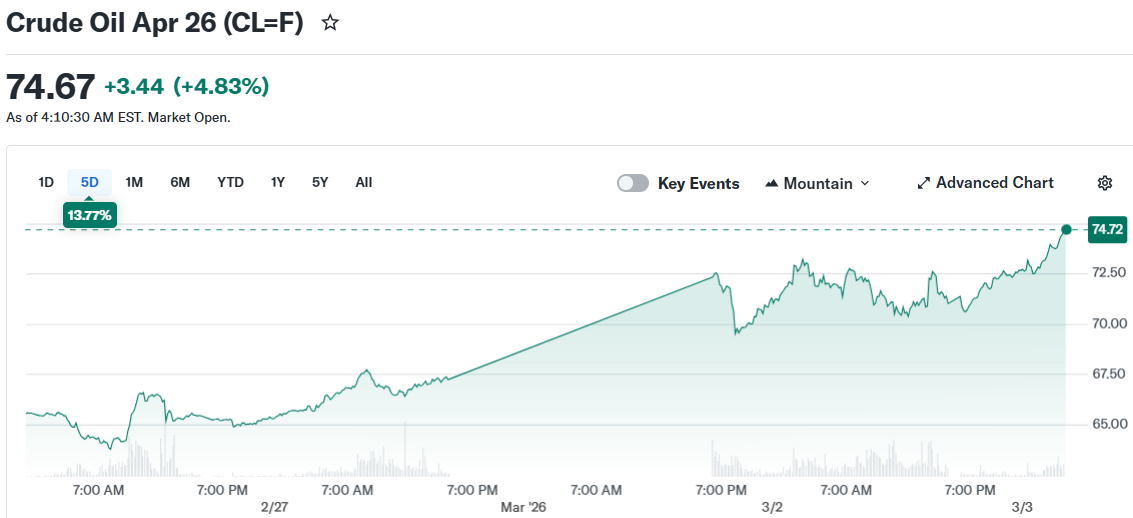
- US and Israel launched strikes on Iran, killing Ayatollah Khamenei, sending oil prices up ~8% to near $80/barrel
- Trump says the campaign will last 4–5 weeks; economists say duration is the key factor for economic damage
- Europe is considered the most exposed major economy due to its reliance on Middle East oil and gas
- If the Strait of Hormuz is blocked, oil could top $100/barrel, pushing US gas prices to ~$4.50/gallon
- The Federal Reserve is now even more likely to hold interest rates, with inflation risks rising
The US and Israel launched military strikes on Iran over the weekend, killing Supreme Leader Ayatollah Ali Khamenei. The attack triggered retaliatory strikes across the Middle East and sent oil prices sharply higher.
Crude oil rose around 8% on Monday, breaking through $80 a barrel. Before the escalation, oil had been averaging around $65 a barrel.
Trump said the bombing campaign is expected to last four to five weeks, but added the US is prepared to extend it to “whatever it takes.” Defense Secretary Pete Hegseth said this would not become a prolonged conflict like Iraq.
Economists say the length of the conflict is the single biggest factor in how much damage it does to the global economy. A short war may cause only a brief energy price spike. A longer one could cause serious economic disruption.
The Strait of Hormuz, which Iran controls access to, is a critical chokepoint for global energy. Around one-fifth of the world’s seaborne oil and gas passes through it. Tanker traffic has already slowed since fighting began.
What Happens If the Strait Closes
If oil shipments through the strait don’t resume, crude could settle above $100 a barrel, according to energy consultancy Wood Mackenzie. That would push US gasoline prices from $3 today to around $4.50 a gallon.
That increase alone would add 1.5 percentage points to US headline inflation, according to ING’s James Knightley. There would also be knock-on effects from higher airfares and distribution costs.

The Federal Reserve had already paused its interest rate cuts. Former Treasury Secretary Janet Yellen said the Iran conflict “puts the Fed even more on hold.”
Natixis economists outlined two scenarios. In the first, US growth slows to between 0.5% and 1.5% this year. In the second, the economy contracts for at least two quarters if the war widens and hits global shipping.
The US has some protection because it is now a net energy exporter. RSM chief economist Joseph Brusuelas said the initial market response does not present “any material risk to US growth or inflation outlooks” at this stage.
Europe More Exposed Than the US
Europe faces a bigger threat. ING economist Carsten Brzeski called the eurozone the “most exposed major economy” to spillovers from the Iran conflict due to its dependence on regional oil and gas.
Things had been improving in Europe, with increased government spending in Germany expected to support modest growth. The Iran escalation adds new uncertainty to that recovery.
Bloomberg Economics said that if the conflict is short, damage will be contained. A prolonged war keeping energy prices high could force European governments to spend more to protect consumers.
European natural gas prices rose sharply on Monday as Gulf supplies came under threat.
Stop guessing and start investing with confidence. KnockoutStocks gives you the AI insights, market intelligence, and stock research you need to spot opportunities, cut through the noise, and make smarter investment decisions — all in one powerful platform.
Sign up today and get 50% OFF full access to our premium stock picks.
Simply use coupon code SPECIAL50 at checkout to claim your exclusive discount.
Get 3 Free Stock Ebooks
Discover top-performing stocks in AI, Crypto, and Technology with expert analysis.
- Top 10 AI Stocks - Leading AI companies
- Top 10 Crypto Stocks - Blockchain leaders
- Top 10 Tech Stocks - Tech giants



