






TLDR
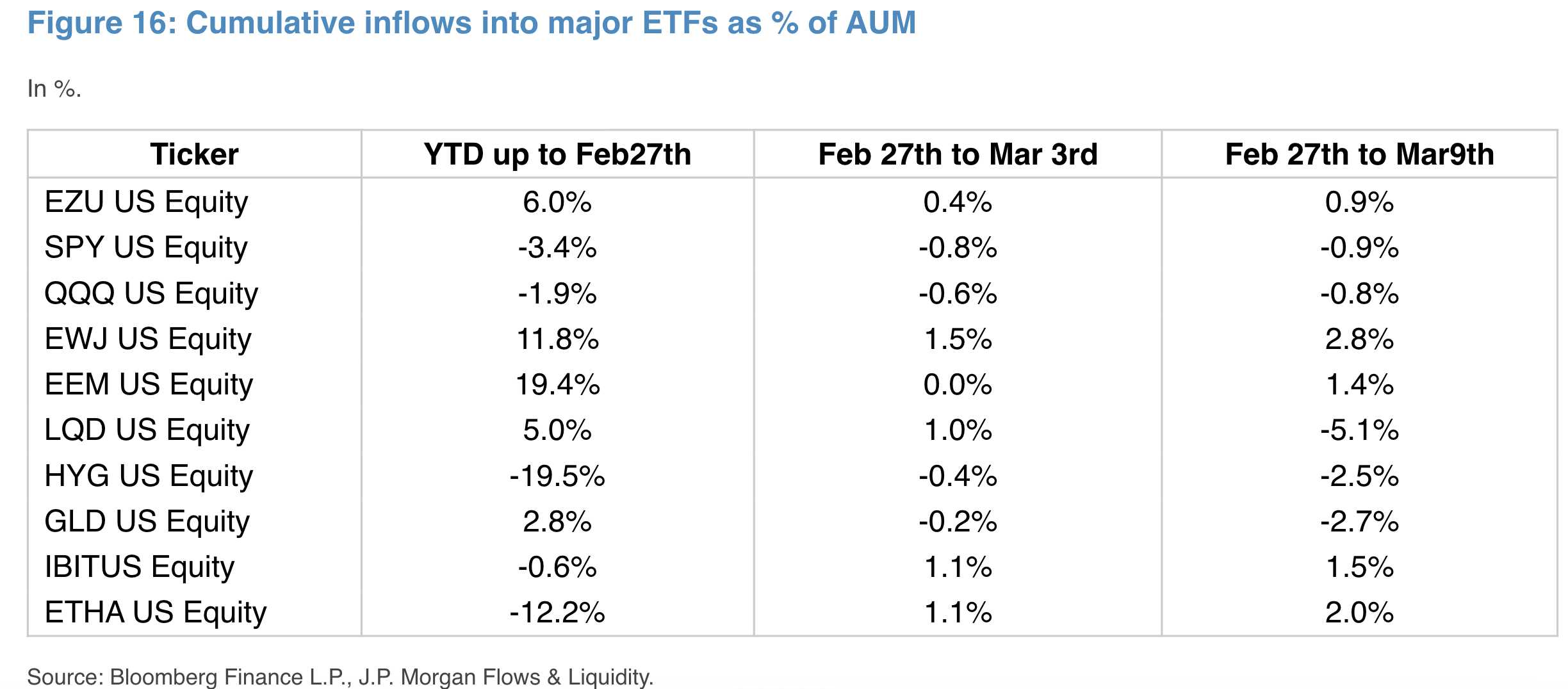
- Since the Iran war erupted, gold ETF outflows hit 2.7% of assets while Bitcoin ETF inflows rose 1.5%
- The largest gold ETF, GLD, lost $3 billion in a single day on March 6, the biggest daily outflow in two years
- Bitcoin ETFs saw $906 million in net inflows in the 30 days to March 11, reversing a $1.9 billion outflow from the prior month
- JPMorgan analysts noted Bitcoin’s volatility is compressing as institutional ownership deepens
- Bitcoin has historically rallied an average of 54% in the 12 months following US midterm elections
Since the Iran war began late last month, investors have been pulling money out of gold funds and putting it into Bitcoin funds at a pace that has surprised analysts.
The largest spot gold ETF, SPDR Gold Shares (GLD), has seen outflows equal to roughly 2.7% of its assets under management. At the same time, BlackRock’s iShares Bitcoin Trust (IBIT), the largest spot Bitcoin ETF, recorded inflows of about 1.5% of assets over the same period. This data comes from JPMorgan analysts led by managing director Nikolaos Panigirtzoglou.
On March 6, GLD recorded a single-day outflow of $3 billion. That figure is more than 200% larger than any previous daily outflow seen over the prior two years, according to The Kobeissi Letter.
Bitcoin ETFs told a different story. The 30-day net inflow figure improved to $906 million as of March 11, compared to a $1.9 billion outflow just a month earlier. Bitcoin ETF balances in native units also improved, rising to positive 12,909 BTC after a prior period showed a loss of 34,197 BTC.
The divergence between the two assets reversed the year-to-date advantage gold ETFs held over Bitcoin ETFs going into the Iran conflict.
Institutional Positioning Has Shifted
JPMorgan noted that the period between last October and early 2026 saw a rotation from Bitcoin into gold, particularly among retail investors. During that stretch, IBIT saw outflows while GLD attracted strong inflows.
But the latest shift goes beyond just ETF flows. Short interest in IBIT increased in recent months while short interest in GLD declined. Analysts said this suggests hedge funds and other institutional players reduced their Bitcoin exposure in favor of gold during that earlier period.

IBIT’s put-to-call ratio also moved above GLD’s and stayed there since November, marking the first sustained period where Bitcoin ETF options showed stronger demand for downside protection than gold ETF options.
Despite the earlier caution, Bitcoin ETFs still lead gold ETFs in total cumulative inflows since 2024. IBIT’s total inflows since launch are roughly double those of GLD over the same timeframe.
Bitcoin Volatility Is Compressing
JPMorgan analysts also noted that Bitcoin’s volatility profile is showing signs of compression. They attributed this to deeper institutional ownership and improving market liquidity.
Analyst MN Capital founder Michaël van de Poppe pointed out that the Bitcoin-to-gold ratio is showing a bullish divergence on the relative strength index on the daily chart. The ratio recently returned to a support level near 12-13, a zone that acted as resistance in 2017 before becoming support in 2022 and 2023.
#Bitcoin vs. Gold is currently breaking upwards after a confirmation of the bullish divergence.
This should indicate that we're about to see significantly more strength in Bitcoin. pic.twitter.com/vwIpwJ82qz
— Michaël van de Poppe (@CryptoMichNL) March 11, 2026
Options-implied volatility for GLD has risen more sharply than for IBIT in recent months, suggesting investors expected larger price swings in gold.
Binance Research described the current environment as an “opportunity within risk” for Bitcoin, noting that BTC has moved alongside macro assets like oil and US equities since the Iran war began.
Bitcoin ETF trading volume from US spot ETFs has increased recently. However, US spot ETFs still account for only around 9% of total Bitcoin spot trading volume, well below the 30-40% ETF share seen in US equity markets.
Historically, the 12 months following US midterm elections have never produced a negative return for the S&P 500 since 1939, averaging gains of 19%. Bitcoin has averaged a 54% rally in all three post-midterm years on record.
JPMorgan analysts reiterated their long-term Bitcoin price target of $266,000 based on a volatility-adjusted comparison to gold.


