






TLDR
- Oil prices bounced back Tuesday after falling 11% Monday, with Brent crude rising to over $102 a barrel
- Iran denied any talks with the U.S., contradicting Trump’s claim that negotiations were underway
- The Strait of Hormuz remains largely closed, cutting off 20% of global oil exports
- Experts predict oil prices will likely stay between $85–$110 until the Strait reopens
- Countries like Slovenia, Chile, Japan, and the Philippines are already rationing or restricting fuel
Oil prices rebounded sharply on Tuesday after a steep drop the day before. Brent crude climbed to around $102 a barrel, while West Texas Intermediate rose about 3% to roughly $90.
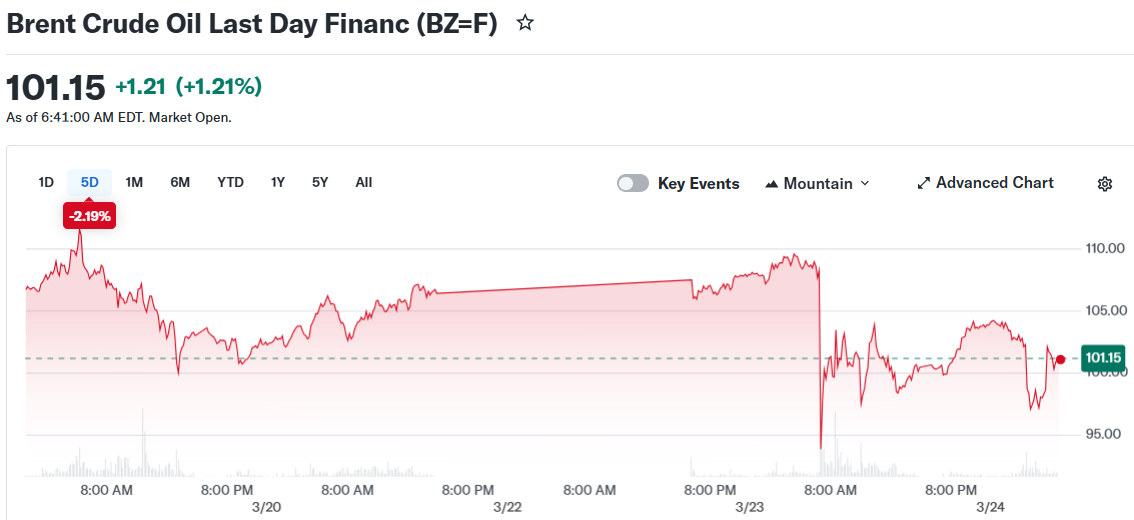
Monday’s selloff came after President Trump said the U.S. and Iran were in talks. That claim helped briefly push oil prices lower. But Iran’s Foreign Ministry quickly denied any negotiations were taking place, and a senior Iranian lawmaker said flatly: “No negotiations have been held with the U.S.”
That denial sent prices climbing again.
BREAKING: The US and Israel have struck new Iranian energy facilities including a natural gas pipeline belonging to an Iranian power plant in Khorramshahr.
Brent oil prices are pushing above $100/barrel.
— The Kobeissi Letter (@KobeissiLetter) March 24, 2026
The key issue remains the Strait of Hormuz. This narrow waterway connects the Persian Gulf to the rest of the world’s oil markets and normally handles around 20% of global oil exports. Iran has kept it largely blocked since the conflict with the U.S. and Israel escalated.
Brent has risen roughly 40% this month alone, driven by fears that the conflict could cause a long-term energy shortage. Diesel and jet fuel prices have risen even faster than crude.
The Global Impact Is Spreading
Countries around the world are already dealing with the fallout. Slovenia became the first European Union country to impose fuel rationing. Chile is set to raise fuel prices by up to 50%. Japan ordered a full review of its oil supply chain.
In Asia, China’s largest refiner said it would focus on domestic supplies. The Philippines warned that grounding flights due to jet fuel shortages was a “distinct possibility.”

New Zealand announced weekly tax credits for roughly 150,000 families to help cover rising fuel costs.
Goldman Sachs warned that if the supply shock continues, demand would eventually need to fall just to rebalance the market.
Diplomatic Signals Remain Unclear
Trump had previously threatened to bomb Iran’s energy infrastructure unless the Strait was fully reopened within 48 hours. He later paused that threat for five days. He also suggested the U.S. and Iran could jointly manage the Strait, saying it could open “very soon.”
Iran’s deputy parliamentary speaker said the Strait would not return to its previous state and that there would be no negotiations with Washington.
Tehran is reportedly reviewing correspondence from the U.S. sent through intermediaries, according to CBS News citing a senior Iranian official. Gas facilities in Isfahan, central Iran, were also hit over the weekend.
Saudi Arabia told the U.S. it was prepared to strike Iran if its own power and water infrastructure came under attack. Reports suggest Saudi Crown Prince Mohammed bin Salman is close to deciding whether to join military action.
RBC Capital Markets analysts noted that ships — not statements — would ultimately determine what happens in physical oil markets.
A small number of vessels have successfully passed through the Persian Gulf in recent days, though most traffic through the Strait remains halted.
Macquarie Group energy strategist Vikas Dwivedi said even if tensions ease, oil prices are likely to stay between $85 and $90 at the floor, with a drift back toward $110 until the Strait fully reopens.
Stop guessing and start investing with confidence. KnockoutStocks gives you the AI insights, market intelligence, and stock research you need to spot opportunities, cut through the noise, and make smarter investment decisions — all in one powerful platform.
Sign up today and get 50% OFF full access to our premium stock picks.
Simply use coupon code SPECIAL50 at checkout to claim your exclusive discount.
Get 3 Free Stock Ebooks
Discover top-performing stocks in AI, Crypto, and Technology with expert analysis.
- Top 10 AI Stocks - Leading AI companies
- Top 10 Crypto Stocks - Blockchain leaders
- Top 10 Tech Stocks - Tech giants



