





TLDR
- Wedbush analyst Daniel Ives reiterated a Buy rating and $600 price target on Tesla, implying ~57% upside
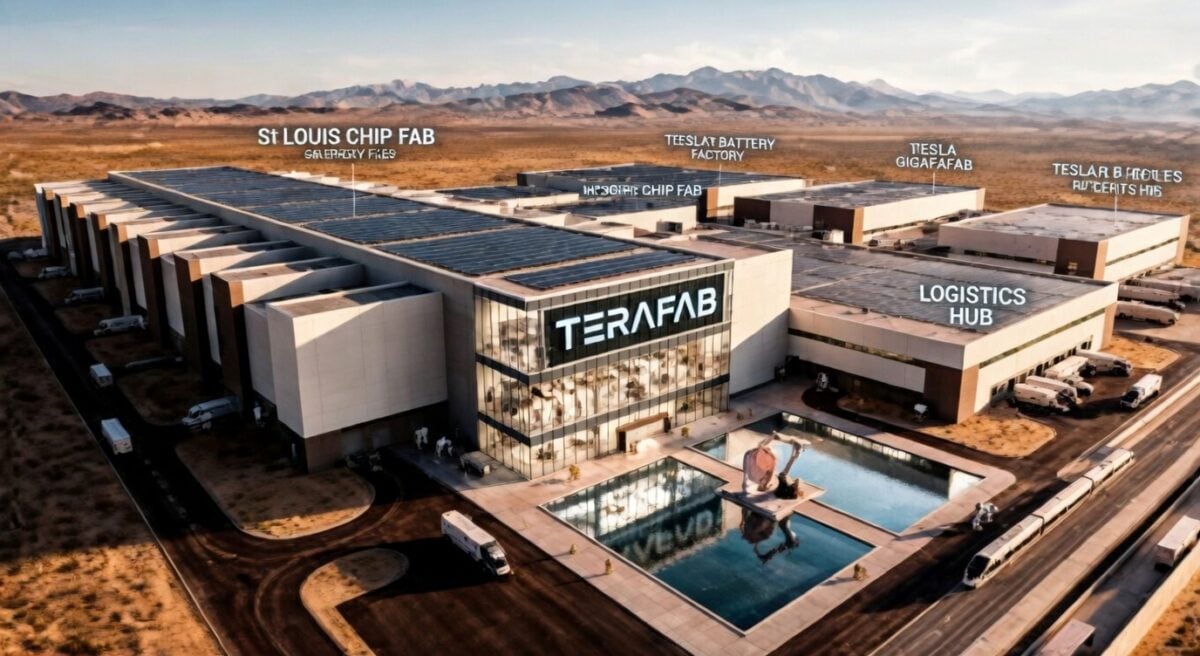
- Elon Musk announced Terafab: two chip factories in Austin, Texas, built jointly by Tesla, SpaceX, and xAI
- One factory will serve Tesla’s EVs and Optimus robots; the other targets AI data centers in space
- Ives calls Terafab the “first step” toward a Tesla-SpaceX merger he expects “likely in 2027”
- Barclays analyst Dan Levy struck a more cautious tone, keeping an Equalweight rating and $360 target
Wedbush analyst Daniel Ives is sticking with his bullish Tesla call, reiterating a Buy rating and Street-high $600 price target following CEO Elon Musk’s announcement of a massive chip factory project called Terafab.
Dan Ives in new $TSLA note:
"We believe this (Terafab project) is the first step to ultimately what will be Tesla and SpaceX combining forces in a merger likely in 2027. While the timeline for this project is uncertain, this will accelerate the company’s ambitious AI path which… pic.twitter.com/s9fxIqWgF4
— Sawyer Merritt (@SawyerMerritt) March 24, 2026
Musk unveiled the Terafab concept on Saturday night at Austin’s defunct Seaholm Power Plant, with Texas Governor Greg Abbott in attendance. The project is a joint venture between Tesla, SpaceX, and xAI — the company SpaceX acquired in an all-stock deal in February.
The plan calls for two chip factories in Austin. One will produce chips for Tesla’s electric vehicles and Optimus humanoid robots. The other is designed for AI data centers, including those in space.
At full capacity, Tesla says the facility could match roughly 70% of TSMC’s entire current global production. Musk wants to hit 1 terawatt of annual capacity — about double current U.S. output.
Two chip families are in the works. The AI5 is a terrestrial inference chip for Tesla’s Full Self-Driving system, Cybercab robotaxi, and Optimus. Tesla claims it delivers a 50x improvement over the current AI4 chip. The D3 is a radiation-hardened chip built for SpaceX’s orbital satellite constellation.

Musk said 80% of Terafab’s output would go toward space-based uses, with 20% for terrestrial applications.
Initial targets call for 100,000 wafer starts per month, scaling to one million at full capacity. The facility would produce between 100 and 200 billion custom AI and memory chips per year at 2-nanometer nodes.
Why Tesla Says It Has to Build Its Own Chips
Musk said current suppliers — Samsung, TSMC, and Micron — simply can’t expand fast enough. “There’s a maximum rate at which they’re comfortable expanding. That rate is much less than we’d like,” he said.
Ives echoed the point, saying those suppliers “are unable to meet future demand.” He framed Terafab as a vertical integration play that consolidates chip design, fabrication, memory production, and packaging under one roof — something no semiconductor company has done at this scale.
Tesla’s CFO confirmed the estimated $20–25 billion cost is not yet in the company’s 2026 capital expenditure plan, which already exceeds $20 billion. No construction timeline was given.
Small-batch production of the AI5 chip is expected in late 2026, with volume production in 2027 — though Tesla had already delayed the AI5 to mid-2027 before the Terafab announcement.
Not Everyone Is Convinced
Barclays analyst Dan Levy kept his Equalweight rating and $360 target, warning the project could require spending “many multiples” above even his $50 billion bull-case estimate.
Levy noted Barclays forecasts Tesla’s 2026 free cash flow at negative $3 billion before any Terafab spending.
Ives also sees Terafab as the opening move toward a Tesla-SpaceX merger “likely in 2027.” He first floated the idea in February, predicting it could happen “over the next 12 to 18 months.”
Wall Street’s broader view on Tesla is more mixed. The stock holds a Hold consensus on TipRanks, based on 13 Buys, 11 Holds, and 7 Sells. The average price target sits at $399.25 — implying just 4.2% upside from current levels. TSLA is down 14.8% year-to-date.
SpaceX is also separately reported to be planning to file its IPO prospectus as early as this week, targeting a public listing as soon as June at a $1.25 trillion valuation.
Stop guessing and start investing with confidence. KnockoutStocks gives you the AI insights, market intelligence, and stock research you need to spot opportunities, cut through the noise, and make smarter investment decisions — all in one powerful platform.
Sign up today and get 50% OFF full access to our premium stock picks.
Simply use coupon code SPECIAL50 at checkout to claim your exclusive discount.
Get 3 Free Stock Ebooks
Discover top-performing stocks in AI, Crypto, and Technology with expert analysis.
- Top 10 AI Stocks - Leading AI companies
- Top 10 Crypto Stocks - Blockchain leaders
- Top 10 Tech Stocks - Tech giants



