






TLDR
- Brent crude briefly fell below $100 a barrel, dropping over 5% before partially recovering
- Trump said the US could exit Iran within two to three weeks
- Oil prices are still around 40% higher than before the war started in late February
- The Strait of Hormuz, carrying roughly one-fifth of global oil supply, remains largely blocked
- US crude inventories rose by 10.26 million barrels last week, well above expectations
Oil markets reacted sharply on Wednesday after President Donald Trump suggested the US could withdraw from the Iran war within weeks, sending Brent crude briefly below $100 a barrel for the first time since the conflict began.
Brent crude fell more than 5% at its lowest point before recovering some ground. It was last trading around $102.25 a barrel. Before the war broke out in late February, Brent was trading near $70 a barrel.
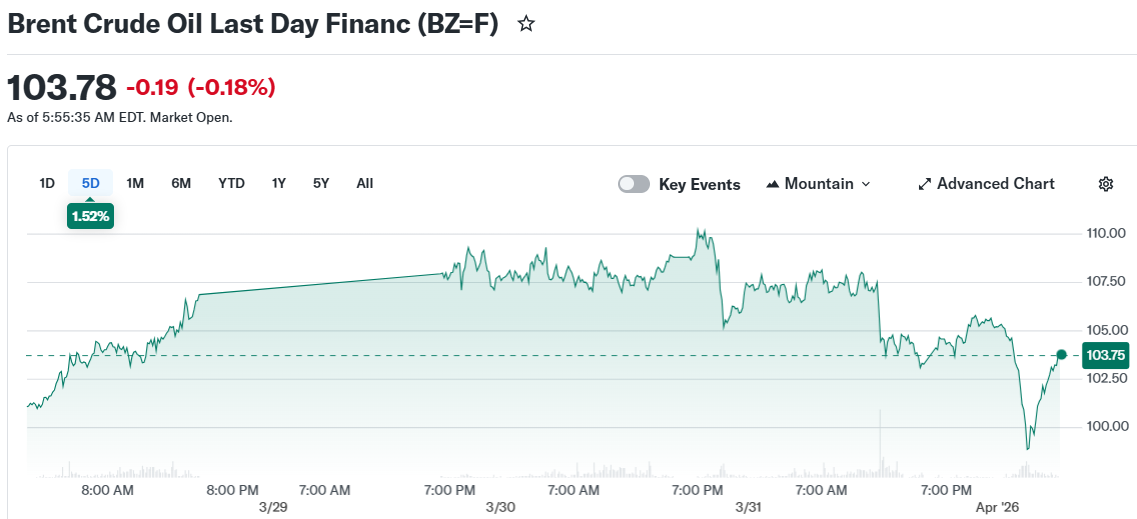
US West Texas Intermediate crude also fell, dropping 2.4% to $98.92 per barrel.
Trump told reporters at the White House that the US could leave Iran in “two to three weeks.” He also said Iran does not need to reach a formal deal for the conflict to end.
NOW – Trump says the U.S. will leave the Iran War in 2 or 3 weeks. pic.twitter.com/p0j83neowV
— Disclose.tv (@disclosetv) March 31, 2026
Iran’s president indicated the country has the “necessary will” to end the war if it receives guarantees it will not be attacked again. Iran’s Foreign Minister Abbas Araghchi confirmed messages were being exchanged with the US but said no formal negotiations were taking place.
Trump was scheduled to address the nation Wednesday evening at 9 p.m. Eastern time to give what the White House called an “important update on Iran.”

Despite the talk of de-escalation, attacks continued on Wednesday. An oil tanker was struck near Qatar, causing a fire that was later put out. No environmental damage was reported.
Why Oil Prices Remain Elevated
Oil prices are still about 40% higher than they were before March. The Strait of Hormuz, a key shipping lane for roughly one-fifth of the world’s oil, has seen tanker traffic nearly collapse due to the threat of Iranian attacks.
The International Energy Agency described the disruption as the biggest supply shock ever recorded. Fuel prices in some markets have topped $200 a barrel. US gasoline prices topped $4 a gallon this week for the first time since August 2022.
Analysts have warned that even a partial reopening of the strait could take time. Trump has said US allies would need to help secure the waterway. The Wall Street Journal reported the United Arab Emirates has urged Western and Asian powers to form a coalition to reopen it by force.
China and Pakistan issued a joint call Tuesday for an immediate ceasefire and for safe shipping to be restored.
Supply Data Points to Weaker Demand
New data from the American Petroleum Institute showed US crude inventories rose by 10.26 million barrels last week. That was far above the expected draw of 1.3 million barrels.
API chief Mike Sommers said reopening the Strait of Hormuz was “the critical piece” to stabilizing global markets, warning prices would keep rising without restored flows.
A third US aircraft carrier strike group is heading to the Middle East, keeping the possibility of further escalation on the table.
Stop guessing and start investing with confidence. KnockoutStocks gives you the AI insights, market intelligence, and stock research you need to spot opportunities, cut through the noise, and make smarter investment decisions — all in one powerful platform.
Sign up today and get 50% OFF full access to our premium stock picks.
Simply use coupon code SPECIAL50 at checkout to claim your exclusive discount.
Get 3 Free Stock Ebooks
Discover top-performing stocks in AI, Crypto, and Technology with expert analysis.
- Top 10 AI Stocks - Leading AI companies
- Top 10 Crypto Stocks - Blockchain leaders
- Top 10 Tech Stocks - Tech giants



