






TLDR
- Gold rose as much as 1.2% to $4,796 an ounce after a two-day decline
- The US launched a naval blockade of the Strait of Hormuz while peace talks continued
- Both the US and Iran signaled openness to a second round of negotiations
- A falling dollar supported gold prices, with the dollar index down for a 7th straight session
- US Producer Price Index data due Tuesday will be watched for signs of energy-driven inflation
Gold prices climbed on Tuesday after two sessions of losses, as fresh signals of possible peace talks between the US and Iran lifted market sentiment.
Spot gold rose 0.7% to $4,773.26 an ounce. Gold futures gained 0.4% to $4,784.05 an ounce. Earlier in the session, bullion briefly touched $4,796.
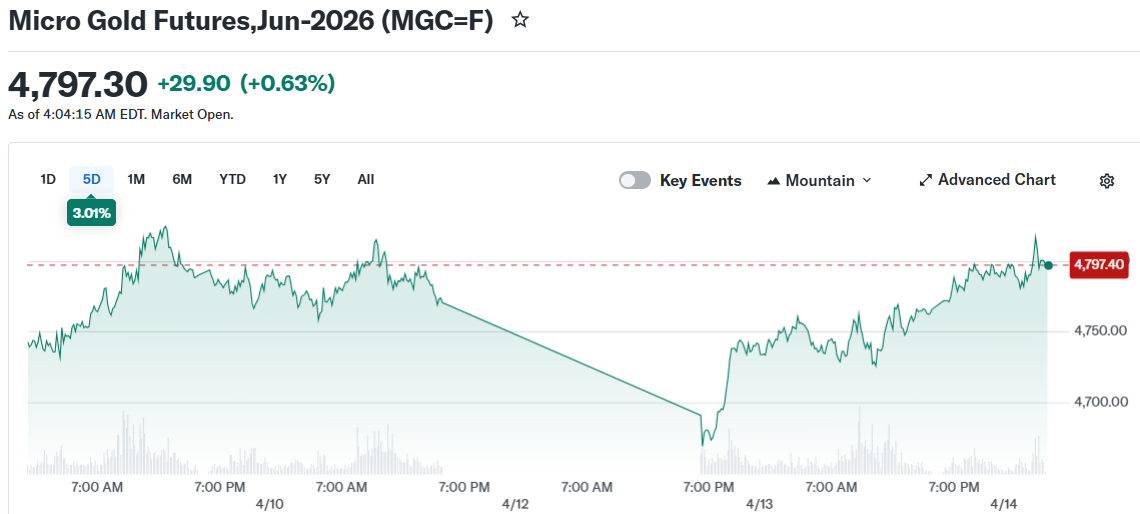
The recovery came even as the US began a naval blockade of Iran’s Persian Gulf ports and coastal areas, ramping up military pressure on Tehran.
President Donald Trump said Iranian officials had reached out to his administration wanting “to work a deal.” Iranian President Masoud Pezeshkian confirmed Tehran was prepared to continue peace talks within international law.
BREAKING: A new round of negotiations between the US and Iran may be held on Thursday, per AP.
President Trump said that “we’ve been called by the other side” and “they want to work a deal.”
— The Kobeissi Letter (@KobeissiLetter) April 14, 2026
US Vice President JD Vance, who led weekend talks in Pakistan, also expressed cautious optimism. He said the outcome of a deal depended on Iran’s decisions.
Reports suggested US and Iranian officials were discussing a second round of talks before a two-week ceasefire expires next week. The Pakistan talks over the weekend produced few concrete results.

The dollar fell for a seventh straight session, its longest losing streak in two years. A weaker dollar tends to support gold, which is priced in the US currency.
Oil prices dropped below $100 a barrel. That eased some of the inflation concerns that have weighed on gold since the conflict began over six weeks ago.
Rate Expectations Keep Gold in Check
Despite the bounce, gold has fallen roughly 10% since the war began in late February. Early in the conflict, investors sold gold holdings to cover losses elsewhere during a liquidity squeeze.
Gold has been trading more on interest rate expectations than as a safe haven, according to Justin Lin, investment strategist at Global X ETFs Australia. He said gold was benefiting from hopes of de-escalation rather than geopolitical fear.
The Federal Reserve’s path remains uncertain. US money markets currently price in less than a 20% chance of a rate cut by December.
Silver rose 2.5% to $77.51 an ounce. Platinum and palladium also advanced. Spot silver was up 1.4% at $76.64 an ounce in earlier trading.
Inflation Data in Focus
US Producer Price Index data for March was due later Tuesday. Markets expected it to show further energy-driven price pressure.
Last week’s Consumer Price Index data already showed a sharp rise in inflation. The Iran war disrupted global energy markets after Tehran blocked the Strait of Hormuz early in the conflict.
Higher energy prices have raised fears the Federal Reserve could hold rates steady or raise them, which is negative for non-yielding assets like gold.
Spot gold was trading at $4,773.26 as of Tuesday afternoon Singapore time, with prices broadly rangebound between $4,700 and $4,900 over the past week.
Stop guessing and start investing with confidence. KnockoutStocks gives you the AI insights, market intelligence, and stock research you need to spot opportunities, cut through the noise, and make smarter investment decisions — all in one powerful platform.
Sign up today and get 50% OFF full access to our premium stock picks.
Simply use coupon code SPECIAL50 at checkout to claim your exclusive discount.
Get 3 Free Stock Ebooks
Discover top-performing stocks in AI, Crypto, and Technology with expert analysis.
- Top 10 AI Stocks - Leading AI companies
- Top 10 Crypto Stocks - Blockchain leaders
- Top 10 Tech Stocks - Tech giants



