






TLDR
- Bitcoin dropped below $77,000 on Monday, hitting its lowest level since May 1
- Oil prices climbed above $110 per barrel, fueling inflation fears and pushing Treasury yields higher
- The 30-year Treasury yield hit 5.13%, its highest close since 2007
- Over $500 million in leveraged long positions were liquidated in just 60 minutes
- On-chain data shows most long-term holders are not selling, but short-term holders are underwater
Bitcoin (BTC) fell below $77,000 on Monday during Asia trading hours, dropping to its lowest point since May 1. The move was driven by a combination of rising oil prices and surging Treasury yields that pushed investors away from riskier assets.
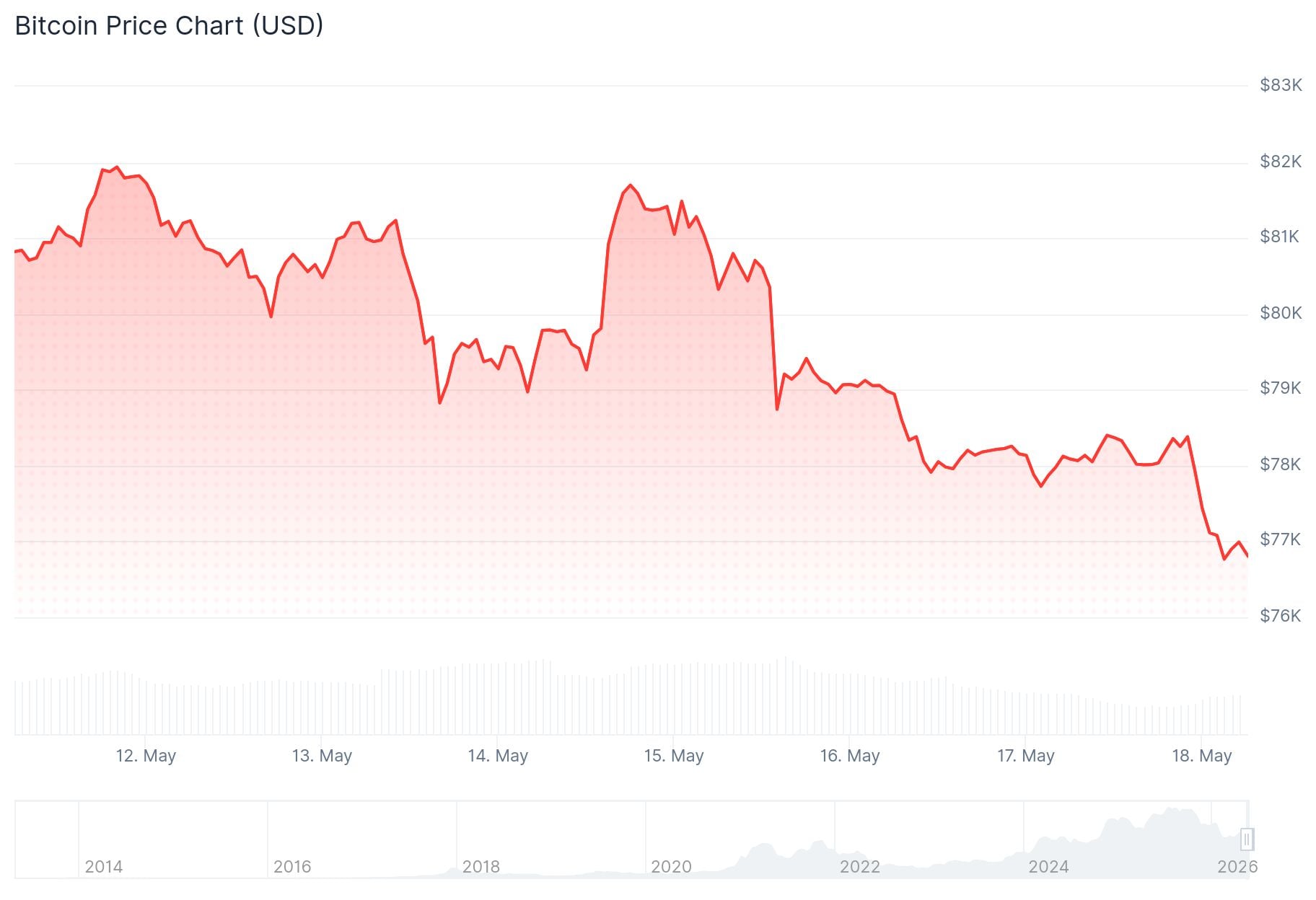
BTC was last trading around $76,726, down roughly 1.5% on the day. The crypto briefly climbed above $80,000 last week but failed to hold that level.
Oil prices moved above $110 per barrel on Monday. Reports of drone incidents in the United Arab Emirates and stalled diplomatic talks over Iran drove the spike. U.S. President Donald Trump added to tensions on Sunday, warning that “time is ticking” for Iran to reach a deal with Washington.
Higher oil prices raised fears of broader inflation, which sent government bond prices lower and yields higher. The 30-year Treasury yield rose to 5.13%, its highest close since 2007. The 10-year yield also climbed to its highest level since early 2025.
Analyst The Kobeissi Letter flagged the speed and scale of the move on X, posting: “BREAKING: Bitcoin falls below $77,000 as over $500 million worth of levered long positions are liquidated in 60 minutes.” That kind of forced selling can accelerate price drops well beyond what spot sellers alone would cause.
BREAKING: Bitcoin falls below $77,000 as over $500 million worth of levered long positions are liquidated in 60 minutes. pic.twitter.com/dpRSbuEZSg
— The Kobeissi Letter (@KobeissiLetter) May 17, 2026
Prediction markets now put the odds of no Fed rate change at 98% in June and 94% in July. Futures markets have also begun pricing in a chance of a rate hike in 2026. Higher rates make safe fixed-income assets more attractive compared to non-yielding assets like BTC.

Short-Term Holders Underwater
On-chain data from Binance Research, citing Glassnode, showed that nearly 60% of the bitcoin supply has not moved in over a year. Exchange balances are also near six-year lows, which limits obvious spot-selling pressure.
However, the short-term holder MVRV ratio is currently below 1. This means recent buyers are, on average, sitting on losses. That makes the market more sensitive to further drops, as those holders have less capacity to absorb another shock.
Analyst Daan Crypto Trades noted on X that BTC was retesting a key support zone known as the bull market support band, warning that a weekly close below $75,000–$76,000 would, in his view, look like a “dead cat bounce.”
$BTC Important retest for the bulls here at the bull market support band.
Another weekly close at it for now, but to confirm a proper breakout you'd need to see a bounce now.
If this ends up falling back below that $75K-$76K area and closes there on the weekly, then this was… pic.twitter.com/OshZ3HbmfN
— Daan Crypto Trades (@DaanCrypto) May 17, 2026
Key Events to Watch This Week
Traders are watching several events that could move markets. Nvidia reports earnings on Wednesday and has become a broader gauge of risk appetite given its central role in AI. U.S. PPI data is due Thursday, which will give another read on inflation.
Progress on the CLARITY Act, a crypto market structure bill in Washington, is also on the radar for crypto-specific watchers.
Bitcoin exchange balances remain near six-year lows, and the 30-year Treasury yield is sitting at its highest close since 2007.


