






TLDR
- Bitcoin fell to around $76,700, a two-week low, as risk appetite weakened and bond yields rose
- Over $661 million in crypto positions were liquidated in 24 hours, with 95% from leveraged long bets
- U.S. spot Bitcoin ETFs saw $290.4 million in net outflows on May 15, following a $630.4 million outflow on May 13
- Ethereum also recorded outflows and lagged Bitcoin in price performance
- The U.S. Senate Banking Committee advanced the CLARITY Act in a 15-9 vote, a step forward for crypto regulation
Bitcoin dropped to a two-week low near $76,700 last week, pulling back from above $80,000 as bond yields climbed and investor appetite for risk fell. The move raised a straightforward question for crypto markets: is this a short-term dip or the start of a deeper correction?
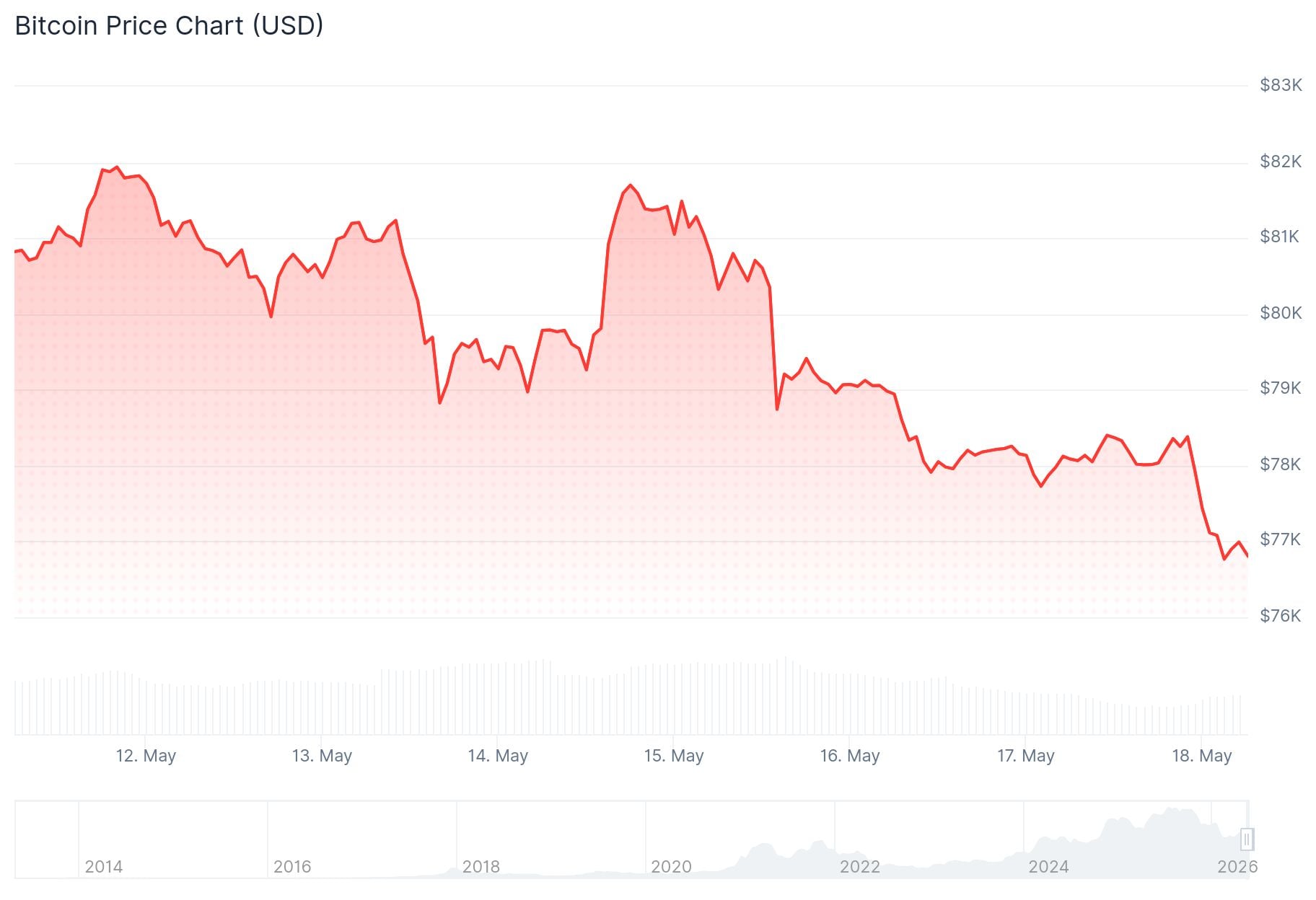
The pullback came with heavy liquidations. Around $661 million in crypto positions were wiped out in a single 24-hour period. About 95% of those losses came from traders who had placed leveraged bets on prices going higher. When too many traders are positioned the same way, a modest price drop can quickly become a larger one as forced selling takes hold.
BREAKING: Bitcoin falls below $77,000 as over $500 million worth of levered long positions are liquidated in 60 minutes. pic.twitter.com/dpRSbuEZSg
— The Kobeissi Letter (@KobeissiLetter) May 17, 2026
ETF Outflows Add to the Pressure
Bitcoin exchange-traded fund flows have become a closely watched indicator of institutional demand. Last week, the data was mixed at best.
Crypto ETF Flows — Weekly Recap 📊$BTC: -$995.5M net outflows$ETH: -$255.2M net outflows$SOL: +$58.2M net inflows
Bitcoin and Ethereum funds bled capital last week, while Solana quietly stood out as the only positive flow 👀 pic.twitter.com/K5S4YV7ugy
— CoinCentral (@realcoincentral) May 17, 2026
U.S. spot Bitcoin ETFs recorded $630.4 million in net outflows on May 13. There was a brief $131.3 million inflow on May 14, but that was followed by another $290.4 million in outflows on May 15, according to Farside Investors data.
That pattern tells investors that larger allocators are not consistently buying. It does not mean institutional interest has disappeared, but the steady demand seen earlier in the year has become uneven.

Ethereum followed a similar path. ETH funds also recorded outflows on May 15, and Ethereum’s price lagged behind Bitcoin. If Ethereum cannot stabilize, a broader recovery in altcoins may be harder to achieve.
Macro Conditions Are Making Things Harder
Rising bond yields are part of the problem. Higher yields make safer investments more attractive and reduce demand for riskier assets like crypto. Bitcoin’s slide toward $78,000 tracked a broader global bond selloff last week.
Investors will be watching Treasury yields, inflation data, and any signals from the Federal Reserve closely. If yields keep rising, crypto could struggle to find support. If yields ease, Bitcoin and other tokens may recover ground.
One Bright Spot: Regulation Moving Forward
The U.S. Senate Banking Committee advanced the CLARITY Act in a 15-9 vote. The bill aims to clarify how crypto tokens should be classified — as securities, commodities, or something else — and also addresses stablecoins and regulatory oversight.
This is a positive step for the industry. However, the bill still faces hurdles. Democrats raised concerns about anti-money laundering rules and potential conflicts of interest. A committee vote does not guarantee passage in the full Senate.
For now, Bitcoin remains above key long-term support levels, and the regulatory picture is slowly improving. But in the short term, ETF outflows, liquidations, and rising yields have left the market in a fragile state.


