






TLDR
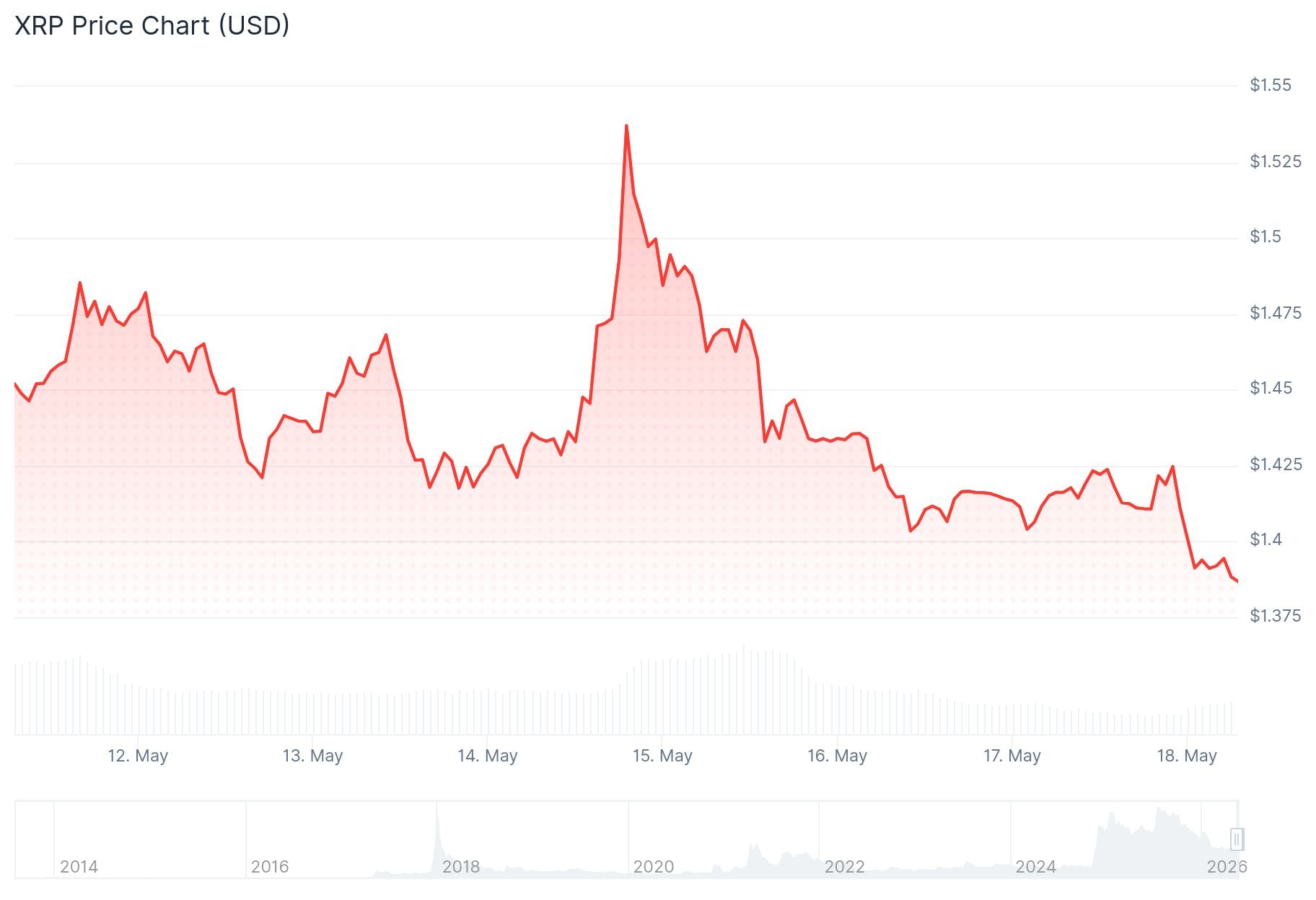
- XRP currently trades around $1.40 with a market cap near $87 billion
- The XRP Ledger drew $1.1 billion in net RWA capital inflows over 30 days, while Ethereum and Solana saw outflows
- XRPL’s total real-world asset value is approaching $3.6 billion, compared to Ethereum’s $17 billion
- The XRP coin does not directly benefit much from ledger activity due to minimal fee burns
- A probability-weighted 5-year price target puts XRP at around $5.80 by 2031
XRP is trading around $1.40, with a market cap close to $87 billion and a circulating supply of about 61.8 billion tokens. The recent spotlight has been on the XRP Ledger’s real-world asset activity, not the coin’s day-to-day price movement.
Over the 30 days ending May 13, the XRPL recorded $1.1 billion in net capital inflows into tokenized real-world assets. In that same period, both Ethereum and Solana saw capital outflows of hundreds of millions of dollars from their RWA sectors.
Tokenization is the process of putting digital records of assets — like bonds, commodities, or equities — on a blockchain to allow faster settlement and tracking. The XRPL’s total RWA value is approaching $3.6 billion, still well below Ethereum’s $17 billion but growing faster.
Why are people still hating on ripple:native when XRPL is up 63% in the last 30 days on the RWA League Table?👇
In just 5 months, the XRP Ledger absorbed over $3.5B in RWA value.
IN JUST 5 MONTHS!
Imagine what the next few months could look like.
XRPL is getting closer to… https://t.co/HOXX33FRP9 pic.twitter.com/YFedTY1a6V
— X Finance Bull (@Xfinancebull) May 15, 2026
One reason some institutions are choosing the XRPL is that regulatory compliance tools such as KYC and AML features are built directly into the protocol. Ethereum requires assembling similar tools from third-party providers, which adds friction for risk-averse asset managers.
Does XRPL Growth Help XRP Holders?
Despite the ledger’s strong inflows, the direct benefit to XRP coin holders is limited. Each transaction on the XRPL costs a fraction of a cent in XRP, and that fee is burned permanently. But since XRP launched in 2012, total fee burns have added up to only about 14 million coins — roughly 0.014% of supply.
That means billions of dollars in activity can flow through the ledger without meaningfully reducing XRP’s supply or pushing its price up. A busy ledger and a rising coin price are not the same thing.

Analyst Javon Marks posted on X that XRP is “still holding broken out against Bitcoin” and has the potential to outrun it by nearly 800%. He set a price target above $15, calling the move “more and more feasible.” Marks pointed to a past breakout pattern he says supports this outcome.
$XRP is still holding broken out against Bitcoin and has potential to outrun by nearly +800%!
This fulfilling, which a breakout similar to this one has done before, can result in XRP being priced above $10.
With a target >$15, this move is looking more and more feasible… https://t.co/sHL9U1CHXb pic.twitter.com/HkoGAvS499
— JAVON⚡️MARKS (@JavonTM1) May 17, 2026
What Analysts Say About the 5-Year Outlook
Separate analysis lays out three scenarios for XRP by 2031. The base case puts the price between $4 and $6, assuming steady growth alongside the broader crypto market. The bull case of $10 to $15 would require XRP to become a widely used settlement asset across payments and tokenized finance. The bear case, between $0.70 and $1.20, applies if banks favor stablecoins or private blockchains instead.
A probability-weighted average across the three scenarios lands at approximately $5.80.
The key drivers analysts are watching include ETF access for institutional investors, legal clarity in major markets, actual growth in XRP Ledger volumes, and competition from Ethereum, Solana, and stablecoin payment rails.
XRP trades around $1.40 today, down approximately 2.11% on the day, as the ledger’s 30-day RWA inflow figure of $1.1 billion continues to draw attention from institutional observers.


