






TLDR
- Ethereum’s Taker Buy Sell Ratio on Binance fell to 0.91, its most bearish weekly level since September 2023.
- A ratio below 1 shows that aggressive ETH sell orders are outweighing buy orders in Binance futures markets.
- Ethereum fell about 9% to 10% over the past week and traded near the low-$2,000 range.
- Wintermute said ETH is not suited to the current macro backdrop due to rising yields, inflation concerns and weaker demand.
- Bitmine Immersion Technologies bought 71,672 ETH during the price drop, raising its treasury holdings above 5.2 million ETH.
Ethereum trader sentiment has weakened to its most bearish level since the 2023 bear market, according to Binance futures data showing a sharp decline in ETH’s Taker Buy Sell Ratio. The reading comes as Ethereum trades under pressure following a weekly price drop and broader concern over the macro backdrop for risk assets.
The weekly ETH Taker Buy Sell Ratio on Binance fell to 0.91, its lowest level since September 2023. A reading below 1 shows that aggressive sell orders are outweighing aggressive buy orders, suggesting that sellers currently have more control over short-term market activity.
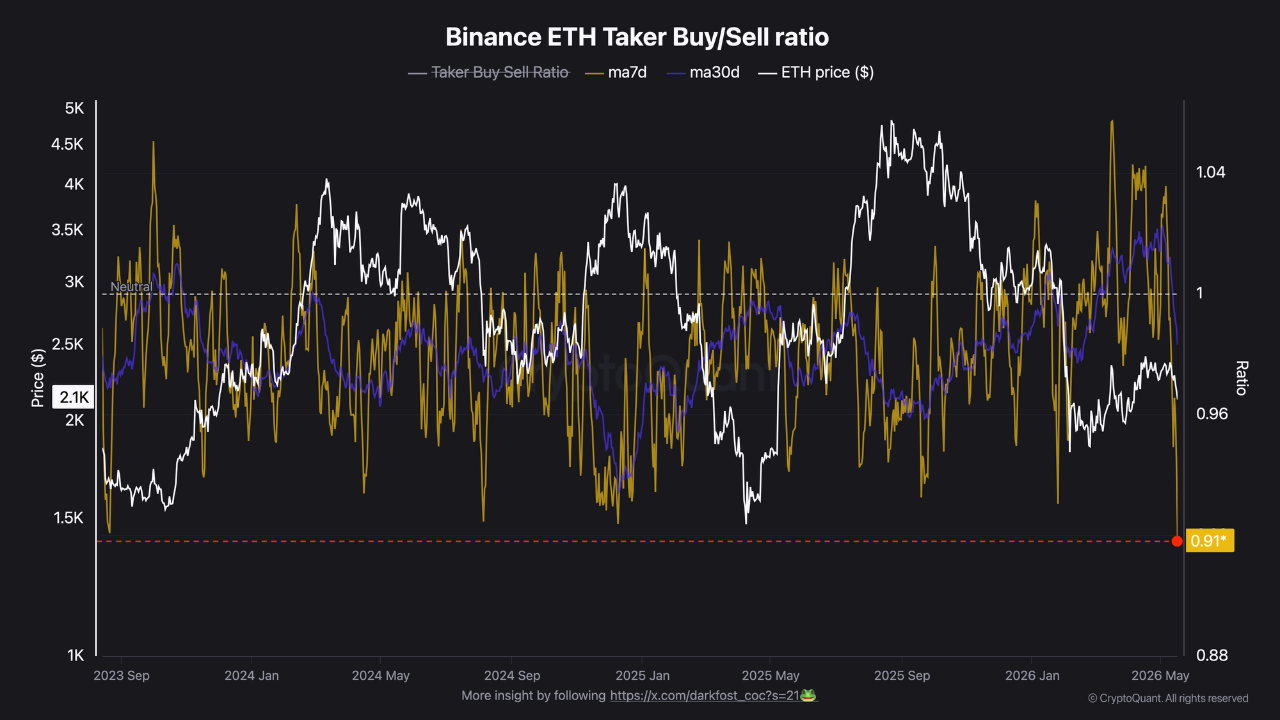
Source: Cryptoquant
Ethereum traded near $2,128 on Tuesday after moving between $2,081 and $2,341 over the previous seven days. ETH has fallen about 9% to 10% during the week, while the ETH/BTC ratio moved toward 0.0275, keeping Ethereum near one of its weakest relative levels against Bitcoin in the current cycle.
Binance Data Shows Heavy ETH Selling
The Taker Buy Sell Ratio is used by traders to track whether buyers or sellers are more active in futures markets. When the ratio falls below 1, sell-side activity is stronger. The latest weekly reading of 0.91 shows that Ethereum futures traders on Binance have shifted toward more defensive positioning.
The change in sentiment follows several weeks of weaker performance for Ethereum. ETH remains inside a broad trading range between about $1,500 and $4,000, but the recent decline has brought attention back to support levels in the low-$2,000 area.
Market positioning has also become more one-sided. When traders lean heavily toward short exposure, markets can become vulnerable to sudden reversals if prices move against those positions. In that setting, forced buying from short sellers can create sharp upward moves, although timing remains uncertain.

Wintermute Cites Difficult Macro Backdrop
Ethereum’s weakness also follows comments from market maker Wintermute, which said ETH is “not the right asset for this macro.” The firm cited rising U.S. Treasury yields, renewed inflation pressure and weaker demand across crypto markets.
Wintermute said Ethereum has been underperforming in both spot and derivatives markets. It pointed to softer ETH funding, higher relative implied volatility and outflows from Ethereum exchange-traded funds as signs that investor demand has weakened.
The firm said Ethereum’s market case depends heavily on future activity in decentralized finance, tokenization, staking and Layer 2 networks. In a higher-yield environment, traders often reduce exposure to assets that rely on future growth and strong liquidity conditions.
Bitcoin has also faced pressure, but it has held up better than Ethereum during the latest pullback. Traders have continued to view BTC as the simpler institutional crypto exposure, while ETH has remained more sensitive to altcoin sentiment and liquidity conditions.
Bitmine Buys More Ether After Pullback
Even as trader sentiment weakened, Bitmine Immersion Technologies added to its Ether holdings during the latest price decline. Chairman Tom Lee said the company purchased 71,672 ETH after the market moved below $2,200.
Lee said the price pullback created an attractive buying opportunity for the company. Bitmine now holds more than 5.2 million ETH in its treasury and has set a target of reaching 5% of Ethereum’s circulating supply in 2026.
Ethereum’s circulating supply is about 120.7 million ETH. To exceed the 5% level, Bitmine would need to hold more than 6 million ETH, leaving the company needing roughly 756,538 additional ETH.
Earlier in May, Bitmine bought 26,659 ETH between May 4 and May 11. That purchase followed a period in which the company had been adding more than 100,000 ETH per week.


