






For years, the cryptocurrency industry has focused heavily on present-day threats. Exchange hacks, phishing attacks, malware, SIM swaps, and compromised private keys have all shaped the evolution of modern crypto security.
But a growing number of developers and infrastructure projects are now paying attention to a different kind of risk one that may still be years away, but could eventually force a major rethink of how digital assets are protected.
Quantum computing.
While practical quantum attacks against Bitcoin or Ethereum are not considered an immediate threat today, the conversation around “post-quantum security” is beginning to move from theoretical research into real infrastructure planning.
And increasingly, wallet developers are starting to prepare for that future now rather than later.
Why Quantum Computing Matters to Crypto
Modern cryptocurrencies rely heavily on public-key cryptography. Wallets use cryptographic systems to generate addresses, sign transactions, and verify ownership of assets without exposing private keys.
The concern is that sufficiently advanced quantum computers could eventually break some of the cryptographic algorithms widely used today.

Much of the discussion centers around Shor’s algorithm, a quantum computing method theoretically capable of solving the mathematical problems that underpin many current encryption systems far faster than classical computers.
If large-scale fault-tolerant quantum computers become viable in the future, experts believe certain forms of public-key cryptography could become vulnerable.
For crypto holders, this raises an uncomfortable long-term question:
How do you secure assets that may need to remain protected for decades?
The Industry Is Starting to Shift
Although the quantum threat is still viewed as long-term, the broader cybersecurity industry has already begun transitioning toward post-quantum cryptography standards.
Governments, security researchers, and major technology companies have increasingly started exploring quantum-resistant systems designed to remain secure even against future quantum attacks. NIST finalised the first three post-quantum cryptography standards in August 2024, providing the algorithmic foundation that wider migration efforts are now beginning to build on.
The crypto industry now appears to be entering the early stages of that same transition.
Rather than waiting for quantum hardware to become a direct threat, some infrastructure projects are beginning to redesign wallet architecture, signing systems, and key generation methods with future cryptographic resilience in mind.
In many cases, this involves integrating hybrid cryptographic approaches that combine existing encryption methods with post-quantum algorithms.
The goal is not necessarily to replace current systems overnight, but to build infrastructure capable of adapting as cryptographic standards evolve.
Beyond Hardware Wallets
The post-quantum conversation is also overlapping with a broader shift happening inside crypto security.
For years, hardware wallets have been widely viewed as the gold standard for self-custody. By isolating private keys from internet-connected devices, they significantly reduce exposure to malware and remote attacks.
However, some developers now argue that hardware-based security models still require users to trust manufacturers, firmware update systems, supply chains, and proprietary device architectures.
As a result, a growing number of projects are exploring more isolated and hardware-independent approaches to wallet security.
Instead of relying entirely on dedicated physical devices, newer systems focus on separating signing environments from broadcasting environments, allowing sensitive cryptographic operations to occur completely offline.
This architecture is often described as “isolated signing” or “air-gapped signing”
Under this model, transaction signing happens on an offline device that never directly interacts with the internet, while separate connected systems handle network broadcasting.
Supporters argue this reduces attack surfaces while also removing some of the trust assumptions associated with traditional hardware wallet manufacturing.
Security Through Architecture
One of the more interesting developments in this space is the growing focus on architecture-level security rather than purely device-level security.
Instead of asking users to trust a single piece of hardware, some projects are attempting to build layered systems where security comes from separation, isolation, redundancy, and cryptographic design.
This includes:
- offline transaction authorization,
- decentralized node infrastructure,
- post-quantum key encapsulation,
- isolated signing environments,
- and hardened seed generation systems.
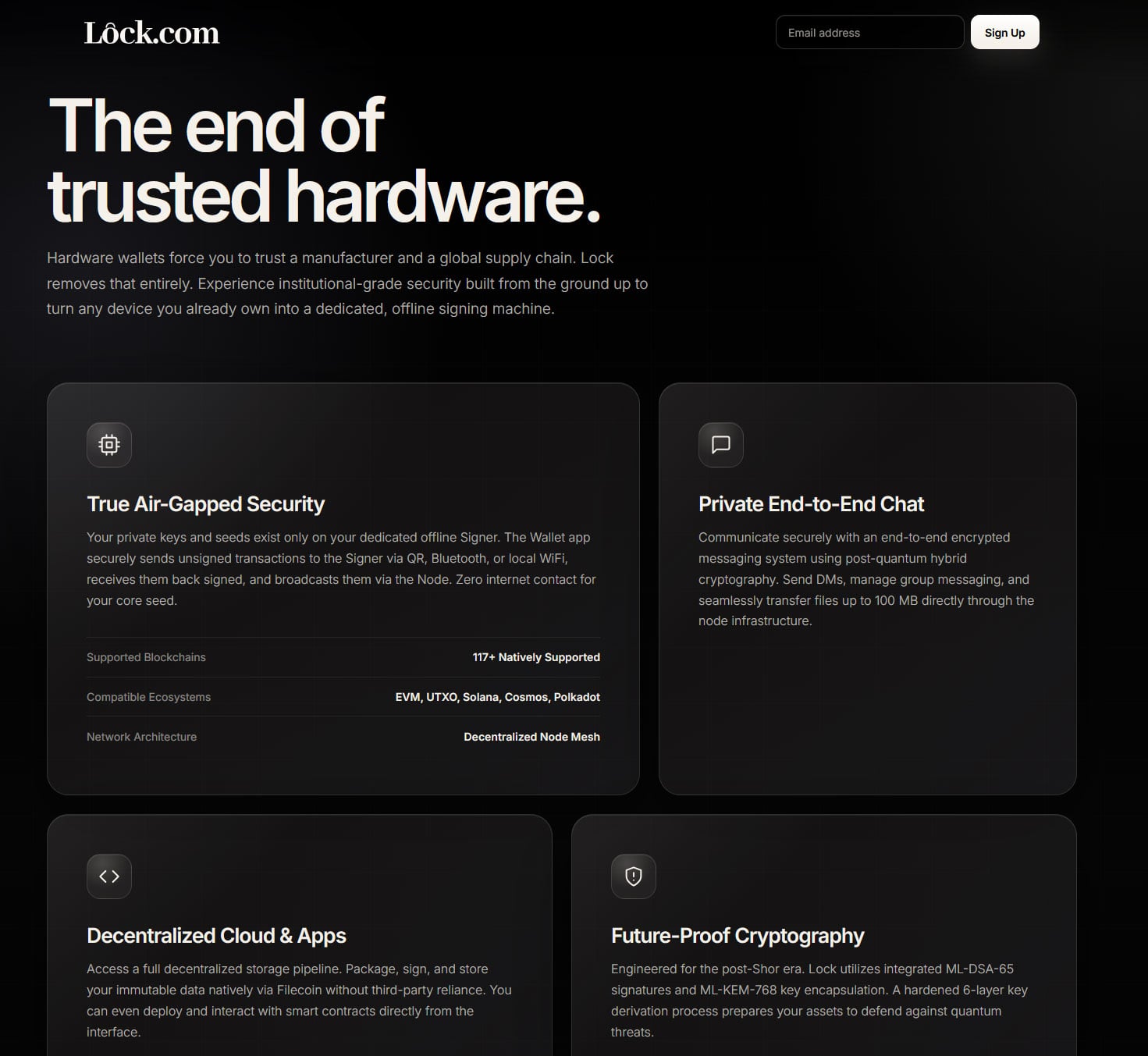
Emerging platforms such as Lock.com are part of this broader trend.
Currently in its early access phase, Lock.com is exploring a hardware-independent security architecture designed around isolated offline signing, post-quantum cryptographic integrations, and decentralized infrastructure rather than traditional hardware wallet dependency.
The project utilizes hybrid post-quantum cryptographic systems including ML-DSA and ML-KEM integrations while also focusing on offline transaction authorization and isolated crypto wallet infrastructure.
While the long-term effectiveness of post-quantum approaches remains an evolving field, the broader direction of travel across the industry is becoming increasingly clear: future-proofing crypto security is starting to become a serious infrastructure discussion rather than a niche theoretical topic.
The Long-Term Self-Custody Challenge
One of the unique challenges facing cryptocurrency is the extremely long lifespan of digital assets.
Unlike traditional payment systems, crypto wallets are often expected to remain secure across decades. Some holders may store Bitcoin, Ethereum, or other assets for generations.
That creates a different security model compared to most modern internet applications.
Even if practical quantum attacks remain distant, infrastructure decisions made today could still matter years from now.
This is why many developers now see post-quantum preparation as less about reacting to an immediate threat and more about responsible long-term system design.
In practice, the transition toward quantum-resistant infrastructure will likely happen gradually.
Existing blockchains, wallets, and cryptographic standards cannot simply be replaced overnight. Migration paths, compatibility layers, and hybrid approaches will all likely play major roles in the years ahead.
But the conversation has clearly started.
And as crypto matures into a larger global financial infrastructure layer, security discussions are increasingly shifting away from short-term convenience and toward long-term survivability.
The post-quantum era may still be years away.
But parts of the crypto industry are already preparing for it.


