





TLDR
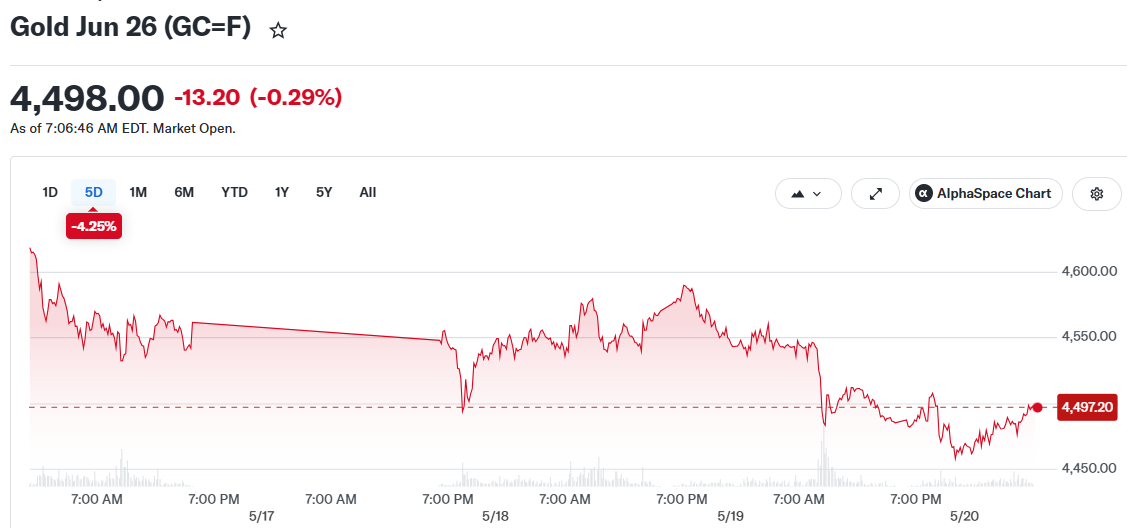
- Gold is trading just below $4,500 an ounce after falling nearly 2% on Tuesday
- U.S. 30-year Treasury yields hit their highest level since 2007, pressuring gold prices
- President Trump threatened to resume strikes on Iran while also signaling a deal could come “very quickly”
- Silver rebounded up to 2.5% after a sharp 5% drop Monday; platinum and palladium also gained
- Gold is down roughly 15% since the U.S.-Israeli war on Iran began in late February
Gold prices steadied on Wednesday after a turbulent few days, with spot gold trading just below $4,500 an ounce. The metal fell close to 2% on Tuesday before stabilizing as investors tried to make sense of conflicting signals from the Iran war and bond markets.
The main pressure on gold has come from rising bond yields. The U.S. 30-year Treasury yield climbed to its highest level since 2007, just before the global financial crisis. Higher yields tend to make non-yielding assets like gold less attractive to investors.
Analysts at Phillip Capital said worries are growing that an Iran-linked oil price spike could trigger a wave of global inflation, which could push central banks to raise interest rates. The Federal Reserve is due to release minutes from its April meeting later Wednesday, which may give more clues on the rate outlook.
The U.S. dollar has also been trading near a six-week high. A stronger dollar can make gold more expensive for buyers outside the United States.
Iran War Uncertainty Keeps Markets on Edge
The situation in Iran remains the key driver of market moves. President Trump told lawmakers Tuesday evening that the war could end “very quickly.” He said he postponed fresh attacks on Iran at the request of three Gulf countries.
However, Trump also threatened to resume strikes within days as part of a push to force a deal. Vice President JD Vance said Tehran wanted to reach an agreement.
Iran has insisted on its core demands, and analysts say the path to a deal remains unclear. Neil Welsh of Britannia Global Markets said the prospects for negotiations “remained uncertain.”

The Strait of Hormuz, a key oil shipping route off Iran’s southern coast, has been effectively closed to tanker traffic since the war began in late February. On Wednesday, two Chinese-flagged supertankers were reported leaving the strait, along with a South Korean vessel. Oil prices fell on hopes that supply flows could soon improve, though Brent crude remains well above pre-war levels.
Gold Down 15% Since War Began
Gold has traded in a narrow range since dropping sharply in the early days of the conflict. The metal is down about 15% since the war started in late February.
Ole Hansen of Saxo Bank said there is a growing split between short-term traders focused on rate expectations and longer-term investors who see gold as a hedge against high inflation and slow growth. He noted a lack of fresh inflows into gold exchange-traded funds and said the market appears to be waiting for a clearer catalyst.
Silver also had a rough week but bounced back Wednesday, gaining as much as 2.5% after falling 5% on Monday. Silver had surged to nearly $90 an ounce last Wednesday but has since dropped around 16%. Platinum and palladium also moved higher on Wednesday.
Spot gold was flat at around $4,475 as of late morning in London.
Stop guessing and start investing with confidence. KnockoutStocks gives you the AI insights, market intelligence, and stock research you need to spot opportunities, cut through the noise, and make smarter investment decisions — all in one powerful platform.
Sign up today and get 50% OFF full access to our premium stock picks.
Simply use coupon code SPECIAL50 at checkout to claim your exclusive discount.
Get 3 Free Stock Ebooks
Discover top-performing stocks in AI, Crypto, and Technology with expert analysis.
- Top 10 AI Stocks - Leading AI companies
- Top 10 Crypto Stocks - Blockchain leaders
- Top 10 Tech Stocks - Tech giants



