



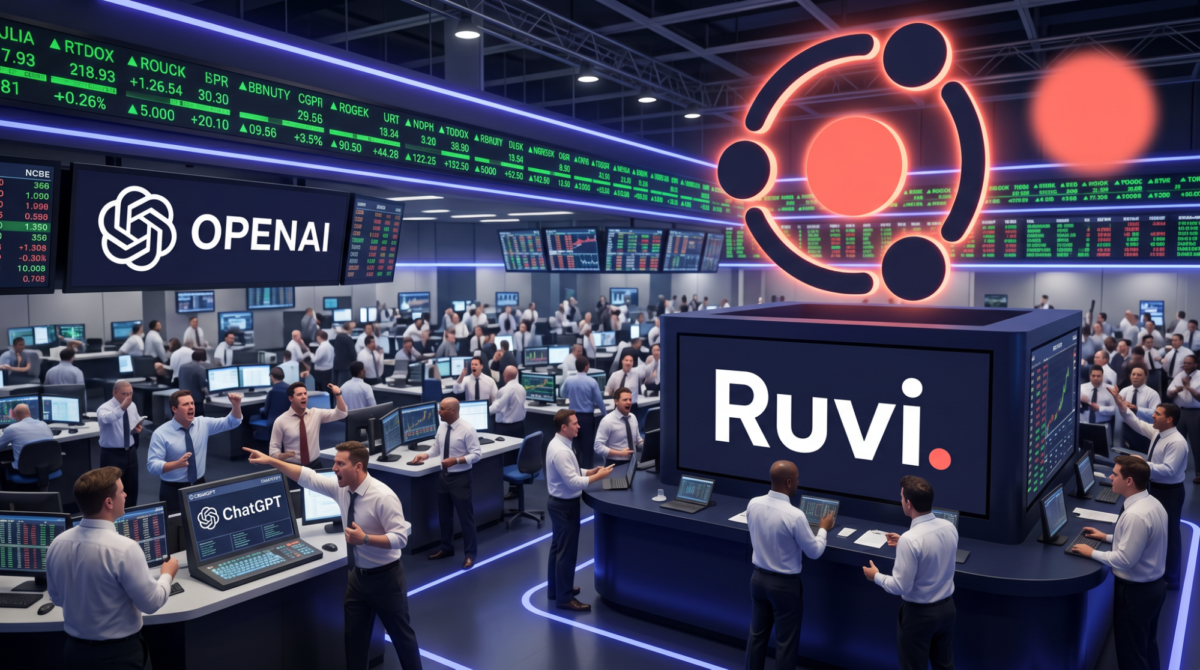


OpenAI confidentially filed its IPO prospectus this month, targeting a public listing valued between $852 billion and $1 trillion, with Goldman Sachs and Morgan Stanley leading the deal. The company runs at roughly $2 billion in monthly revenue yet posted a net loss near $9 billion in 2025, and ordinary investors cannot buy a single share until the Q4 listing.
Some are looking instead at the Ruvi AI (RUVI) decentralized AI superapp, which already runs 20+ AI models behind one $RUVI economy and is rolling out an open on-chain sale across seven phases, now live at Phase 3 for $0.020.
Why Ruvi Pays the Trainers OpenAI Bills
OpenAI improves its frontier models on the prompts of hundreds of millions of users who receive no equity for that contribution. Ruvi inverts the flow. Every contributor who corrects, ranks, or refines an output earns $RUVI for the value they create, funded by a 1.25 billion token Ecosystem and Rewards allocation, a full 25% of the fixed 5 billion supply.
The same daily activity that quietly compounds an $852 billion private valuation becomes a payout on Ruvi rather than free labor. Closed AI captures the value above its users. Ruvi is building the model where that value flows back to the people improving the system.

Why Capital Rotates From Locked Equity to Open Sales
You cannot own a piece of OpenAI before its IPO, and when the listing arrives the entry is an $852 billion to $1 trillion valuation with most upside already priced in by private rounds. That is the structural gap.Retail either waits or buys at the top.
The Ruvi sale is the inverse: fully on-chain, publicly verifiable, with no private unlocks and 100% of presale tokens released at launch. Staking activates at the end of the presale, so early entrants hold position before that window shuts. Capital is rotating toward AI exposure that does not require a Wall Street allocation to access.

The $0.020 Entry Against a Trillion-Dollar Listing
Phases 1 at $0.010 and 2 at $0.015 sold out; Phase 3 is live at $0.020. The final phase is $0.070, a 3.5x step, and the listing target is $0.10, a 5x move from Phase 3. A $500 position at Phase 3’s $0.020 buys 25,000 $RUVI. At the $0.070 final phase that allocation is worth $1,750. At the $0.10 listing target that is $2,500.

At a $1 token price that is $25,000. Supply is fixed at 5 billion tokens, non-mintable, with platform revenue funding an on-chain buyback that permanently burns $RUVI as usage grows. VIP tiers stack on top, from +20% up to a +100% bonus at VIP 5 before listing. After the sale, stakers will earn an estimated 6% to 14% APY across Bronze, Silver, and Gold. OpenAI investors buy a near trillion-dollar company. Ruvi buyers enter at two cents with the upside still ahead.
Conclusion
The OpenAI IPO is a near trillion-dollar entry that locks retail out until Q4 and prices the upside before the bell. Ruvi at $0.020, with 3,000+ holders, 20+ AI models live, a fixed 5 billion supply, and contributor/payouts in $RUVI, is open to anyone on-chain today. Make a move before Phase 3 closes and today’s entry becomes the floor.
FAQs
What is the OpenAI IPO valuation? OpenAI filed this month targeting a listing valued between $852billion and $1 trillion, after a record $122 billion raise. Retail cannot buy shares until the Q4 listing.
Why are AI investors buying Ruvi instead of waiting for OpenAI? OpenAI prices most upside into private rounds before retail can access it. Ruvi offers an open on-chain entry at $0.020 and pays contributors in $RUVI for training value.
Is Ruvi better than an OpenAI position? Ruvi runs 20+ AI models live, has 3,000+ holders, Phase 3 live at$0.020, and 1.5 billion tokens in the sale.The contrast in access speaks for itself.
Useful Links
Website/Buy $RUVI: Ruvi.io
Whitepaper: Docs
X/Twitter: @RuviAiOfficial
Telegram: @Ruviofficial


