






TLDR
- Bitcoin dropped below $70,000 after the Fed held interest rates steady and signaled only one rate cut in 2026.
- The Fed raised its 2026 inflation forecast to 2.7%, citing rising oil prices driven by conflict in the Middle East.
- Crude oil surged past $110 per barrel after Iran attacked energy facilities across the region.
- Long-term Bitcoin holders, known as “OGs,” sold over 1,650 BTC worth around $117 million.
- Markets across crypto, stocks, and gold all fell, with the Nasdaq closing down 1.5% and Ether dropping over 6%.
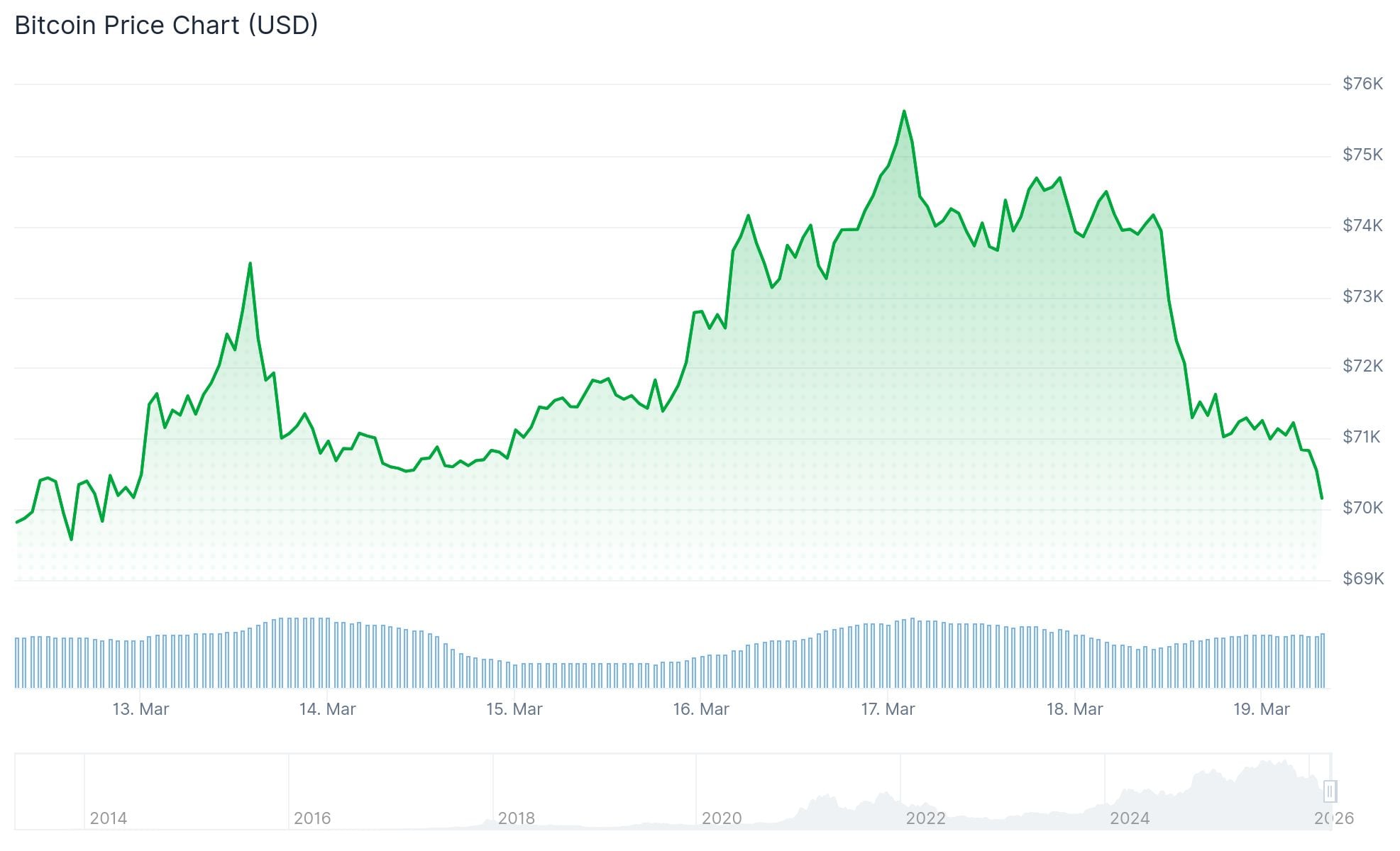
Bitcoin (BTC) fell sharply this week, sliding below $70,000 after the Federal Reserve held interest rates steady and signaled it would cut rates more slowly than markets had hoped.
The Fed kept its benchmark rate in the 3.5%–3.75% range. But the bigger concern for traders was the tone of Fed Chair Jerome Powell’s press conference.
Powell pointed to rising oil prices as a new inflation risk. “The oil shock for sure shows up,” he said, referring to its effect on the central bank’s projections.
SUMMARY OF FED DECISION (3/18/2026):
1. Fed halts rate cuts for the second straight meeting
2. Fed projects one rate cut in 2026, one in 2027
3. Fed 2026 PCE inflation forecast revised higher to 2.7%
4. Fed says implications of Middle East developments are "uncertain"
5. Fed…
— The Kobeissi Letter (@KobeissiLetter) March 18, 2026
The Fed raised its 2026 inflation forecast to 2.7%, up from its earlier estimate of 2.4%. That increase spooked investors who had expected inflation to keep cooling.
The central bank’s “dot plot,” which tracks where policymakers expect interest rates to go, now shows a median of just one rate cut in 2026. A month ago, markets were pricing in two to three cuts.
Trading on Polymarket and CME Fed funds futures moved quickly. The probability of just one rate cut this year jumped to around 80%, up from a 38% chance just a month prior.

Oil Prices Add Pressure
Oil prices were already rising before the Fed meeting. Crude surged above $110 per barrel after Iran attacked energy facilities across the Middle East, following a strike on its South Pars gas field.
Higher oil prices pushed bond yields up and strengthened the U.S. dollar, which tends to weigh on risk assets like Bitcoin.
The Bank of Japan also held rates steady on Thursday and flagged the Middle East conflict as a risk to Japan’s inflation path.
History seems to be repeating itself again.$BTC pic.twitter.com/ooxyy3YN3z
— Ted (@TedPillows) March 18, 2026
Bitcoin had been trading above $74,000 earlier in the week, briefly touching near $76,000. By early Thursday, it had fallen to around $70,817, a drop of roughly 4.2% in 24 hours.
Ether fell over 6%, while XRP, Solana, and Dogecoin all posted losses in the 3%–5% range. The CoinDesk 20 Index dropped 3%.
Bitcoin OGs Sell Over $117 Million in BTC
Blockchain data tracked by Lookonchain showed that at least two long-term Bitcoin holders sold into the decline.
Bitcoin OG Owen Gunden, who previously sold 11K $BTC($1.12B), sold another 650 $BTC($46.3M) 10 hours ago.https://t.co/Fx6wtq0Whmhttps://t.co/dU3RoJViyh pic.twitter.com/K6e9RwwWsD
— Lookonchain (@lookonchain) March 19, 2026
One early holder who had previously sold an 11,000 BTC stack offloaded another 650 BTC. A second OG with a 5,000 BTC position sold all 1,000 BTC of a recent holding.
Together, the two sold over 1,650 BTC worth more than $117 million.
Digital asset stocks also fell sharply. Strategy (MSTR) and Bitmine (BMNR) dropped 5%–6%. Galaxy (GLXY) fell nearly 7%, and Gemini (GEMI) tumbled 15%, hitting its lowest level since going public.
Gold also extended losses, falling 3.1% to below $4,850 per ounce — its weakest price in over a month.
Powell dismissed comparisons to 1970s stagflation, saying unemployment remains near normal levels and inflation is only slightly above target. Markets are now pricing in a tighter monetary environment for the rest of 2026.


