






TLDR
- Bitcoin dropped nearly 5% to near $63,000 after the U.S. and Israel launched military strikes on Iran
- The sell-off hit its lowest level since the Feb. 5 crash, when BTC briefly dipped below $60,000
- Israeli Defense Minister Israel Katz declared a state of emergency across all of Israel
- Bitcoin’s 24/7 trading means it acts as a pressure valve for risk-off sentiment when other markets are closed
- Traders liquidated bitcoin as one of the few large liquid assets available on weekends
Bitcoin fell sharply on Saturday, February 28, 2026, dropping close to $63,000 after the United States and Israel launched military strikes on Iran.
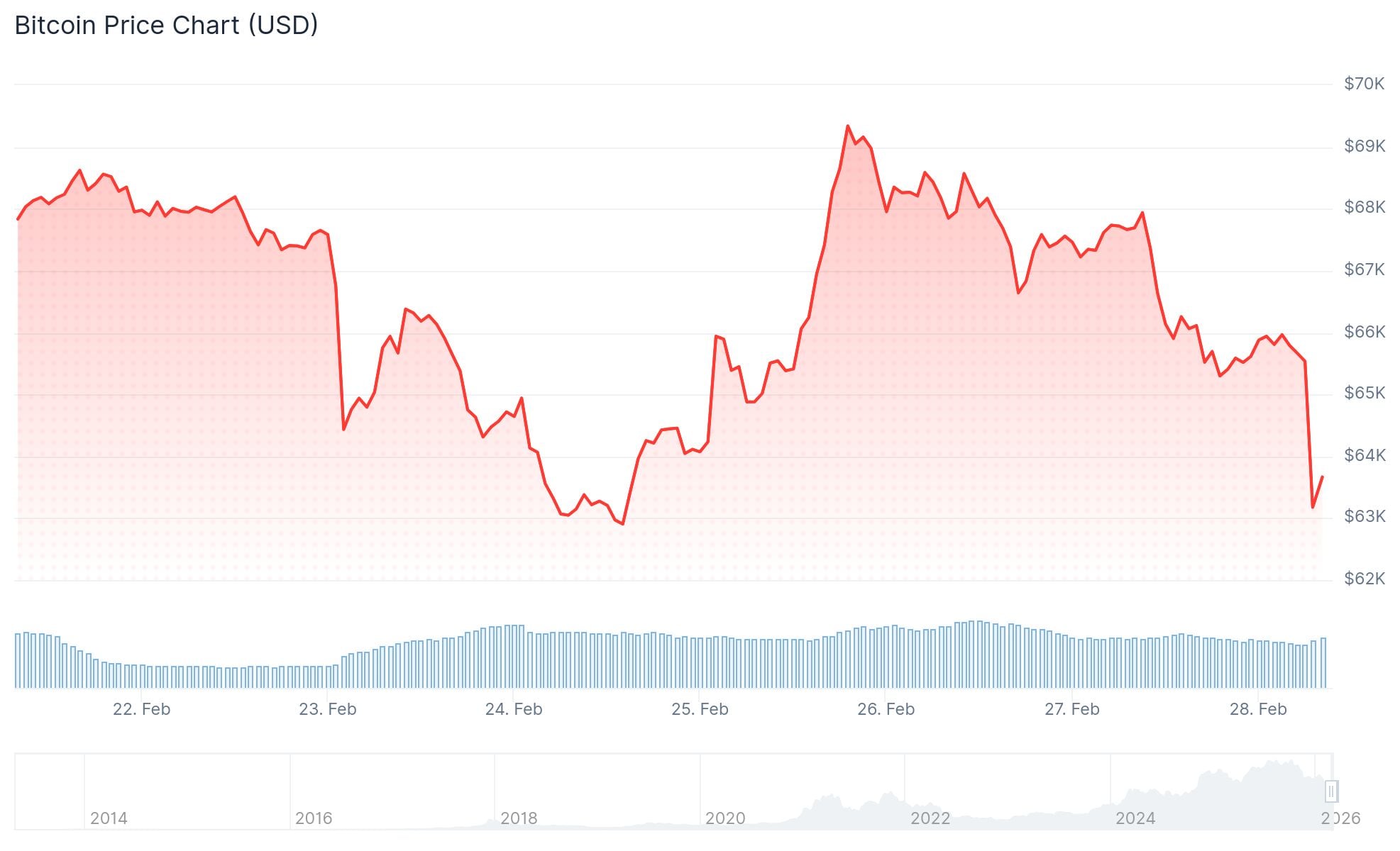
The drop represented a loss of nearly 5% in a matter of minutes for the world’s largest cryptocurrency.
This brought bitcoin to its lowest price since the February 5 crash, when BTC briefly dipped below $60,000.
BREAKING: Bitcoin falls below $64,000 as Israel launches strikes on Iran.
Over $100 million worth of levered longs have been liquidated in 15 minutes. pic.twitter.com/S4SibWkks3
— The Kobeissi Letter (@KobeissiLetter) February 28, 2026
Israeli Defense Minister Israel Katz declared a state of emergency across all areas of Israel shortly after the strikes began.
A U.S. official confirmed American participation in the attacks, according to a report from The Wall Street Journal.
Israel described the operation as a “preemptive strike,” as reported by Reuters, citing statements from the country’s defense minister.

Why Bitcoin Sold Off First
Bitcoin trades around the clock, seven days a week, unlike equity and bond markets which are closed on weekends.
🚨BREAKING: Bitcoin just dumped $2,500 in 45 MINUTES after Israel launched an attack on Iran.
$209 MILLION worth of longs have been liquidated in the past 60 minutes.
$72 billion wiped out from crypto market. pic.twitter.com/eUmgLpipH5
— Bull Theory (@BullTheoryio) February 28, 2026
That makes it one of the only large, liquid assets traders can sell when risk spikes outside traditional market hours.
This pattern has played out before. Bitcoin tends to sell off quickly during geopolitical shocks, then often recovers once other markets open.
“Bitcoin just dropped off a cliff,” one market watcher posted to X, adding that “Monday will be a bloodbath in the market.”
Geopolitical Context
The strikes follow weeks of U.S. military buildup and stalled nuclear negotiations with Tehran.
JUST IN: Bitcoin crashes below $65,000 after Israel launches strikes on Iran.
$175,000,000 worth of leveraged crypto positions have been liquidated from the crypto market in the past 30 minutes. pic.twitter.com/Z7UZ0GrT0s
— Bitcoin Junkies (@BitcoinJunkies) February 28, 2026
Analysts had already been speculating about what a conflict with Iran could mean for bitcoin, gold, and stocks.
The attack raises the risk of a broader regional conflict in one of the world’s most economically sensitive areas.
Bitcoin’s price has not tracked closely with gold in recent months, which has put pressure on its reputation as a safe-haven or “digital gold” asset.
As of Saturday morning, bitcoin was trading near $63,000, with further market movement expected when traditional financial markets open Monday.


