






TLDR
- Veteran trader Peter Brandt flagged a rising wedge sell signal, pointing to a possible drop to $60,000 or even $49,000.
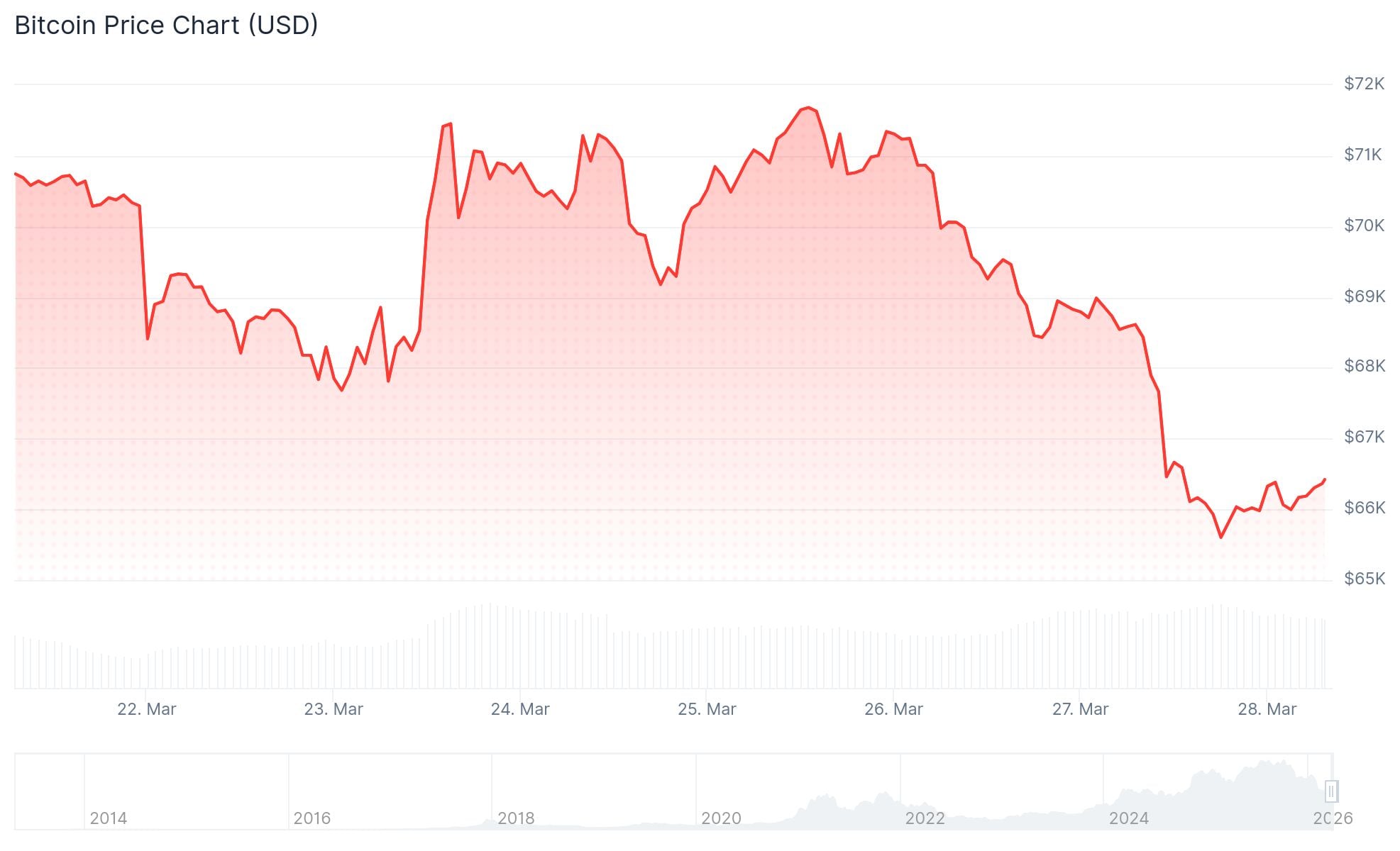
- Bitcoin fell over 4% on March 27, trading around $65,720–$66,030.
- A $14.16 billion options expiry on Deribit wiped out 40% of open positions and triggered over $115 million in long liquidations.
- The U.S.-Israel conflict with Iran is driving investors toward the U.S. dollar and away from riskier assets like BTC.
- Analysts at CEX.IO and Bitget Wallet both warned of further downside, with $60,000 flagged as the next key level to watch.
Bitcoin dropped sharply on March 27, falling over 4% to trade around $65,720 as a combination of geopolitical tension and a record options expiry hit the market at the same time.
The drop comes as the U.S.-Israel conflict with Iran continues to push investors toward safer assets like the U.S. dollar. Iran’s declaration that the Strait of Hormuz remains closed added more pressure, even after Trump claimed Iran had allowed 10 oil tankers to pass as a goodwill gesture.
Veteran trader Peter Brandt posted on X that Bitcoin is setting up a rising wedge sell signal. His chart pointed to $60,000 as a key downside target on this move.
Bitcoin setting up for a rising wedge sell signal $BTC pic.twitter.com/NTzz30azWy
— Peter Brandt (@PeterLBrandt) March 26, 2026
Brandt also posted a second chart marking $49,000 as a potential longer-term bottom for BTC. He noted that Bitcoin follows classical charting rules better than most markets.
Brandt had previously predicted Bitcoin would fall below $50,000 during the current bear market phase. His latest posts reinforce that view.
$14 Billion Options Expiry Hits BTC Hard
On March 27, top crypto options platform Deribit settled $14.16 billion in Bitcoin options at 08:00 UTC. This was the largest options expiry of 2026, clearing roughly 40% of all open positions on the exchange.

Over $115 million in long positions were liquidated in a single hour. Bitcoin’s put/call ratio is currently above 0.62, meaning more traders are betting on further price declines than a recovery.
Illia Otychenko, lead analyst at CEX.IO, said macro and sentiment are both bearish right now. He warned that if Bitcoin breaks below its current channel support, a retest of $60,000 is likely.
Analysts Flag Volatility Ahead
Lacie Zhang, market analyst at Bitget Wallet, said institutional investors have spent much of the quarter selling upside Bitcoin exposure to generate yield. As those contracts expire, that structural cushion disappears.
This could be the best-case scenario for Bitcoin.
A drop below the $50,000 level by Q2 2026 and then a V-shape recovery to $100,000 by year end. https://t.co/N7Peeef1jz pic.twitter.com/2Fq1gdHsDZ
— Ted (@TedPillows) March 27, 2026
Analyst Ted suggests Bitcoin could drop below $50,000 by Q2 2026 before a potential V-shape recovery to $100,000 by year end.
Zhang said Bitcoin needs to reclaim and hold above $75,000 to shift sentiment bullish. Without that, sharper and less controlled price swings are likely.
Elevated crude oil prices have pushed the U.S. 10-year Treasury yield to its highest level since July 2025, creating additional pressure on non-yielding assets like Bitcoin.
Bernstein analysts reiterated a year-end price target of $150,000, arguing Bitcoin historically outperforms gold during periods of extreme uncertainty.
Bitcoin’s next key technical level remains $66,000. A daily close below that support could open the door to a move toward the $50,000 range, according to technical analysis.


