






TLDR
- Bitcoin is holding near $67,000 despite oil prices surging past $110 a barrel
- The U.S.-Israel-Iran conflict rattled global markets, but Wall Street held relatively firm
- Bitcoin ETFs posted their second straight week of net inflows, totaling $568 million
- Bitcoin increasingly trades like a U.S. risk asset, closely following Nasdaq and tech stocks
- Asian markets dropped sharply, with South Korea’s Kospi falling over 16%
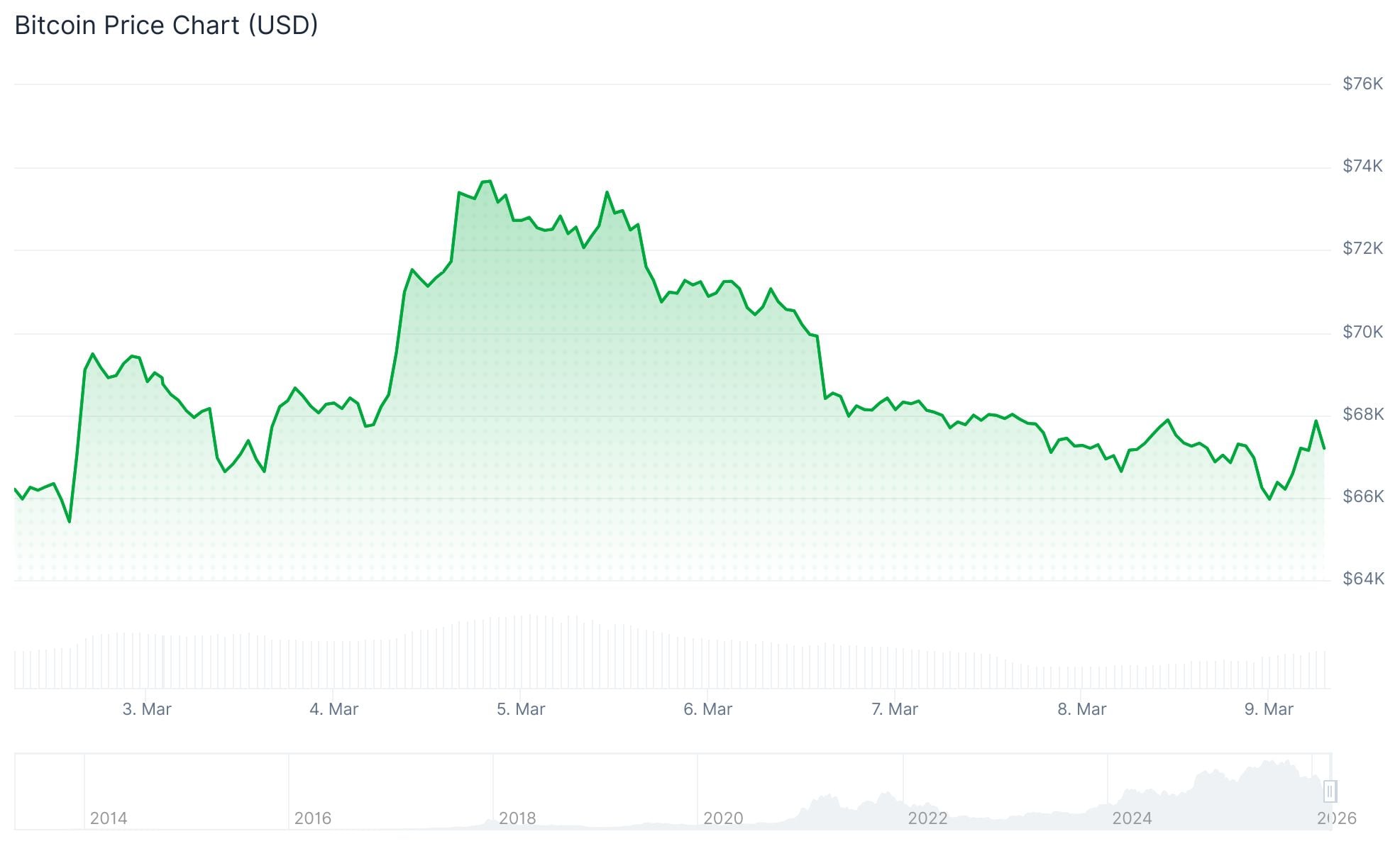
Bitcoin is trading near $67,000 as an escalating military conflict between the U.S., Israel, and Iran pushed oil prices above $110 a barrel. Global markets reacted sharply, but Bitcoin stayed relatively calm.
The conflict began on Feb. 28 and quickly sent oil prices on both sides of the Atlantic past $100 a barrel. Concerns over disruptions to oil flows through the Strait of Hormuz drove crude even higher by Monday.
BREAKING: US oil prices fall -$15/barrel in under 2 hours, now trading below $104/barrel, on reports that G7 countries are considering releasing 400 million barrels of crude oil reserves. pic.twitter.com/hMEJCK5QWZ
— The Kobeissi Letter (@KobeissiLetter) March 9, 2026
Asian markets took the hardest hit. Japan’s Nikkei dropped 10%, India’s Nifty fell 5%, and South Korea’s Kospi declined more than 16%. Wall Street futures slipped just over 3% since the conflict began.
Bitcoin fell below $66,000 early Monday in Asian trading before recovering to $67,226. It had already dropped to near $60,000 before the conflict started, following weeks of profit-taking.
Bitcoin’s Ties to Wall Street
Analysts point to Bitcoin’s growing connection to U.S. markets as a key reason it held up. The U.S. imports oil mainly from Canada and Mexico, and is now the world’s largest net oil exporter. That insulates American markets from Middle East supply disruptions.
JP Morgan strategists Kriti Gupta and Justin Beimann noted that the U.S. imports just 4% of its oil from Saudi Arabia. They said energy independence gives the U.S. a buffer before higher oil prices reach consumers.

Before You Sleep, the Most Important Level in Crypto Right Now:$BTC hit $66,500 Today. It is now inches away from the zone $60,000 that has marked major turning point of Bear Market.
VanEck CEO on CNBC: "We are in a Bitcoin Bear Market. Now I think we are making a bottom."… pic.twitter.com/M90xgOLqr6
— Crypto Patel (@CryptoPatel) March 8, 2026
Bitcoin has followed Wall Street more closely since the launch of U.S. spot ETFs in early 2024. Institutional access through those products tied BTC more closely to U.S. financial conditions.
Donald Trump’s election in late 2024 added to this shift. His promises of crypto-friendly regulation boosted market sentiment and drew more institutional interest.
ETF Inflows Return
U.S. spot Bitcoin ETFs recorded $568.45 million in net inflows this week, according to SoSoValue. That followed $787.31 million in inflows the previous week.
From March 2 to March 6 (ET),Bitcoin spot ETFs recorded net inflows of $568 million. Ethereum spot ETFs saw net inflows of $23.56 million. SOL spot ETFs had net inflows of $24.05 million. XRP spot ETFs experienced net outflows of $4.0855 million. https://t.co/YcNXWVZGwE pic.twitter.com/k3GvlU2hJu
— Wu Blockchain (@WuBlockchain) March 9, 2026
It marks the first back-to-back weekly gains for Bitcoin ETFs in five months. Before this, the funds had seen roughly $3.8 billion in cumulative outflows over five weeks.
Daily flows were uneven. Monday saw $458 million in inflows, Wednesday added $461 million, but Thursday and Friday saw a combined $576 million in outflows.
Spot Ether ETFs also posted a second straight week of inflows, drawing $23.56 million after $80.46 million the prior week.
Blockstream’s director of marketing noted that Bitcoin ETFs have matched roughly 15 years of gold ETF inflows in under two years, even during a 46% price drawdown.
Bitcoin was last trading at $67,226, up 0.3% in early Monday trading.


