




TLDR
- Cloudflare experienced a major outage on Tuesday that took down approximately 20% of internet webpages, including crypto platforms like Coinbase, BitMEX, Toncoin, and Blockchain.com
- The outage was caused by a bug in Cloudflare’s Bot Management System where a “feature file” grew beyond its normal limit, not by a cyberattack
- Major non-crypto platforms like X and ChatGPT were also affected, impacting millions of users worldwide
- The incident has renewed calls for decentralized infrastructure solutions, with industry leaders pointing to DePIN (Decentralized Physical Infrastructure Networks) as a potential solution
- This outage occurred weeks after an Amazon Web Services failure that affected major blockchains including Coinbase’s Base chain and Infura
Cloudflare suffered a major system failure on Tuesday that knocked offline approximately 20% of internet webpages. The outage affected numerous crypto platforms and mainstream websites.
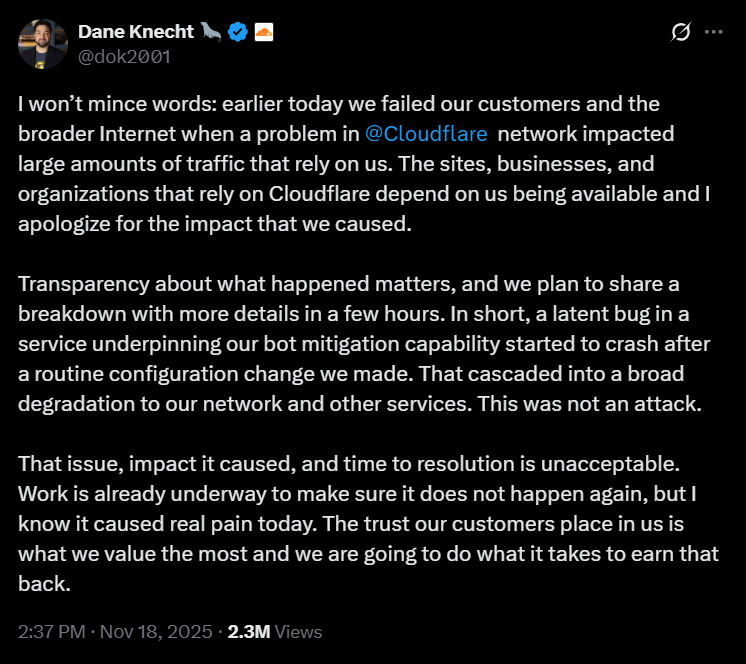
The company confirmed the incident was caused by a bug in its Bot Management System. A “feature file” used to combat cyberattacks grew beyond its normal size limit, causing the software to fail. Cloudflare initially suspected a large-scale Distributed Denial of Service attack but later confirmed no malicious activity occurred.
The internet services provider handles roughly 20% of global internet traffic. It powers about one-third of the top 10,000 websites, apps, and services worldwide.
Major crypto platforms experienced downtime during the outage. Coinbase, Blockchain.com, Ledger, BitMEX, Toncoin, Arbiscan, and DefiLlama all went offline. Non-crypto platforms including X and ChatGPT were also affected, impacting millions of users.
Cloudflare issued an apology in its post-mortem statement. “We are sorry for the impact to our customers and to the Internet in general,” the company said. “Given Cloudflare’s importance in the Internet ecosystem any outage of any of our systems is unacceptable.”
Calls for Decentralized Infrastructure Grow Louder
The outage happened just weeks after Amazon Web Services experienced a network failure. That incident took down access to major blockchains including Coinbase’s Base chain and Infura, which powers many blockchain networks.
Industry experts say the repeated failures expose vulnerabilities in centralized systems. Fadl Mantash, Chief Information Security Officer at Tribe payments, explained how payment infrastructure relies on multiple connected services. “When any link in that chain fails, the entire journey can break,” Mantash told CoinDesk.
DePIN Proposed as Solution
Several crypto industry leaders have called for wider adoption of DePIN technology. DePIN, or Decentralized Physical Infrastructure Networks, uses blockchain incentives to coordinate infrastructure maintenance. Users contribute hardware or services and earn tokens in return, creating community-run infrastructure.
Nökkvi Dan Ellidason, CEO of Gaimin, a DePIN project focused on cloud infrastructure, said the industry must move to a distributed cloud model. “By harnessing existing globally dispersed resources like underutilized PCs, Gaimin is building a network where capacity is spread across regions and continents,” Dan Ellidason said.
He added that distributing resources makes it difficult for a single error to take down the global system. “This is the only way to safeguard the digital economy against the inevitable fragility of centralization,” Dan Ellidason stated.

Ethereum co-founder Vitalik Buterin recently published a “Trustless Manifesto” calling on builders to prioritize decentralization. The document, co-authored with Ethereum Foundation researchers Yoav Weiss and Marissa Posner, warned that crypto platforms sacrifice trustlessness when integrating hosted nodes or centralized relayers. The researchers explained that each new checkpoint becomes a potential chokepoint.
Considering a new stock? You may want to see what’s on our watchlist first.
Our team at Knockout Stocks follows top-performing analysts and market-moving trends to spot potential winners early. We’ve identified five stocks gaining quiet attention that could be worth watching now. Create your free account to unlock the full report and get ongoing stock insights.Get 3 Free Stock Ebooks
Discover top-performing stocks in AI, Crypto, and Technology with expert analysis.
- Top 10 AI Stocks - Leading AI companies
- Top 10 Crypto Stocks - Blockchain leaders
- Top 10 Tech Stocks - Tech giants



