





TLDR
- Bitcoin is holding above $66,000, down only 6% on the week while most assets fall harder
- Gold has dropped for nine straight days, losing around 18% from recent highs
- US stock futures fell Monday, with the Dow posting its longest losing streak since 2023
- Trump issued a 48-hour ultimatum to Iran over the Strait of Hormuz, threatening strikes on energy infrastructure
- Goldman Sachs raised its oil forecasts, calling the Hormuz disruption the largest-ever supply shock for crude markets
Bitcoin is holding up better than most assets as global markets slide into their fourth week of losses, driven by the ongoing US-Israeli war with Iran.
As of Monday morning Asia time, Bitcoin was trading at $68,316, up 1.5% in the past 24 hours but down 6% on the week. Ether rose 2.7% to $2,059. Dogecoin was the worst performer among major cryptocurrencies, down 7.4% on the week to $0.09.
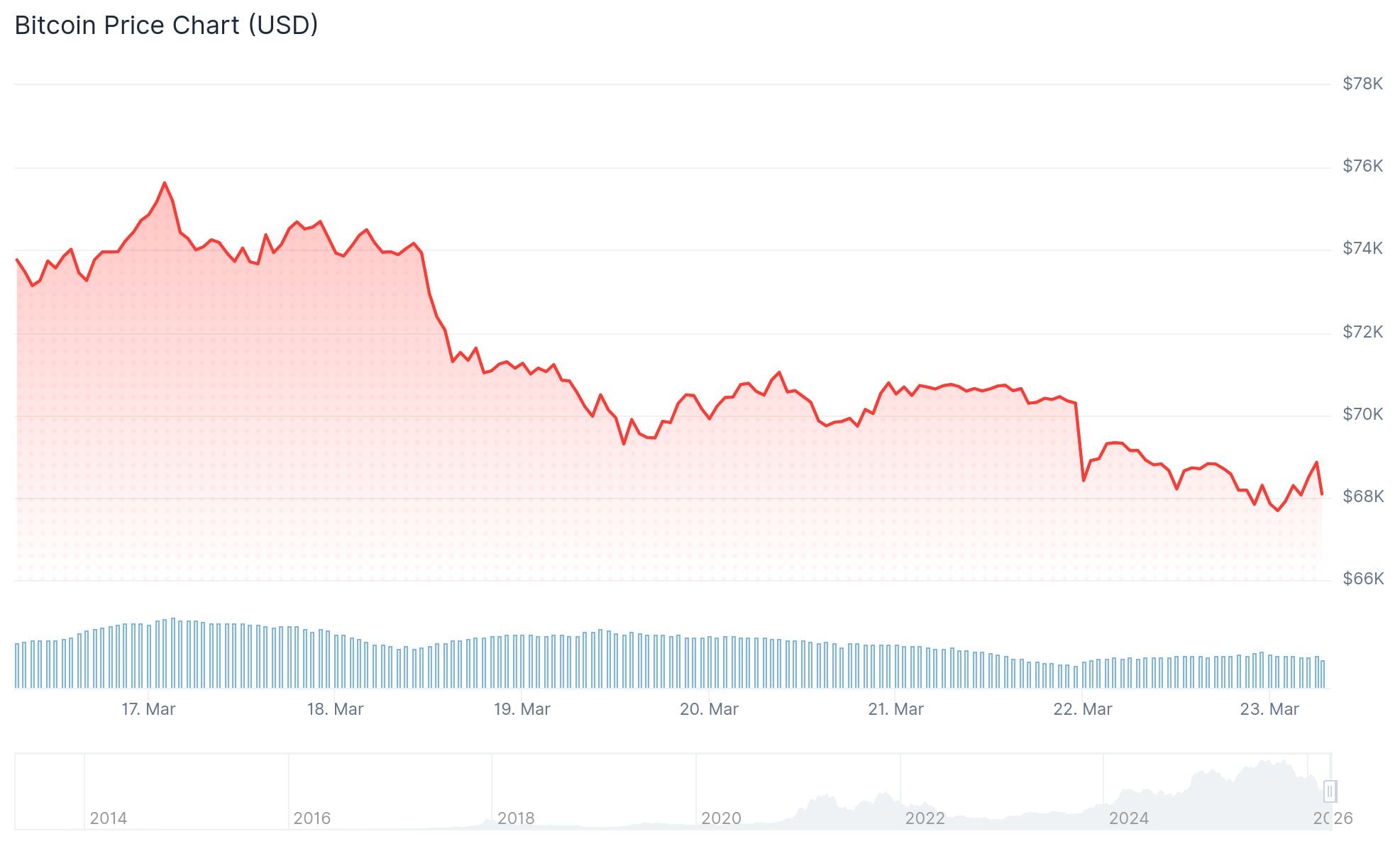
Tron was the only major crypto in the green on a weekly basis, up 3.8%.
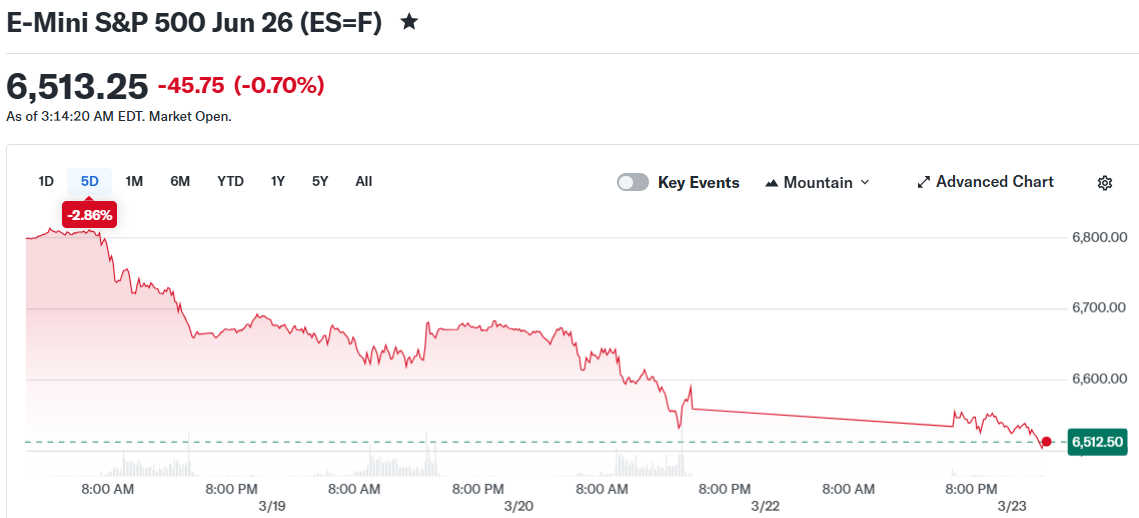
US stock futures pointed lower early Monday. Dow futures dropped around 0.4%, S&P 500 futures fell 0.5%, and Nasdaq 100 futures declined 0.6%.
For the week ending Friday, the Dow and Nasdaq each lost roughly 2%, while the S&P 500 dropped 1.5%. The Dow has now posted four straight weeks of losses, its longest losing streak since 2023.
Gold fell for a ninth consecutive day on Monday to around $4,360. That puts it down roughly 18% from recent highs, despite its traditional role as a safe-haven asset during geopolitical crises.
Alexander Blume, CEO of Two Prime, an SEC-registered investment advisor, said the moves in gold and Bitcoin are “more structural than market-based.” He pointed to China and other countries systematically buying gold to reduce dependence on the US dollar, a trend that reversed as the conflict deepened and liquidity became the priority.
What’s Driving the Sell-Off
The conflict in Iran is now in its fourth week. President Trump said over the weekend he does not want a ceasefire and issued a 48-hour ultimatum on Saturday, threatening to strike Iranian energy infrastructure if the Strait of Hormuz is not reopened.

IMPORTANT UPDATE:
Trump gave Iran a 48 hour deadline to open the Strait of Hormuz or he will bomb their power plants
Iran responded they are open to opening the Straits, but want an end to the war and assurances there won't be more wars
I think we have the foundation for an… pic.twitter.com/KrJW8L2MUL
— Mario Nawfal (@MarioNawfal) March 22, 2026
Iran responded by saying any such attack would result in an indefinite closure of the Strait and retaliatory strikes on US and Israeli energy assets in the region.
Brent crude edged up to around $113 a barrel, now up more than 70% year-to-date. Goldman Sachs raised its full-year Brent forecast to $85 from $77 and its WTI forecast to $79 from $72. The bank described the Hormuz disruption as the largest-ever supply shock for global crude markets.
Bond yields rose as prolonged conflict raised inflation concerns, reducing expectations for central bank rate cuts.
Market Outlook
Asian stocks fell for a third straight session and are approaching correction territory. European and S&P futures pointed to further losses.
Friday will bring an update to the University of Michigan consumer sentiment index, along with short and long-term inflation expectations. The S&P Global Flash US PMI report is due Tuesday.
Blume said Two Prime is positioned for higher funding and futures rates in the coming weeks, suggesting he sees more upside for Bitcoin than the current market pricing implies.
Trump’s 48-hour ultimatum expires Monday evening.
🚨 Our April Stock Picks Are Live!
A new month means new opportunities. Our analysts have just released their top stock picks for April, highlighting companies with strong momentum that rank highly on our KO Score algorithm. We’re also now sharing trade ideas for both long-term and short-term investors, giving you more ways to spot potential opportunities in the market.
Sign up to Knockout Stocks today and get 50% off to unlock the full list and see which stocks made the cut.
Use coupon code Special50 for your exclusive discount!
Get 3 Free Stock Ebooks
Discover top-performing stocks in AI, Crypto, and Technology with expert analysis.
- Top 10 AI Stocks - Leading AI companies
- Top 10 Crypto Stocks - Blockchain leaders
- Top 10 Tech Stocks - Tech giants



