





TLDR
- Gold futures fell over 7% to $4,558 an ounce on Thursday, while silver dropped more than 9%.
- The Federal Reserve held rates steady at 3.5%–3.75% and signaled fewer cuts ahead due to inflation concerns.
- Iran launched strikes on Middle East energy infrastructure after Israel attacked the South Pars gas field.
- Mining stocks including Freeport-McMoRan, Newmont, and Royal Gold all fell ahead of the opening bell.
- Traders now expect no Fed rate cuts until at least September, boosting the dollar and pressuring gold.
Gold suffered one of its sharpest single-day drops in recent memory on Thursday, as investors weighed the risk of prolonged high interest rates against a widening conflict between Israel and Iran.
BREAKING: Spot gold extends its selloff to -$400/oz on the day, now trading at $4,500/oz for the first time since February 2nd. pic.twitter.com/ARqkGaABpz
— The Kobeissi Letter (@KobeissiLetter) March 19, 2026
Continuous gold futures fell more than 7% to $4,558 an ounce in early trading, a drop of $289. Spot gold was down 4.3% to $4,609.02 an ounce by 8:36 AM ET. Silver futures fell 9.3%, with spot silver down 11% to $67.17 an ounce.
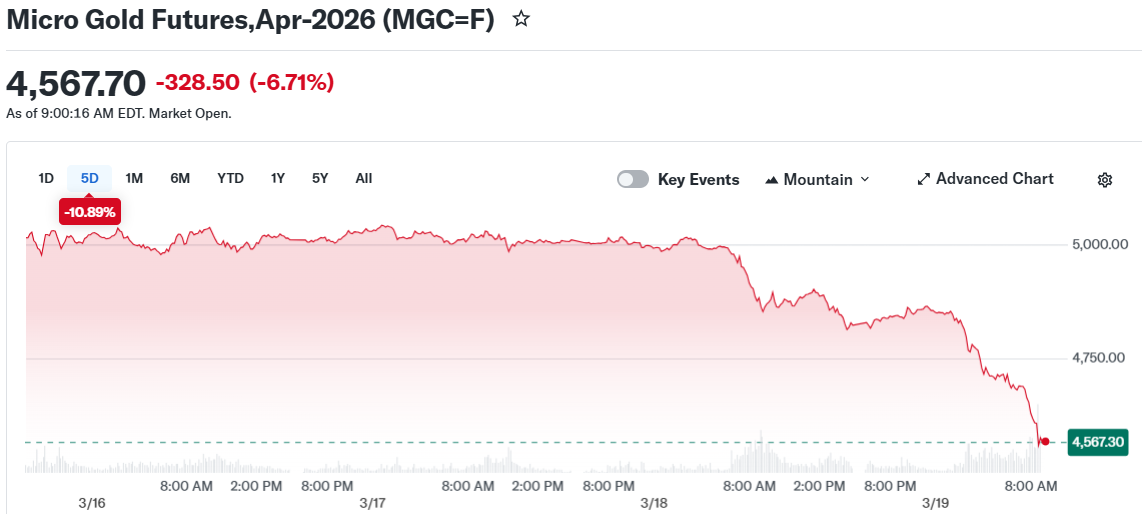
The selloff pushed gold well below the $5,000-per-ounce level it had held for nearly a month.
Fed Holds Rates, Signals Fewer Cuts
The Federal Reserve left interest rates unchanged Wednesday, keeping them in the 3.5%–3.75% range. Chair Jerome Powell pointed to growing inflation risks and suggested there would be “a meaningful amount of movement toward fewer cuts.”
Strong U.S. producer inflation data released Wednesday added to the pressure. Markets responded by pushing back their expectations for rate cuts to September at the earliest, according to CME FedWatch data.
Gold is a non-yielding asset, meaning it tends to lose appeal when rates stay high. Investors often shift toward interest-bearing assets instead.

“Fed rate cuts have been pushed out further in the future,” said Adrian Ash, a researcher at BullionVault. “Mechanically, that would be bad for gold.”
Ash called the current moment a “test” for gold, but stopped short of calling it a price bottom.
Iran Strikes Rattle Energy Markets
The price drop in gold came alongside a sharp rise in oil prices. Brent crude futures jumped 6.3% after Iran struck key energy infrastructure across the Middle East overnight.
The conflict escalated Wednesday when Israel attacked South Pars, the world’s largest gas field. Iran responded with strikes on multiple energy facilities in the region and continued attacking targets in Israel.
The Strait of Hormuz, a critical shipping lane for global oil and gas, has been effectively closed, putting further upward pressure on energy prices.
Higher oil prices are seen as inflationary, which further reduces the likelihood of near-term Fed rate cuts.
OCBC analysts wrote in a note: “The market is effectively trading less on geopolitical hedging demand and more on the worries of higher inflation risks delaying Fed cut trajectory.”
They added that safe-haven flows into gold are “being offset by the drag from rising real yields.”
Precious metal mining stocks also fell in premarket trading. Freeport-McMoRan dropped 4.4%, Newmont fell 7.6%, and Royal Gold was down 4.6%.
The U.S. dollar strengthened on the back of the higher-for-longer rate outlook, adding further headwinds for gold, which is priced in dollars.
CME FedWatch data showed traders pricing in no rate cuts until at least September, later than previously expected.
🚨 Our April Stock Picks Are Live!
A new month means new opportunities. Our analysts have just released their top stock picks for April, highlighting companies with strong momentum that rank highly on our KO Score algorithm. We’re also now sharing trade ideas for both long-term and short-term investors, giving you more ways to spot potential opportunities in the market.
Sign up to Knockout Stocks today and get 50% off to unlock the full list and see which stocks made the cut.
Use coupon code Special50 for your exclusive discount!
Get 3 Free Stock Ebooks
Discover top-performing stocks in AI, Crypto, and Technology with expert analysis.
- Top 10 AI Stocks - Leading AI companies
- Top 10 Crypto Stocks - Blockchain leaders
- Top 10 Tech Stocks - Tech giants



