






TLDR
- Gold rose 0.4% to around $4,509/oz Monday after falling as low as $4,000/oz last week
- OCBC analysts say the rebound looks technical, with key resistance at $4,624, $4,670, and $4,850/oz
- Houthi rebels attacked Israel over the weekend, raising fears of a wider Middle East conflict
- Iran struck aluminum facilities in Bahrain and the UAE, sending aluminum prices up 5.4%
- Higher energy prices and a stronger dollar are keeping pressure on gold, which is down 13% this month
Gold prices edged higher in Asian trade on Monday, rising 0.4% to $4,509.51 an ounce. Futures also gained 0.4%, reaching $4,537.40 per ounce.
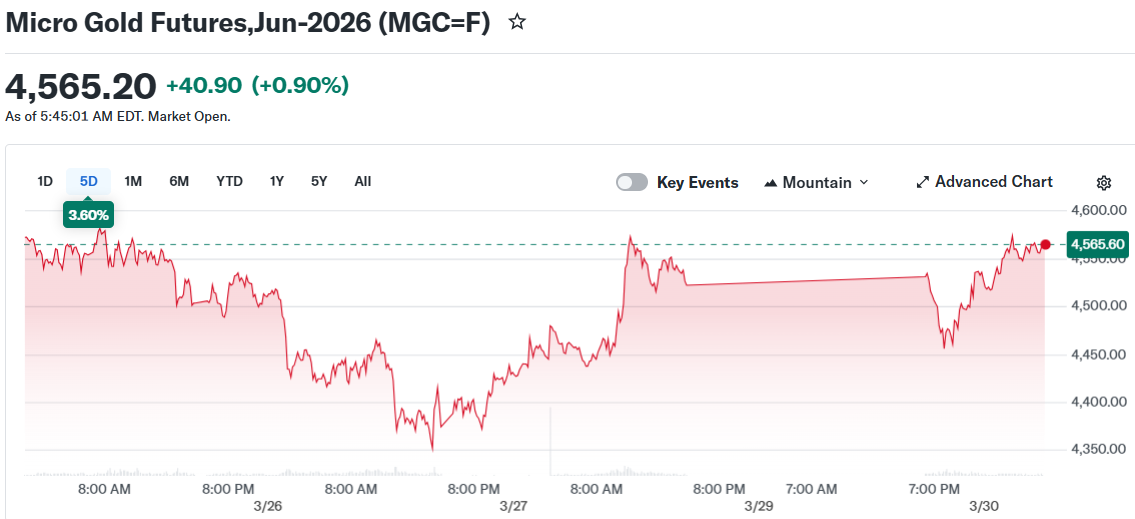
The move comes after a turbulent week that saw spot gold drop as low as $4,000 an ounce before recovering to near $4,500 by Friday.
ANZ analysts said opportunistic buyers stepped in after what they called the biggest gold sell-off in years. Gold-backed ETF liquidations had pushed prices down more than 15% this month alone.
Gold is still down more than 13% on the month. A stronger U.S. dollar and climbing oil prices have kept a lid on any recovery.
Brent crude surged above $115 a barrel after Yemen’s Houthi rebels entered the conflict and claimed responsibility for a missile strike on Israel over the weekend.
OCBC analysts said gold’s rebound from last week’s lows looks largely technical. They noted the relative strength index had recovered from oversold territory, but said that alone was not enough to confirm a sustained rally.
They identified key resistance levels for spot gold at $4,624, $4,670, and $4,850 per ounce. Failing to hold above those levels could leave gold trading on a softer footing, they warned.

Higher energy prices are also a concern. OCBC said they risk keeping inflation elevated, which could push Treasury yields higher and create a more challenging environment for gold.
Iran War and the Risk of Escalation
The U.S.-Israel war on Iran entered a new phase over the weekend. The Houthi group, backed by Iran and based in Yemen, attacked Israel, raising fears of a broader conflict and potential disruption to Red Sea shipping lanes.
Iran said it was prepared for a ground invasion by the U.S., following reports that Washington was moving thousands of troops to the region.
President Trump told reporters that negotiations with Iran were going well and that a deal could be near. He gave no timeline and also warned of further strikes against Tehran.
Trump had extended a deadline for attacks on Iran’s energy infrastructure to early April.
Aluminum Markets Shaken by Iranian Strikes
Iran struck aluminum production facilities in Bahrain and the UAE over the weekend. Three-month aluminum futures on the London Metal Exchange jumped 5.4% to $3,461 a metric ton and are up more than 10% on the month.
Aluminium Bahrain confirmed its facilities were targeted and said it was assessing the damage.
Emirates Global Aluminium said its plant at Al Taweelah in Abu Dhabi sustained heavy damage from Iranian drone and missile strikes.
ANZ analysts warned that around 4 to 5 million tons of regional aluminum exports remain at risk, with no alternative supply to cover the shortfall.
Silver fell 0.9% to $69.09 an ounce, while platinum rose 1.8% to $1,898.73 an ounce on Monday.
Considering a new stock? You may want to see what’s on our watchlist first.
Our team at Knockout Stocks follows top-performing analysts and market-moving trends to spot potential winners early. We’ve identified five stocks gaining quiet attention that could be worth watching now. Create your free account to unlock the full report and get ongoing stock insights.Get 3 Free Stock Ebooks
Discover top-performing stocks in AI, Crypto, and Technology with expert analysis.
- Top 10 AI Stocks - Leading AI companies
- Top 10 Crypto Stocks - Blockchain leaders
- Top 10 Tech Stocks - Tech giants



