






TLDR
- Brent crude oil is trading above $100 a barrel after Iran pledged to keep the Strait of Hormuz closed.
- The IEA called this the largest supply disruption in oil market history and agreed to release 400 million barrels from emergency reserves.
- The US issued a temporary waiver allowing some countries to buy Russian oil, valid until April 11.
- Iran has reportedly begun laying mines in the strait, making tanker passage even more dangerous.
- The US Navy may begin escorting tankers through the strait by end of March, though experts doubt it will fully ease the crisis.
Brent crude oil rose above $100 a barrel this week as Iran vowed to keep the Strait of Hormuz shut, sending shockwaves through global energy markets and pushing stock markets lower.
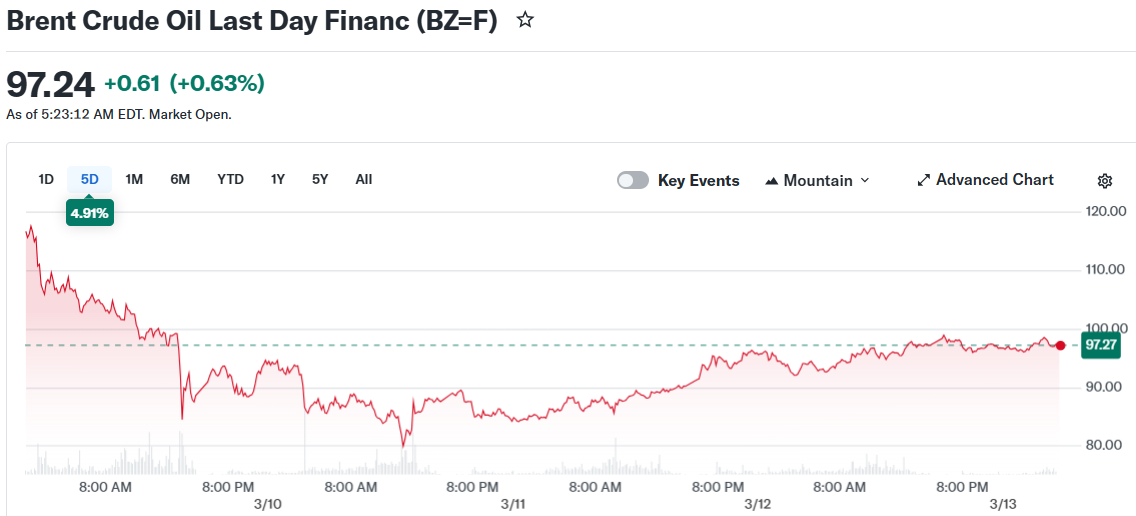
The price surge follows some of the most volatile trading in years. West Texas crude was near $97, and both benchmarks swung in wide ranges not seen since the pandemic.
Iran’s new supreme leader Mojtaba Khamenei made his first public statements since succeeding his father. He said Iran would work to keep the strait closed to shipping.
The Strait of Hormuz is a narrow waterway between Iran and Oman. Around one fifth of the world’s oil passes through it. Since the US-Israel war with Iran began on February 28, vessel traffic has slowed to almost nothing.
The International Energy Agency called this the largest supply disruption in oil market history. It announced a record release of 400 million barrels from emergency reserves held by member countries.
Iran has also begun laying mines in the strait, according to the New York Times, citing US officials. That makes passage even more dangerous for commercial shipping.
US Energy Secretary Chris Wright said the Navy could begin escorting tankers through the strait by the end of March. However, a previous social media post suggesting a tanker had already been escorted through was later walked back by the White House.

US Eases Russia Oil Sanctions
To ease market pressure, the US Treasury issued a temporary waiver allowing certain countries to continue purchasing Russian oil that was already loaded onto ships before March 12. The waiver runs until April 11.
Treasury Secretary Scott Bessent said the move was aimed at stabilizing global energy markets. Russia said it had around 100 million barrels of oil currently in transit at sea.
The UK said it would not follow the US in easing Russian oil sanctions. British energy minister Michael Shanks said it could give Russia an opportunity to fund its war effort.
French President Emmanuel Macron also pushed back, saying the Hormuz shutdown did not justify lifting sanctions on Russia. Ukrainian President Zelensky called the move a “serious blow” for Ukraine.
Markets and Prices
Stock markets fell this week as oil prices climbed. The wild price swings have been made worse by activity in options markets and exchange-traded funds.
WTI crude traded in a range of about $43 this week, the widest band since oil prices turned negative during the pandemic. Brent swung in a roughly $38 range.
Asia, which relies heavily on Gulf oil, has moved quickly. Japan, South Korea, and Thailand announced petrol price caps. The Philippines, which gets around 95% of its crude from the Middle East, told public workers to work a four-day week to cut fuel use.
One analyst said a price range of $85 to $105 was likely while the conflict remained unresolved. The IEA reserve release may offer some short-term relief, but experts say it will not be enough to stabilize markets on its own.
President Trump said on social media that preventing Iran from having nuclear weapons was more important to him than oil prices.
Considering a new stock? You may want to see what’s on our watchlist first.
Our team at Knockout Stocks follows top-performing analysts and market-moving trends to spot potential winners early. We’ve identified five stocks gaining quiet attention that could be worth watching now. Create your free account to unlock the full report and get ongoing stock insights.Get 3 Free Stock Ebooks
Discover top-performing stocks in AI, Crypto, and Technology with expert analysis.
- Top 10 AI Stocks - Leading AI companies
- Top 10 Crypto Stocks - Blockchain leaders
- Top 10 Tech Stocks - Tech giants



