






TLDR
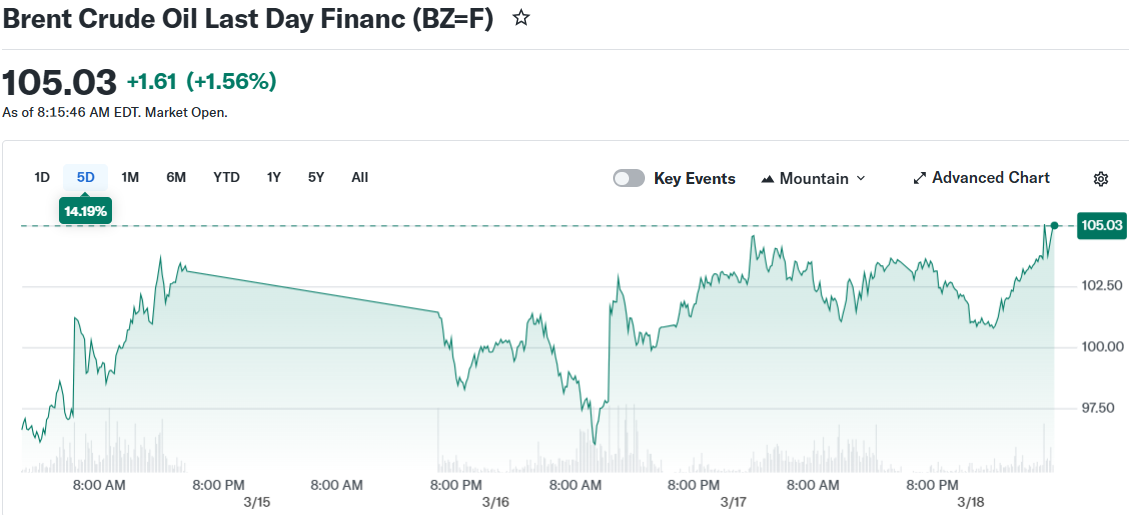
- Brent crude rose to $104.76/barrel as U.S.-Israel military action against Iran chokes Strait of Hormuz oil flows
- The Strait carries roughly one-fifth of the world’s oil, and sailings have nearly stopped
- JPMorgan says European oil stocks could see free cash flow yields rise to ~14% in a $100 oil world
- JPMorgan’s top picks are Shell, TotalEnergies, Eni, and Galp
- The Fed is expected to hold rates steady, but the oil shock could delay planned rate cuts
European oil stocks are drawing fresh attention from Wall Street as crude prices climb above $100 a barrel, driven by supply fears linked to the ongoing U.S.-Israel military campaign against Iran.
Brent crude futures rose 1.3% to $104.76 a barrel on Wednesday, pulling back from earlier losses. The move came even after Iraq and Kurdish authorities agreed to resume oil exports through Turkey’s Ceyhan port, which offered some relief to markets.
West Texas Intermediate fell 0.6% to $94.95 a barrel in the same session.
The war, now in its third week, has caused a near-total halt in shipping through the Strait of Hormuz. The U.S. military has bombed Iranian coastal sites housing cruise missiles capable of targeting ships crossing the waterway.
The Strait of Hormuz handles roughly one-fifth of global oil flows. Any sustained disruption there has wide consequences for energy markets worldwide.
JPMorgan analyst Matthew Lofting says the financial impact for European oil companies is “clearly positive.” He estimates that lost volumes from Hormuz disruptions cost companies around $6 per barrel in cash flow, or up to $10 for the most exposed firms.
That compares to a roughly $30 increase in oil prices since the conflict began, meaning the price gain far outweighs the volume loss for most companies.

Free Cash Flow Yields Could Hit 14%
Lofting estimates that free cash flow yields for European oil stocks could rise from around 10% under current forward prices to roughly 14% in a sustained $100 oil environment. He described valuations as still “modestly cheap” compared to levels seen during the 2022 energy crisis.
European oil sector shares have already risen more than 10% since the conflict began.
JPMorgan’s top picks in the sector are Shell, TotalEnergies, Eni, and Galp. The bank cites strong price leverage, long production profiles, and improving valuations as key reasons.
Eni and Shell are highlighted for their higher sensitivity to oil prices. Galp’s leverage is described as understated by near-term financial data.
TotalEnergies, Shell, and OMV have the most direct exposure to Middle East assets. Equinor, Repsol, and Galp have little to no direct exposure and may show stronger sensitivity to near-term oil price moves.
JPMorgan also expects strong trading performance to add upside, modelling around $4 billion in potential gains for Shell alone.
One risk flagged by Lofting is the possible return of windfall taxes, based on the 2022–23 precedent. He models an additional 5% tax on cash flows as a potential headwind.
Fed Meeting Adds Uncertainty
Markets were cautious ahead of a Federal Reserve decision later Wednesday. The Fed is widely expected to hold rates steady at 3.5% to 3.75%.
Fed Chair Jerome Powell, who steps down in May, is due to speak after the decision. Investors will be watching closely for any signals on how the oil shock could affect the rate outlook.
Before the conflict, markets had pencilled in a rate cut in the second half of 2025. Analysts at ING say the Fed could now signal a delay to those cuts.
A colder-than-usual winter and recent market moves are expected to support stronger energy trading performance in the first quarter, according to JPMorgan.
🚨 Our April Stock Picks Are Live!
A new month means new opportunities. Our analysts have just released their top stock picks for April, highlighting companies with strong momentum that rank highly on our KO Score algorithm. We’re also now sharing trade ideas for both long-term and short-term investors, giving you more ways to spot potential opportunities in the market.
Sign up to Knockout Stocks today and get 50% off to unlock the full list and see which stocks made the cut.
Use coupon code Special50 for your exclusive discount!
Get 3 Free Stock Ebooks
Discover top-performing stocks in AI, Crypto, and Technology with expert analysis.
- Top 10 AI Stocks - Leading AI companies
- Top 10 Crypto Stocks - Blockchain leaders
- Top 10 Tech Stocks - Tech giants



