






TLDR
- Brent crude rose to over $106 a barrel on Thursday, up around 4%, while West Texas Intermediate climbed to $93.66
- The Strait of Hormuz remains effectively closed, cutting off roughly a fifth of global oil shipments
- Iran rejected US peace overtures and its parliament is drafting a bill to charge fees for ship passage through the strait
- BlackRock’s president warned oil could spike to $150 a barrel even if a ceasefire is announced tomorrow
- US officials are privately studying what a spike to $200 a barrel would mean for the broader economy
Oil prices jumped sharply on Thursday as conflicting signals from Washington and Tehran kept energy markets on edge. Brent crude climbed about 4% to $106.34 a barrel. West Texas Intermediate rose 3.7% to $93.66.
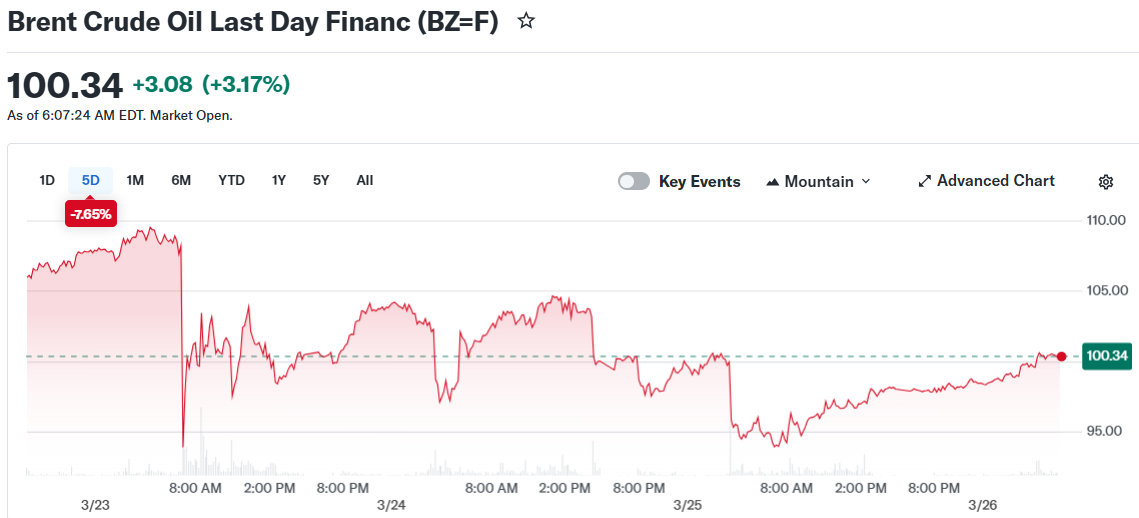
The gains came one day after prices dropped more than 2%, driven by cautious optimism about peace talks. That optimism faded quickly.
Iran publicly denied it was in direct negotiations with the United States. Officials in Tehran said key differences remain and outlined their own conditions, including sovereign control over the Strait of Hormuz.
The White House pushed back, insisting talks are ongoing. President Trump said at a fundraising event Wednesday night that Iran “wants to make a deal so badly, but they’re afraid to say it.”
Iran’s parliament is working on a bill that would charge fees to ships passing through the strait in exchange for security. The plan is expected to be finalized next week, according to the semi-official Fars news agency.
🚨BREAKING: IRAN ALLOWS INDIA, CHINA, RUSSIA THROUGH STRAIT OF HORMUZ
Iran has granted passage to key allied nations. Foreign Minister Abbas Araghchi confirmed the route is not fully closed.
India, China, Russia, Iraq, and Pakistan are on the approved list. Other nations face… pic.twitter.com/8SJylnwdt3
— BSCN (@BSCNews) March 26, 2026
The Strait of Hormuz is a narrow waterway connecting the Persian Gulf to global markets. About one-fifth of the world’s oil passes through it. Since the conflict began in late February, the strait has been nearly shut to tanker traffic.
Ships seeking to pass under Iranian protection are being asked to provide crew lists, cargo details, and voyage information to the Islamic Revolutionary Guard Corps before receiving clearance.

Oil at Risk of Further Spikes
BlackRock president Rob Kapito said investors may be underestimating the risks. Speaking at an event in Melbourne on Thursday, Kapito said oil could still hit $150 a barrel even if a ceasefire is announced tomorrow, because supply chains would take time to recover.
US administration officials are also privately studying scenarios where oil reaches $200 a barrel, according to people familiar with the matter.
Brent crude is on pace for its biggest monthly gain since 1990. Prices had already spiked to nearly $120 a barrel earlier this month before pulling back.
A drone struck a Turkish tanker carrying Russian crude near Istanbul in the Black Sea on Wednesday, adding another layer of concern for traders watching multiple conflict zones.
Global Pressures Building
Analysts at Capital Economics warned that a prolonged disruption could deliver a hit to global activity similar to the one that followed Russia’s invasion of Ukraine in 2022, and could push central banks to raise interest rates again.
Countries across Asia are already feeling the pressure. Thailand raised gasoline prices by as much as 22% on Thursday. The Philippines suspended its wholesale electricity spot market. Farmers in India and China are dealing with higher costs for agrochemicals.
Pump prices in the United States have also been rising steadily since the conflict began.
The White House announced on Thursday that a summit between President Trump and Chinese leader Xi Jinping has been rescheduled for May 14–15 in Beijing
Considering a new stock? You may want to see what’s on our watchlist first.
Our team at Knockout Stocks follows top-performing analysts and market-moving trends to spot potential winners early. We’ve identified five stocks gaining quiet attention that could be worth watching now. Create your free account to unlock the full report and get ongoing stock insights.Get 3 Free Stock Ebooks
Discover top-performing stocks in AI, Crypto, and Technology with expert analysis.
- Top 10 AI Stocks - Leading AI companies
- Top 10 Crypto Stocks - Blockchain leaders
- Top 10 Tech Stocks - Tech giants



