






TLDR
- Brent crude fell nearly 4% to around $100 a barrel on reports of a US-led 15-point ceasefire plan for Iran
- WTI crude dropped 4% to $88.70, while UK natural gas prices fell 8%
- Trump said the US is “in negotiations right now” with Iran, but Tehran denied any talks are taking place
- Israel struck Tehran even as diplomatic signals were being sent from Washington
- Global stock markets rallied, with the FTSE 100, Germany’s DAX, and France’s CAC 40 all gaining
Brent crude was trading around $100.41 per barrel, down nearly 4%, while WTI crude fell to $88.70 as of Wednesday morning.
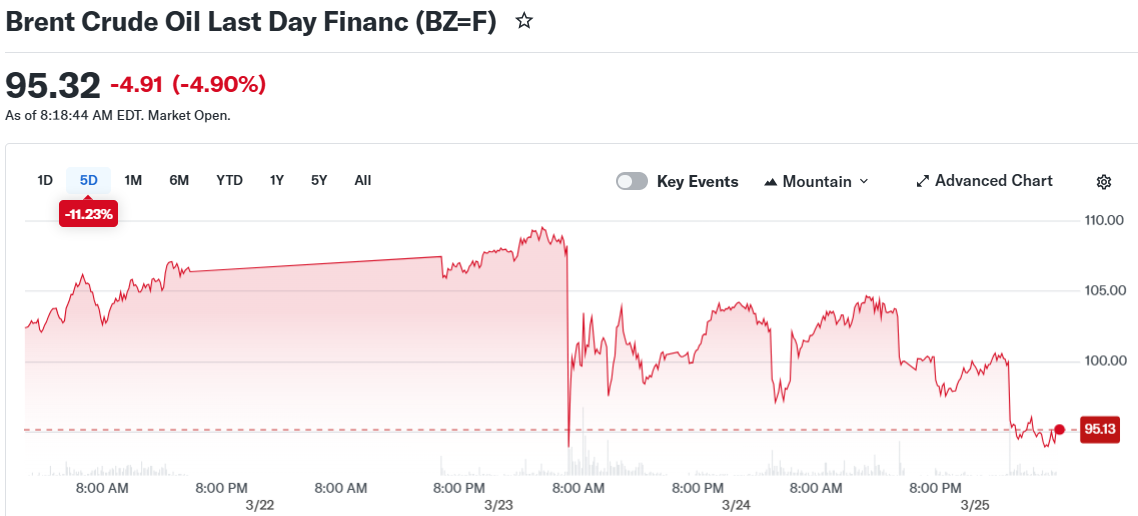
Oil markets took a sharp step back on Wednesday after reports emerged that the Trump administration had sent Iran a 15-point plan aimed at ending the conflict in the Middle East. The proposal was delivered through Pakistani intermediaries, who have also offered to host fresh talks between Washington and Tehran.
President Trump said the US is “in negotiations right now” with Iran, and suggested Tehran was “talking sense.” He had described earlier talks as “productive” on Monday.
Iranian officials, however, flatly denied any negotiations were taking place — saying the Americans were only negotiating with themselves.
JUST IN: Iran responds on the Negotiations allegations:
"You have reached a stage where you are negotiating with yourselves"
“Do not call your defeat an agreement.”
“There will be no news of your investments in the region, and you will not see the former price of energy and… pic.twitter.com/ufZ0GchFjF
— Sulaiman Ahmed (@ShaykhSulaiman) March 25, 2026
That contradiction set the tone for a volatile session. Traders were clearly relieved at the prospect of de-escalation but aware the situation could shift fast.
Brent crude hit a session low of $97.30 before recovering slightly. WTI crude also fell sharply, dropping 4% to $88.70 per barrel. UK natural gas prices dropped 8% in parallel.

Stock Markets Rally on Oil Price Drop
The fall in energy prices gave equity markets a lift. London’s FTSE 100 gained over 1%, rising 103 points to 10,068. Germany’s DAX surged 1.6% and France’s CAC 40 climbed 1.5%. Asian markets had already posted strong gains overnight.
Matt Britzman, senior equity analyst at Hargreaves Lansdown, said: “Oil prices have moved lower on the developments, offering some relief to equities that had been weighed down by worries over inflation and the knock-on impact for interest rates.”
Richard Hunter, head of markets at interactive investor, struck a more cautious note, pointing out the FTSE 100 is still roughly 8% below its record high from late February.
Strait of Hormuz Remains Key to Any Recovery
The key flashpoint has been the Strait of Hormuz, the critical shipping lane that has been effectively shut down by threats of Iranian strikes on oil tankers. That disruption has driven prices sharply higher in recent weeks.
Analysts at ING wrote: “Despite the initial market relief, uncertainty remains high. Overall, volatility remains elevated and a geopolitical risk premium persists.”
Meanwhile, even as diplomatic signals were being sent, Israel struck Tehran on Wednesday — adding another layer of contradiction to an already messy situation.
The US military is also preparing to deploy at least 1,000 more troops to the region, adding to the 50,000 already stationed there.
Britzman was direct about what it will actually take to bring prices down for good: “Social media posts and press conferences can only go so far, and it will likely take a full reopening of the Strait of Hormuz to drive any meaningful and sustained move lower from here.”
Prices remain well above pre-conflict levels, and the Strait of Hormuz has not reopened.
Considering a new stock? You may want to see what’s on our watchlist first.
Our team at Knockout Stocks follows top-performing analysts and market-moving trends to spot potential winners early. We’ve identified five stocks gaining quiet attention that could be worth watching now. Create your free account to unlock the full report and get ongoing stock insights.Get 3 Free Stock Ebooks
Discover top-performing stocks in AI, Crypto, and Technology with expert analysis.
- Top 10 AI Stocks - Leading AI companies
- Top 10 Crypto Stocks - Blockchain leaders
- Top 10 Tech Stocks - Tech giants



