






TLDR
- Brent crude fell 0.8% to $106.91 and WTI dropped 1% to $101.14 on Wednesday
- Both benchmarks have stayed near or above $100/barrel since the U.S.-Israeli war on Iran began in late February
- Iran’s closure of the Strait of Hormuz has disrupted roughly one-fifth of global oil and LNG flows
- Trump is set to meet China’s Xi Jinping Thursday and Friday; China is Iran’s biggest oil buyer
- The EIA expects the Strait to remain closed until at least late May, with flows unlikely to return to prewar levels until later in 2026
Oil prices fell on Wednesday, ending a three-day rally. Brent crude dropped 0.8% to $106.91 a barrel, while U.S. West Texas Intermediate slipped 1% to $101.14.
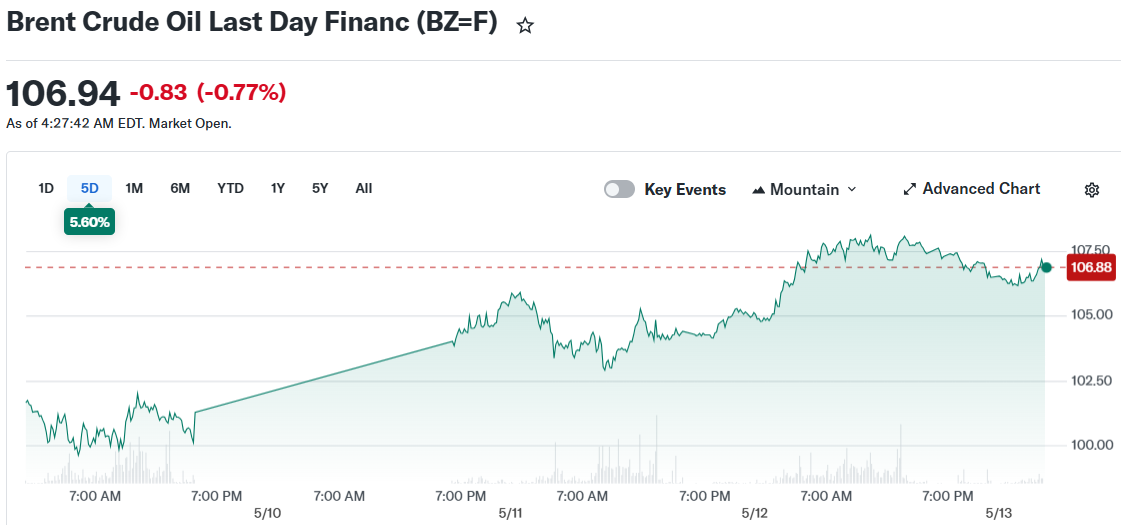
The pullback came as traders waited for news on a fragile ceasefire in the Middle East and watched for outcomes from a planned summit between U.S. President Donald Trump and Chinese President Xi Jinping in Beijing on Thursday and Friday.
This is absolutely insane.
President Trump is currently flying to China with all of the following people to request "deals" with China's President Xi:
1. Elon Musk, Tesla and SpaceX CEO
2. Jensen Huang, Nvidia CEO
3. Tim Cook, Apple CEO
4. Larry Fink, BlackRock CEO
5. Stephen…— The Kobeissi Letter (@KobeissiLetter) May 13, 2026
Both oil benchmarks have stayed near or above $100 a barrel since the U.S.-Israeli war on Iran started in late February. The conflict led Tehran to effectively shut the Strait of Hormuz, a key shipping lane.
About one-fifth of global oil and liquefied natural gas normally moves through the strait. Its closure has squeezed global supply and kept prices elevated.
“The market remains highly reactive to every update from the region, meaning sharp swings are likely to persist,” said Priyanka Sachdeva, senior market analyst at Phillip Nova.
On Tuesday, prices had risen more than 3% after hopes for a lasting ceasefire faded. That dimmed expectations of the strait reopening anytime soon.
Iran War’s Impact on Supply
Analysts at ING said energy markets remain “in limbo” ten weeks into the conflict. Supply disruptions in the Gulf and falling inventories are clouding the outlook.

U.S. crude inventories fell for a fourth straight week last week, according to American Petroleum Institute data. Distillate inventories also declined. Government stockpile data was due later Wednesday.
Eurasia Group said in a client note that the supply loss has already exceeded one billion barrels. The firm expects oil to stay above $80 a barrel for the rest of the year.
The U.S. Energy Information Administration assumes the Strait of Hormuz will remain closed until at least late May. Even if shipping picks up in June, flows are unlikely to reach prewar levels until later in 2026.
Trump-Xi Summit in Focus
Trump said Tuesday he does not think he will need China’s help to end the war with Iran. China is the biggest buyer of Iranian oil despite U.S. sanctions pressure.
The Trump-Xi meeting is being watched closely by energy markets. Any shift in China’s position on Iranian oil could affect global supply dynamics.
Higher oil prices are feeding through to U.S. consumers. Fuel costs have risen, and U.S. consumer prices climbed sharply for a second straight month in April, posting the largest annual increase in nearly three years.
Economists expect more price pressure in the months ahead. The Federal Reserve is widely expected to hold interest rates steady, which could weigh on oil demand over time.
Stop guessing and start investing with confidence. KnockoutStocks gives you the AI insights, market intelligence, and stock research you need to spot opportunities, cut through the noise, and make smarter investment decisions — all in one powerful platform.
Sign up today and get 50% OFF full access to our premium stock picks.
Simply use coupon code SPECIAL50 at checkout to claim your exclusive discount.
Get 3 Free Stock Ebooks
Discover top-performing stocks in AI, Crypto, and Technology with expert analysis.
- Top 10 AI Stocks - Leading AI companies
- Top 10 Crypto Stocks - Blockchain leaders
- Top 10 Tech Stocks - Tech giants



