





TLDR
- Samsung projected Q1 2026 operating profit of 57.2 trillion won ($37.8 billion), up more than eightfold year-over-year.
- Revenue is expected to surge nearly 70% to 133 trillion won for the January–March period.
- The results are being driven by soaring demand for AI chips, which has caused memory chip supply shortages and pushed prices sharply higher.
- Samsung has been closing the gap with rival SK Hynix in high-bandwidth memory (HBM) chips, shipping HBM4 to Nvidia in February.
- The Middle East conflict poses a risk, as it may disrupt supplies of chipmaking materials like helium and push up energy costs.
Samsung projected Q1 2026 operating profit of 57.2 trillion won — more than eightfold higher than the same period a year ago — smashing analyst estimates of around 40–42 trillion won from LSEG SmartEstimate.
If confirmed, that figure would nearly triple Samsung’s previous record quarterly profit of 20 trillion won, set in Q4 last year. It would also exceed the company’s total operating profit for all of 2025.
Revenue for the quarter is expected to hit 133 trillion won, a 68% jump from a year ago. The numbers are due to be confirmed in full when Samsung reports detailed earnings on April 30.
The results were largely driven by Samsung’s memory chip business. AI infrastructure demand has created a shortage across the memory market, pushing prices sharply higher. Contract DRAM prices are expected to rise more than 50% in the current quarter, according to research firm TrendForce.
One analyst at Meritz Securities estimated that Samsung’s memory chip business generated around 54 trillion won in operating profit for the quarter. Its logic chip divisions posted a loss of about 1.6 trillion won. The mobile division came in at roughly 4 trillion won in profit, slightly down year-over-year.
Samsung Narrows Gap in High-Bandwidth Memory Race
A year ago, Samsung’s CEO issued a public apology over the company’s earnings performance and its lag behind rival SK Hynix in supplying high-bandwidth memory chips to Nvidia. That gap has since started to close.
Samsung began shipping its latest HBM4 chips to Nvidia in February. However, HBM chips still accounted for less than 10% of Samsung’s DRAM chip revenue in Q1, according to Heungkuk Securities. The bulk of the profit surge came from traditional DRAM demand fueled by AI inference workloads, which have exacerbated shortages in commodity memory.

Analysts at Heungkuk Securities expect Samsung’s total operating profit to reach another record of 75 trillion won in Q2, driven by a projected 30%+ rise in DRAM prices.
The company also benefited from a weak South Korean won, which is near a 17-year low against the U.S. dollar. That has boosted the value of repatriated earnings.
Middle East Conflict Adds Uncertainty
The ongoing U.S.-Israel war with Iran has emerged as a risk for the chip industry. Disruptions to the supply of materials critical to semiconductor manufacturing — including helium — could affect output at companies like Samsung and SK Hynix.
Rising energy costs tied to the conflict have also raised questions about whether AI data center demand could slow in the second half of the year.
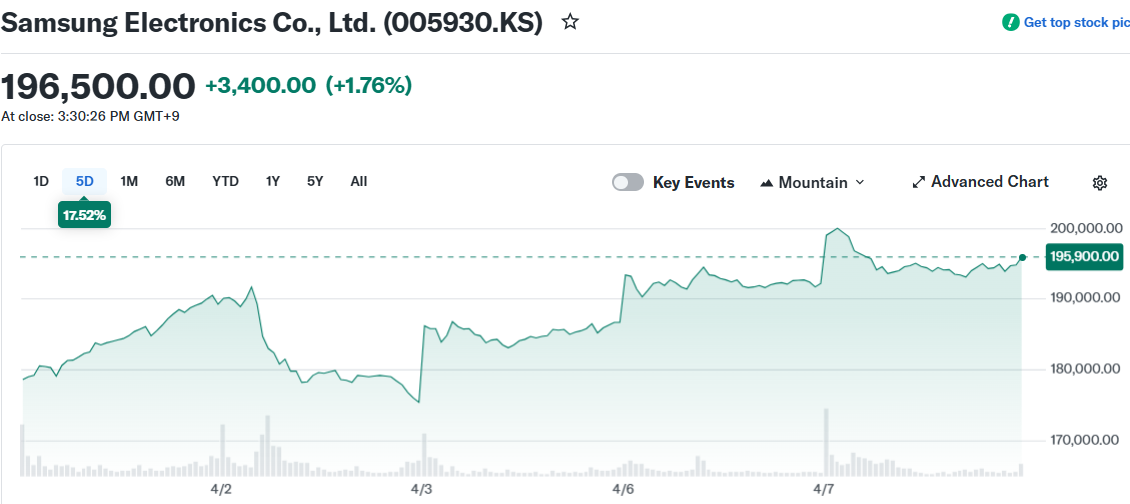
Spot DRAM prices eased slightly last week, with TrendForce noting that end-user demand was struggling to absorb elevated prices. Google’s release of a memory-saving technology called TurboQuant in March added further pressure, contributing to a selloff that has taken Samsung’s stock down about 9% since the war began on February 28.
Even so, Samsung’s stock is still up more than 60% in 2026, following a 125% gain in 2025.
Rival SK Hynix closed 3.4% higher on Tuesday.
Considering a new stock? You may want to see what’s on our watchlist first.
Our team at Knockout Stocks follows top-performing analysts and market-moving trends to spot potential winners early. We’ve identified five stocks gaining quiet attention that could be worth watching now. Create your free account to unlock the full report and get ongoing stock insights.Get 3 Free Stock Ebooks
Discover top-performing stocks in AI, Crypto, and Technology with expert analysis.
- Top 10 AI Stocks - Leading AI companies
- Top 10 Crypto Stocks - Blockchain leaders
- Top 10 Tech Stocks - Tech giants



