





TLDR
- Samsung shares jumped 5.4% to a record high of 190,900 won Thursday after a report said it is negotiating HBM4 chip prices at ~$700 per unit.
- The $700 price tag is 20%–30% higher than its previous HBM3E model and implies an operating profit margin of 50%–60%.
- SK Hynix, which priced HBM4 for Nvidia in the mid-$500s, may move to match Samsung’s higher number.
- Samsung began mass production of HBM4 chips last week and has shipped commercial products to customers.
- South Korea’s Kospi index is up 34% this year, making it the world’s best-performing stock market.
Samsung Electronics shares hit a record high Thursday after a report said the company is negotiating prices for its next-generation HBM4 memory chips at around $700 per unit — 20% to 30% above what it charged for its previous HBM3E model.
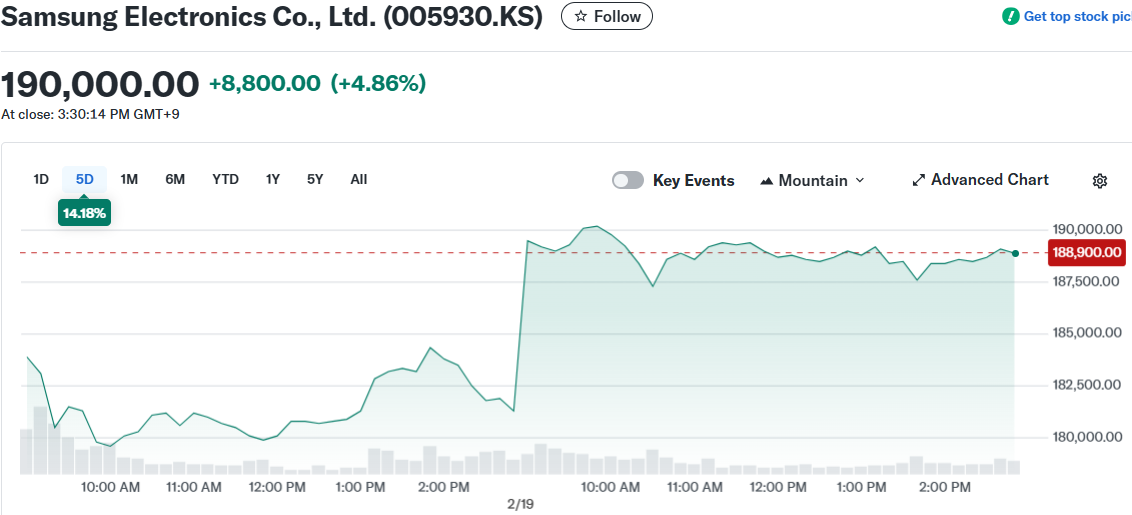
The stock climbed as much as 5.4% on the Korea Exchange to 190,900 won by mid-morning, as markets reopened after a three-day holiday.
The report came from South Korean newspaper Chosun Ilbo, which cited industry sources. Samsung declined to comment.
The $700 price point would give Samsung an operating profit margin of 50% to 60% on HBM4 chips, according to Bloomberg Intelligence analyst Masahiro Wakasugi.
That is a meaningful jump in profitability, and it signals Samsung believes it has real pricing leverage in the premium AI memory segment right now.
Samsung only started mass production of HBM4 chips last week and has already shipped commercial products to customers — a sign the ramp-up is moving quickly.
SK Hynix Could Follow Samsung’s Lead
Rival SK Hynix, which had set its HBM4 price for Nvidia in the mid-$500 range back in August, may now move to match Samsung’s higher figure, Chosun Ilbo said, citing unnamed industry sources.

SK Hynix shares also rose on Thursday, gaining 1.59% on the Korea Exchange.
If SK Hynix does raise prices to align with Samsung, it would push average selling prices higher across the HBM market more broadly.
Charu Chanana, chief investment strategist at Saxo Markets, said the report is “a sign that the AI memory market is still tight,” adding that Samsung appears to have “regained some pricing leverage at the premium end.”
Samsung’s Comeback in the AI Chip Race
Samsung had fallen behind SK Hynix in the early stages of the AI memory race, but has been steadily closing the gap.
Bloomberg Intelligence’s Wakasugi noted that the price gap between Samsung and SK Hynix could narrow in 2026 if Samsung supplies more HBM chips to Nvidia, since those prices are likely to be higher than what it charges other customers.
Nvidia itself got a lift Wednesday after Meta Platforms agreed to deploy millions of its AI processors over the next few years — a deal that keeps demand for high-end AI memory strong.
South Korea’s broader Kospi index has surged 34% this year, making it the world’s best-performing stock market, with Samsung and SK Hynix driving much of that move.
Samsung’s HBM4 mass production started last week, with commercial shipments already underway.
🚨 Our April Stock Picks Are Live!
A new month means new opportunities. Our analysts have just released their top stock picks for April, highlighting companies with strong momentum that rank highly on our KO Score algorithm. We’re also now sharing trade ideas for both long-term and short-term investors, giving you more ways to spot potential opportunities in the market.
Sign up to Knockout Stocks today and get 50% off to unlock the full list and see which stocks made the cut.
Use coupon code Special50 for your exclusive discount!
Get 3 Free Stock Ebooks
Discover top-performing stocks in AI, Crypto, and Technology with expert analysis.
- Top 10 AI Stocks - Leading AI companies
- Top 10 Crypto Stocks - Blockchain leaders
- Top 10 Tech Stocks - Tech giants



