





TLDRs;
- Sandisk benefits from sustained demand for high-margin flash memory amid AI infrastructure growth.
- AI inference growth fuels demand for Sandisk’s high-capacity, low-latency storage solutions.
- Long-term supply contracts and strong financial growth bolster Sandisk’s AI market position.
- Analysts debate Sandisk’s valuation amid strong demand and potential supply risks.
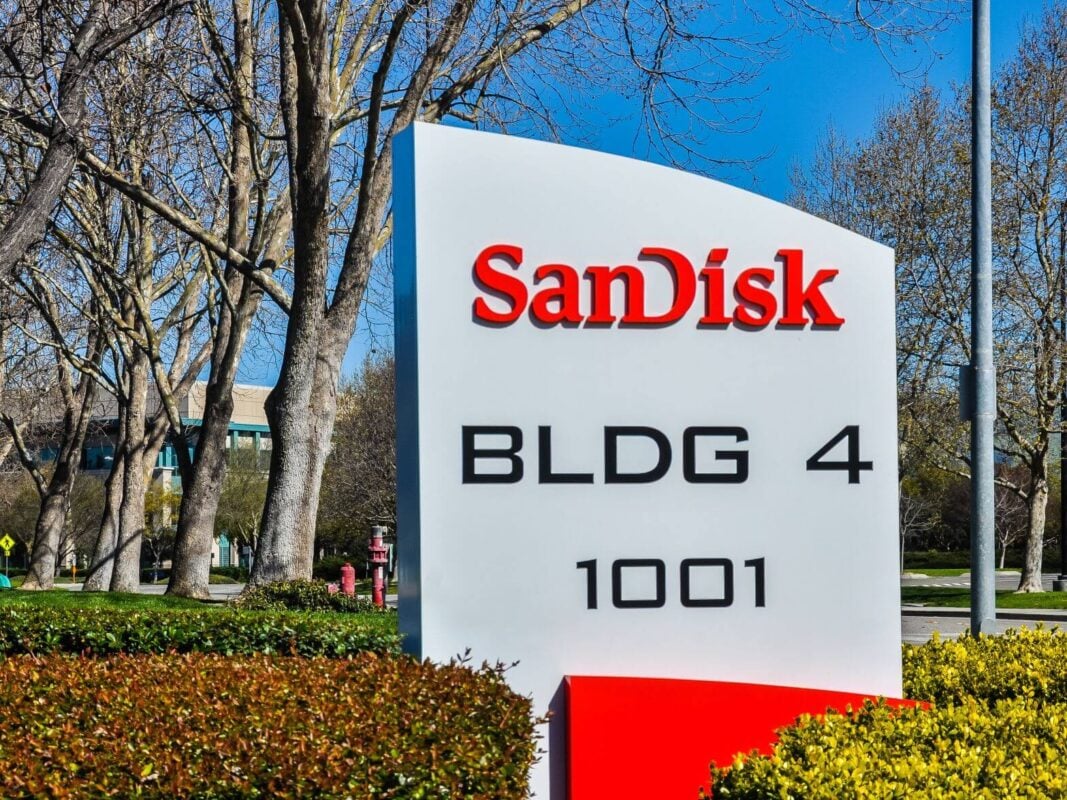
MILPITAS, Calif., March 18, 2026 – Shares of Sandisk (NASDAQ: SNDK) edged higher on Wednesday, closing at $753.69, as the company rides a wave of demand driven by inference-focused artificial intelligence (AI) workloads. Analysts point to continued strong interest in high-capacity, low-latency flash storage for data centers, even amid questions over valuation and the broader memory market cycle.
Sandisk’s recent gains follow encouraging signals from Micron and other AI memory suppliers, reinforcing investor confidence in the company’s role in supporting the fast-growing AI infrastructure market.
Flash Storage Demand Remains Strong
Investors have been closely watching the flash memory sector, particularly as AI applications move beyond graphics processing units into storage-intensive tasks. Analysts from Seeking Alpha, Simply Wall St, and Zacks highlighted that data-center flash demand remains elevated despite the stock’s sharp run-up.
The company’s margins are strong, with guidance for the upcoming quarter set at 65% to 67%, while current gross margins sit above 50%. This financial resilience underpins the market’s positive sentiment toward Sandisk’s ability to capitalize on AI-driven storage needs.
AI Inference Drives Infrastructure Expansion
The latest AI boom is centered on inference workloads, AI models processing prompts in real time, which require fast and reliable data throughput. Nvidia recently projected that AI chip revenue could reach $1 trillion by 2027, highlighting the growing scale of memory and storage needs.
Sandisk is positioned to benefit directly, as its NAND flash solutions are critical for these large-scale AI deployments. Micron’s recent earnings beat and robust outlook also signal strong tailwinds for memory suppliers catering to the AI market.

Strong Financials and Long-Term Supply Deals
Sandisk’s fiscal Q2 revenue jumped 61% year-over-year to $3.03 billion, with data-center sales up 76% to $440 million. For the upcoming quarter, management expects revenue between $4.4 billion and $4.8 billion, with non-GAAP earnings projected at $12 to $14 per share.
The company has also secured long-term flash supply agreements with Kioxia, extending through 2034. CEO David Goeckeler emphasized that AI developers prioritize supply over price, ensuring Sandisk a predictable manufacturing runway while the market for inference workloads continues to expand.
Valuation Debate Persists
Despite strong demand, valuation remains a point of debate. Some analysts, including Seeking Alpha, argue the stock still makes sense based on 2027 earnings projections. Others, like Simply Wall St, suggest fair value near $717, roughly matching the recent market price, while Zacks notes a higher forward sales multiple compared to peers.
Investors are also weighing risks, including potential supply shortages, reliance on a limited number of buyers, and geopolitical or trade policy shifts. SK Group recently highlighted the possibility of a global wafer shortage extending to 2030, underscoring ongoing market tightness.
Sandisk’s performance illustrates the broader AI memory trend: as AI inference workloads expand, companies supplying high-performance storage are experiencing robust growth. While valuation and supply challenges remain, the market appears confident in Sandisk’s ability to deliver consistent results in an increasingly AI-driven world.
🚨 Our April Stock Picks Are Live!
A new month means new opportunities. Our analysts have just released their top stock picks for April, highlighting companies with strong momentum that rank highly on our KO Score algorithm. We’re also now sharing trade ideas for both long-term and short-term investors, giving you more ways to spot potential opportunities in the market.
Sign up to Knockout Stocks today and get 50% off to unlock the full list and see which stocks made the cut.
Use coupon code Special50 for your exclusive discount!
Get 3 Free Stock Ebooks
Discover top-performing stocks in AI, Crypto, and Technology with expert analysis.
- Top 10 AI Stocks - Leading AI companies
- Top 10 Crypto Stocks - Blockchain leaders
- Top 10 Tech Stocks - Tech giants



