





TLDR
- U.S. strikes on Iran triggered market volatility, with oil prices rising and stocks initially falling Monday
- The S&P 500 and Nasdaq turned positive by midday Monday, recovering early losses
- Multiple Wall Street strategists are urging investors to “buy the dip”
- Historical data shows equities were higher 12 months later in 4 out of 5 similar geopolitical shocks since 1990
- A potential Fed rate cut could further support markets if conflict continues
The U.S. launched strikes on Iran over the weekend, sending shockwaves through financial markets on Monday. Oil prices jumped, stocks dropped, and Treasury yields edged higher as investors reacted to the news.
But the panic didn’t last long. The S&P 500 and Nasdaq Composite turned positive by midday Monday. The Dow Jones Industrial Average also climbed well off its early lows.
Nvidia posted a 2.9% gain on Monday. Apple rose 0.2%, helping lift the broader Magnificent Seven tech index by 0.4%.
The iShares Expanded Tech-Software Sector ETF had fallen nearly 35% from its September peak. It has since bounced more than 7.6% from last week’s low.
JPMorgan analyst Mislav Matejka published a note saying investors with a longer time horizon “should be using the weakness” to add exposure to risk assets. He said fundamentals remain positive.
BTIG’s chief market technician Jonathan Krinsky titled his research note “When Missiles Fly, Time to Buy.” He called the market move a tactical opportunity to buy rather than sell.
Westwood’s Adrian Helfert noted that staying invested has been the right call in every comparable geopolitical event since 1990. Across five similar shocks, equities were higher twelve months later in four out of five cases.
What History Shows About Markets and Geopolitical Shocks
Carson Group’s Ryan Detrick points to data showing the median S&P 500 gain three months after a major market shock is 2.7%. Over 12 months, it rises to 7.4%, with gains occurring 65% of the time.
After Hamas attacked Israel on October 7, 2023, global stocks rose for a full year. A year after the Iraq War began in 2003, stocks were up nearly 30%.

Ed Yardeni, a longtime market strategist, believes any spike in oil prices will be temporary. He said lower gasoline prices could boost consumer purchasing power and push inflation closer to the Fed’s 2% target.
Ivan Feinseth of Tigress Financial Intelligence said the Fed may be willing to cut rates if the conflict drags on. A rate cut would likely come sooner if Kevin Warsh is confirmed to replace Jerome Powell as Fed chair.
Key Levels to Watch for the S&P 500
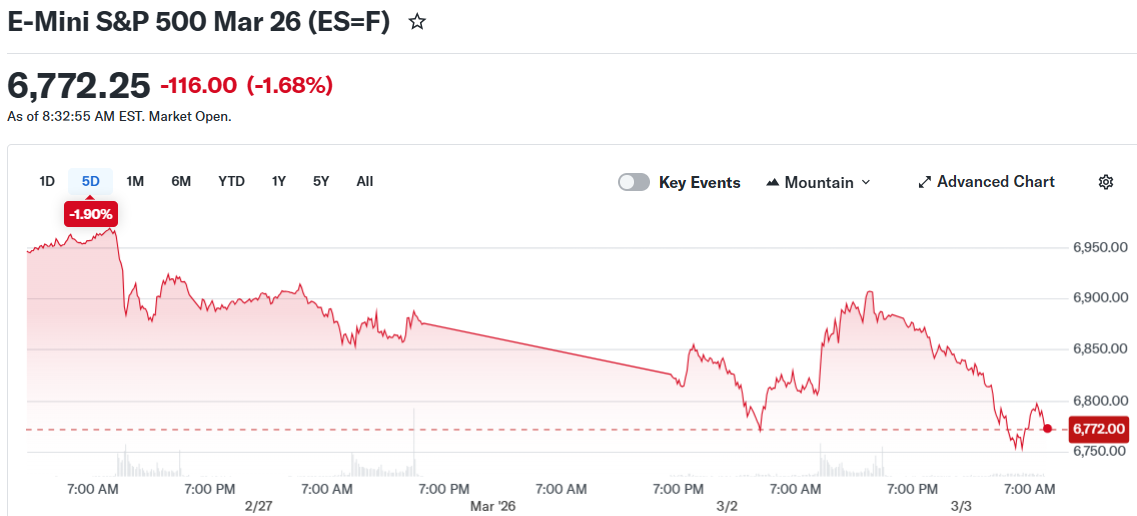
Tuesday futures pointed lower, with Dow futures down nearly 800 points. Brent crude was trading above $83 a barrel.
The VIX volatility gauge remained above 20, a level seen as a sign of broader investor caution. The S&P 500 is up just 0.5% for the year.
LPL Financial’s Adam Turnquist warned that a break below 6,775 points on the S&P 500 could trigger a retest of November lows at 6,522. That level is now closely watched by technical traders.
Considering a new stock? You may want to see what’s on our watchlist first.
Our team at Knockout Stocks follows top-performing analysts and market-moving trends to spot potential winners early. We’ve identified five stocks gaining quiet attention that could be worth watching now. Create your free account to unlock the full report and get ongoing stock insights.Get 3 Free Stock Ebooks
Discover top-performing stocks in AI, Crypto, and Technology with expert analysis.
- Top 10 AI Stocks - Leading AI companies
- Top 10 Crypto Stocks - Blockchain leaders
- Top 10 Tech Stocks - Tech giants



