






TLDR
- SK Group Chairman Chey Tae-won said the global memory chip shortage will likely last until around 2030.
- The shortage is driven by AI demand for high-bandwidth memory (HBM), which requires large amounts of wafers to produce.
- Wafer supply is currently lagging demand by more than 20% industry-wide.
- SK Hynix holds a 57% share of the HBM market and 32% of the global DRAM market.
- SK Hynix is also reviewing a potential American Depository Listing in the US.
SK Hynix Chairman Chey Tae-won made headlines on Monday after telling reporters that the global memory chip shortage could run for another four to five years. He was speaking on the sidelines of Nvidia’s GTC conference in San Jose, California.
Chey pointed to AI as the root cause. “AI actually wants to have a lot of HBM, and once you make the HBM… we have to use a lot of wafers,” he told reporters, per Reuters.
The problem is simple: wafer supply can’t keep up. Chey said the gap between supply and demand for the basic wafers used to make chips is running more than 20% across the industry. That’s not a problem that fixes itself overnight.
Building new wafer capacity takes time — Chey said at least four to five years — which puts a floor on how quickly the shortage can ease. That timeline points to around 2030 before supply and demand come back into balance.
Prices Already Climbing
The shortage isn’t just a future problem. Server memory chip prices surged between 60% and 76% in Q4 2025, according to Counterpoint Research. Prices are expected to keep rising into Q1 2026.
SK Hynix has been one of the biggest beneficiaries of that price jump. The company ranks No. 1 in the HBM market with a 57% share and sits second in global DRAM with a 32% share, per Counterpoint data.
It is also the primary HBM supplier to Nvidia, whose chips sit at the center of the AI infrastructure build-out driving demand.
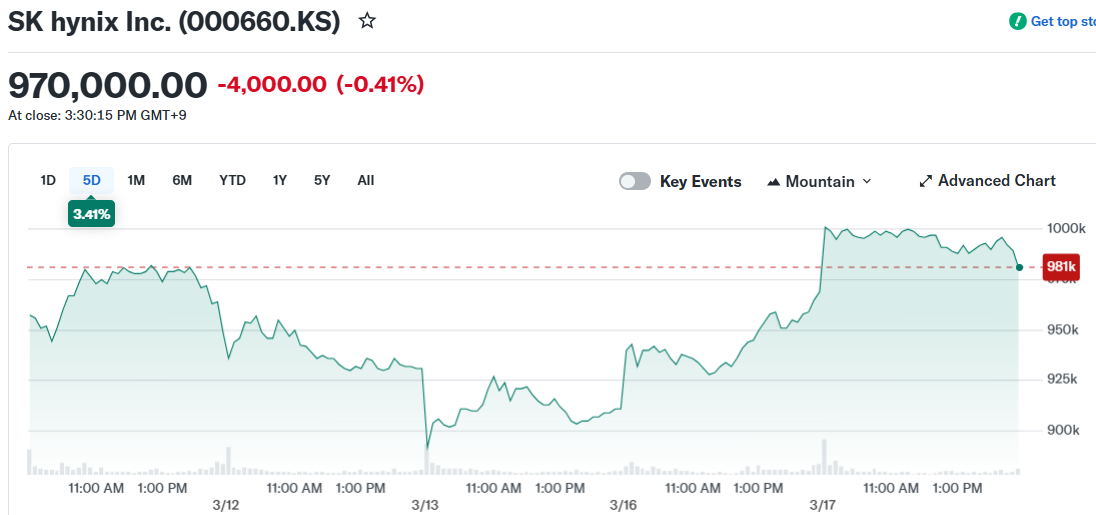
SK Hynix stock rose more than 2% on Tuesday following the chairman’s comments.

Chey also said the company would work on a strategy to help stabilize DRAM prices, though no specific plan has been announced yet.
ADR Listing Under Review
Separately, Chey confirmed that SK Hynix is reviewing a potential American Depository Receipt listing. An ADR would allow US investors to buy SK Hynix stock directly on American exchanges without going through the Korean market.
No timeline or formal decision has been announced on that front.
Samsung Electronics and US-based Micron round out the top three in global memory. Micron ranks third worldwide in memory and storage chip production, trailing Samsung and SK Hynix.
The comments from Chey come as the AI industry continues to drive unusual demand patterns across the semiconductor supply chain. SK Hynix stock is up sharply over the past three years as AI-related orders have grown.
Counterpoint data shows server memory demand has risen consistently alongside AI infrastructure spending, and there are no signs of that slowing down.
The most recent data available puts server memory price growth firmly in positive territory heading into 2026, with further increases expected as supply constraints remain in place.
🚨 Our April Stock Picks Are Live!
A new month means new opportunities. Our analysts have just released their top stock picks for April, highlighting companies with strong momentum that rank highly on our KO Score algorithm. We’re also now sharing trade ideas for both long-term and short-term investors, giving you more ways to spot potential opportunities in the market.
Sign up to Knockout Stocks today and get 50% off to unlock the full list and see which stocks made the cut.
Use coupon code Special50 for your exclusive discount!
Get 3 Free Stock Ebooks
Discover top-performing stocks in AI, Crypto, and Technology with expert analysis.
- Top 10 AI Stocks - Leading AI companies
- Top 10 Crypto Stocks - Blockchain leaders
- Top 10 Tech Stocks - Tech giants



