




The crypto market is in a critical phase, and traders are keeping an eye on whether the wave is moving to Solana or Ethereum in the coming few weeks. The Solana price follows the trend as well since SOL is approaching major levels of resistance, and Ethereum is attempting to regain the ground above $4,000. Simultaneously, many investors are expanding their perspective beyond layer one chains and monitoring PayFi platforms, such as Remittix, which has already amassed more than $ 28.8 million by selling in excess of 701 million tokens for $0.123 per token.
This pattern of price action and narrative change indicates larger crypto trends. The inflow of capital into digital assets is increasing as the market mood is optimistic, and crypto investors are considering the speed, scalability, and real-life use cases. The comparison of Solana and Ethereum can be used to identify the best opportunities in the future.

Solana Price Prediction: Technical Pressure Builds as Bulls Target $200
Source: CryptoUB
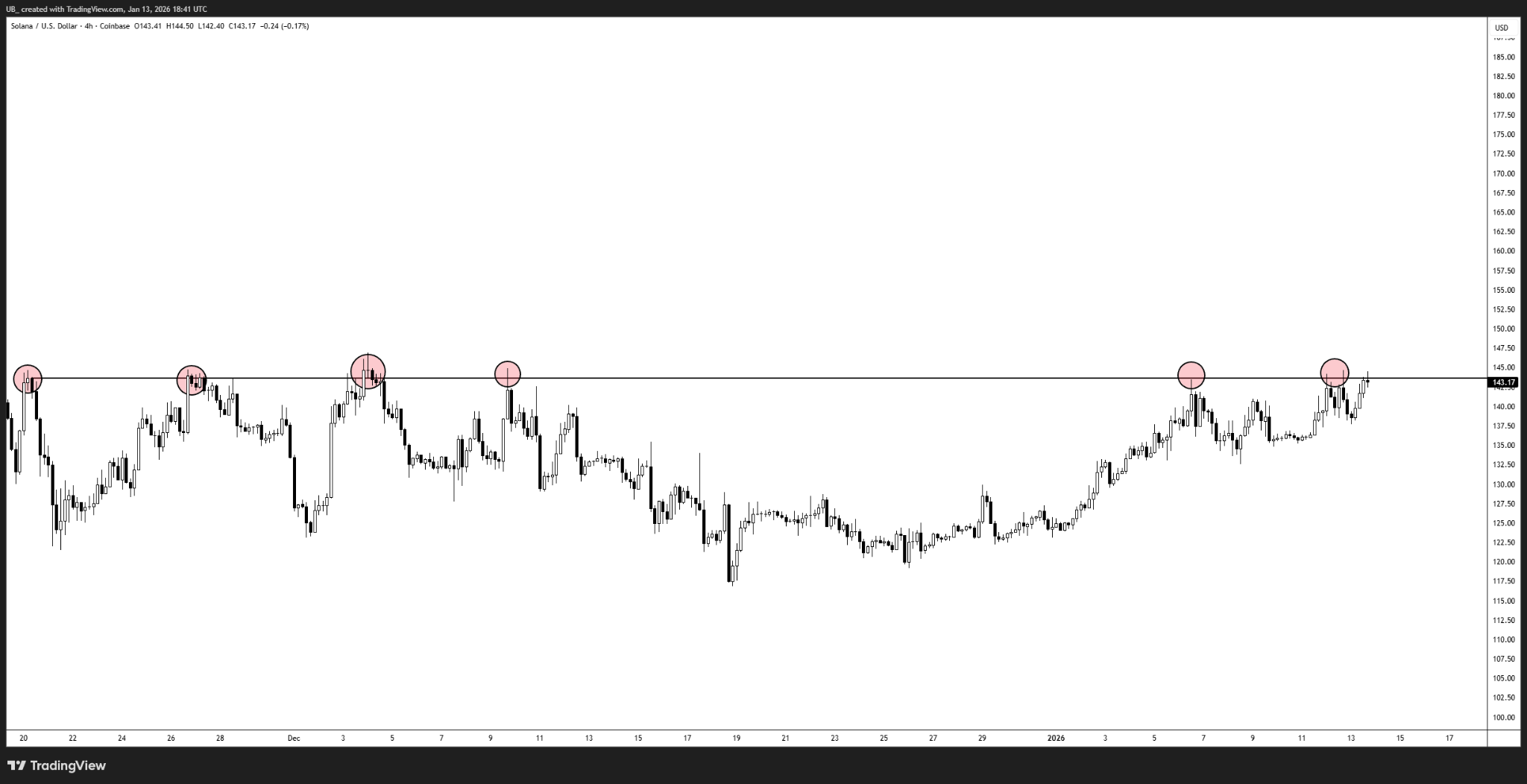
The current Solana price prediction hinges on whether SOL can break and hold above the $146 to $153 resistance zone. SOL is trading at around 144 following a gain of more than 2 percent in the day, with an impressive volume of about 7.7 billion. Momentum indicators indicate a positive but mixed picture. Its RSI of approximately 60 (bullish) is neither overbought nor underbought, and the MACD is positive. At the same time, the threat of rejection is denoted by Supertrend resistance at 153.
In the four-hour chart, Solana has been rejected on the higher Bollinger Band of 146.5. This implies that the market is turning volatile, and to hold on to an upside, there is a clear breakout that is required. Should the buyers continue to push above the 146.5, the subsequent levels to monitor are around 148 and 153. Analyst UB on X has pointed out the critical pivot zone of $141.17 as the zone that has dictated price action for months. Such a strong step would set a way to $200 and strengthen a positive Solana outlook in 2026.

The inability to maintain these levels may result in a crisis of consolidation or even a pullback to the levels of $140 or even $134. This balance of risk and reward explains why Solana price prediction discussions remain active across the crypto market. Solana continues to benefit from strong on-chain activity, fast block times, and growing decentralized applications, which support long term crypto adoption even during short term swings.
Ethereum’s Race Back to $4,000 and What It Means for SOL

Source: CryptoMich
While the spotlight is on Solana, Ethereum is quietly rebuilding strength. ETH is trading near $3,335 after forming a bullish inverted head and shoulders pattern on the weekly chart. Indicators such as RSI crossing above 50 and a flatlining PPO suggest momentum is shifting back toward buyers. If ETH holds above the right shoulder near $2,663, many analysts see a rebound toward $4,000 as likely.
Spot Ethereum ETFs are reinforcing this outlook. Recent inflows of over $129 million in a single day show renewed institutional adoption. Ethereum’s dominance in decentralized finance and real-world asset tokenization remains strong, with over $152 billion locked in DeFi and massive bridged liquidity. This advantage sets the competitive stage of any Solana price prediction, with capital tending to move in and out of these two ecosystems.
Ethereum returning to $4,000 would also help the overall crypto market, boosting altcoins and sustaining the Solana bull price forecasting situation. The question is whether SOL can front-run that move and reach $200 first.
Remittix PayFi: The Missing Link Between Crypto and Real Life

While traders argue over every new Solana price prediction and watch Ethereum fight for $4,000, Remittix is building where real demand actually comes from. This project is not chasing speed wars or meme cycles. It is solving a simple problem that millions of people face every day: moving money across borders without losing time or value. That focus is why Remittix has already raised over $28.8 million through the sale of more than 701 million tokens at $0.123 each, even before its full PayFi platform goes live.
The Remittix wallet is already live on the Apple App Store, which means users are not betting on a promise. They are using a product. People can store assets, send value, and prepare for what comes next without needing complex DeFi tools or deep crypto knowledge. This matters because real adoption does not come from traders. It comes from workers, freelancers, families, and small businesses who just want payments to work.
The biggest shift arrives on February 9, 2026, when the crypto-to-fiat PayFi platform launches. At that point, Remittix stops being just a wallet and becomes a full bridge between blockchain technology and traditional finance. Crypto can move directly into bank accounts. Payments can settle faster. Fees drop. This creates constant, real demand for the ecosystem, not short bursts of hype. That is how long-term value is built.
Why Remittix stands out as a 2026 PayFi leader
- Live wallet already being used for real transfers, not test demos
- PayFi launches in February 2026 connects crypto directly to bank accounts
- Built for everyday users like freelancers, remitters, and small businesses
- Removes the friction that keeps normal people away from crypto adoption
- Designed to create steady demand instead of relying on hype cycles
- Positioned as a payment infrastructure rather than a short-term trade
In a market full of fast chains and crowded narratives, Remittix is doing something rare. It is making crypto useful without making it complicated. That is why, as attention moves beyond Solana price prediction targets and Ethereum resistance levels, more eyes are landing on PayFi. And that is exactly where Remittix is strongest.
A Market Choosing Between Speed, Scale, and Utility
The next few months will be a test of whether these Solana price prediction models that suggest that it will hit $200 will come to fruition before Ethereum recovers $4,000. Both networks are well-built and vibrant. However, the larger trend in crypto indicates that utility-based platforms could gain traction.
To the investors, it might not be one or the other. Solana is fast and innovative, Ethereum is large and liquid, and Remittix is useful. Collectively, they are an indication of the changes in the crypto market, where speculation is giving way to actual adoption.
Discover the future of PayFi with Remittix by checking out their project here:
Website: https://remittix.io/
Socials: https://linktr.ee/remittix
FAQs
1. Why is Remittix being referred to as one of the strongest PayFi projects going into 2026?
Remittix is getting traction since it is not speculative but rather about real-world payments. The live wallet demonstrates how the product is already functioning, and this creates confidence among the users. Its PayFi introduction in February 2026 will be a bridge to bank accounts via crypto. This generates continuous demand among the regular users, such as freelancers and small enterprises. That working application provides Remittix with long-term value regardless of the hype in the market.
2. What is the difference between Remittix, Solana, and Ethereum in the crypto market?
The rivalry between Solana and Ethereum deals with speed, scale, and smart contract ecosystems, whereas Remittix deals with the reality of sending and receiving money. It is a transitional point between blockchain technology and old-fashioned finance, and therefore, this makes Remittix something that can be adopted by non-technical people. They have a complementary role in the adoption of crypto together.
3. Is Remittix dependent on market cycles as meme coins are?
No, Remittix is not built around hype or short-term price cycles. Its demand comes from real payment activity rather than social trends. People still move money even during slow crypto markets, and that gives Remittix a more stable growth path than meme coins. This is why many see it as a utility-driven digital asset for 2026.


