






The UK House of Lords has kicked off a formal review of stablecoin regulation as the Bank of England works toward final rules by the end of 2026. Meanwhile, Citrea launched its Bitcoin ZK-rollup mainnet with BTC-backed lending and a new dollar stablecoin, reopening debate around how Bitcoin block space should be used. And on the enforcement side, the SEC quietly closed its civil case against Gemini, ending the long-running Earn dispute after users were fully repaid.
It seems as though the market is heading away from disorder and toward structure. If you have your eye on the Solana price prediction and other altcoin setups, it’s worth considering how a shift like that will land up putting utility-driven tokens at the helm.
DeepSnitch AI is almost certainly one of them, and this token has sincere 1000x potential before Q1 is through. The presale has raised $1.4M at $0.03755, up almost 150% in price, and its five AI agents have been developed by expert on-chain analysts who know what retail needs to succeed in crypto like few others. Its launch is coming up, and after that, its powerful utility could take it far in no time at all, so buying in early is the thing to do.

UK probes stablecoin rules as Bitcoin rollup launches
The UK House of Lords Financial Services Regulation Committee launched an inquiry into proposed stablecoin rules, seeking public input on plans from the Bank of England and Financial Conduct Authority. The review will assess how stablecoins could affect traditional financial services like banking and payments.
Bank of England executive director Sasha Mills confirmed the central bank is working jointly with the FCA on a regime for systemic stablecoins, aiming to finalize the framework by the end of 2026. The proposed regime would provide systemic stablecoins with a deposit account at the Bank of England while considering a liquidity facility as a backstop.
Citrea, meanwhile, has gone with a different approach, launching its mainnet with BTC collateral lending, BTC-structured products, and ctUSD, a US dollar stablecoin issued by MoonPay and backed by cash and short-term US Treasurys. The team expects active DeFi liquidity to reach $50 million in the first few weeks.

Bitcoin core developer Jameson Lopp called the rollout the next grand experiment in generating sustainable demand for Bitcoin block space.
This convergence of regulators building frameworks for stablecoins while Bitcoin infrastructure expands is where platforms offering transparency and utility can thrive.
Altcoins with momentum in 2026
1. DeepSnitch AI: Full intelligence layer operational before launch
Most traders only realize a token was unsafe after liquidity vanishes, and DeepSnitch AI is here to prevent that from happening with utility that’s truly unmatched. Its five-agent system has been developed by expert on-chain analysts, and together, its tools continuously monitors whale behavior, social velocity, contract structure, and holder dynamics, then flags risks while there’s still time to decide rationally.
Launch is coming up, but tools have shipped internally already. SnitchGPT is live and answering holder queries, Token Explorer maps liquidity and concentration visually, and AuditSnitch now delivers blunt verdicts on contracts before users touch them.
These tools are already in the hands of early holders, sharpening their execution ahead of anyone who hasn’t yet bought in. And for that very reason, the platform’s credibility is impossible to deny. Its utility is proving itself in real time.
With dynamic, uncapped staking APR active and DSNT priced low still, at $0.03755, this is a token that could explode massively once it launches. While big caps need billions to move, early-stage platforms don’t, and DeepSnitch AI’s pre-launch moment is the last big opportunity to ensure an edge ahead of a 1000x run.
2. Solana price prediction faces validator pressure despite network strength
Solana price prediction models are getting complicated by validator economics. SOL is at $118.58 as of late January, extending a nearly 7% weekly decline.
The drop has coincided with a broader market selloff, as Bitcoin hit a two-month low while Microsoft shares plunged roughly 11% after earnings, souring risk appetite. Over $800 million in leveraged crypto positions were liquidated in 24 hours, so the downward spiral was intense.
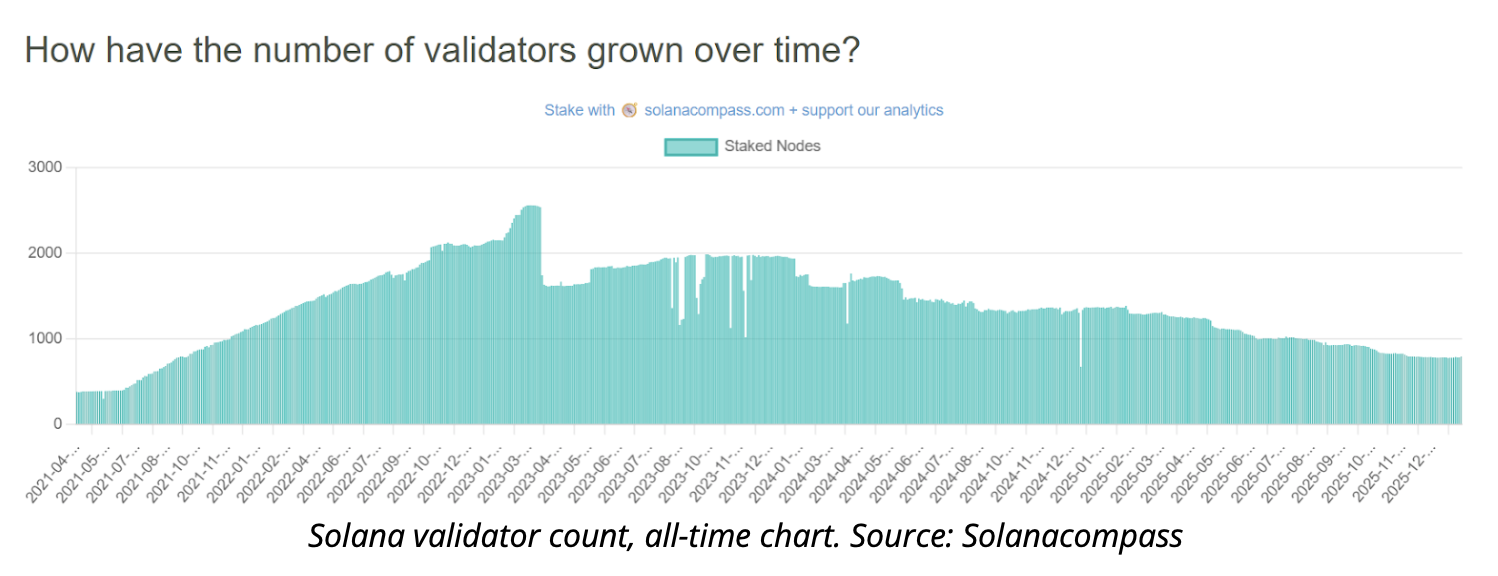
Under the price action, Solana’s validator count dropped 68% from its 2023 peak as rising operational costs and zero-fee competition squeezed smaller operators offline. This raises decentralization concerns even as the network processes transactions efficiently.
For Solana ecosystem updates and SOL network growth, the validator economics matter long-term. But even so, if you want more explosive upside, smaller-cap projects like DeepSnitch AI have infinitely more potential to rake in the big gains at a lower market cap.
3. Sui targets $3.36 by year-end despite recent drop
Sui’s been powering through a correction, but its long-term setup isn’t looking too shabby. On 29 January, it’s at $1.32, having dropped nearly 6% in the last da,y while forecasts point to a 153% upward climb ($3.36 by the end of 2026).
Sui’s parallel execution model and Move programming language position it for gaming and DeFi adoption, but the token is still battling broader market weakness.
Why DeepSnitch AI could outpace altcoins in this cycle
Clearer UK stablecoin rules and new Bitcoin rollup infrastructure point to a market settling into something more structured, where regulation and engineering are finally moving in the same direction. Platforms that already work, rather than promises still on the whiteboard, are the ones with the sharpest edge right now. And if you’re among those already tracking the Solana price prediction, then looking to this kind of asymmetric setup is a powerful alternative amid tightening conditions.
And DeepSnitch AI has all that and more, with live tools running and presale pricing at $0.03755, leaving plenty of room for demand to show up without needing Ethereum-scale inflows. It’s a rare token, with serious 1000x potential, and with launch just days away, it’s also offering bonus codes for the last early buyers to get involved in its potentially enormous returns.
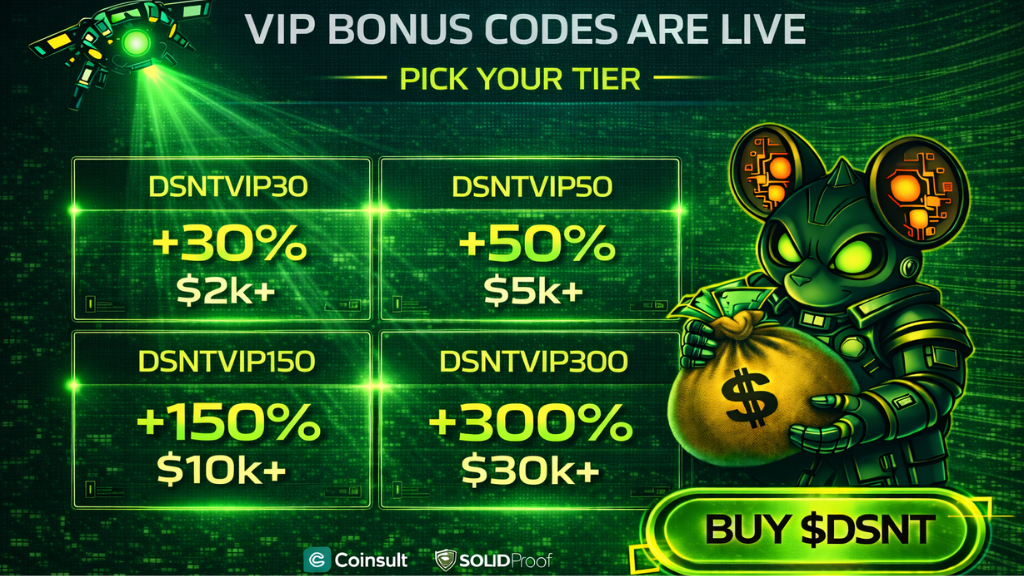
A $30,000 buy normally lands around 800,000 DSNT, but the 300% bonus code DSNTVIP300 boosts that to roughly 3.2 million tokens. Should it reach only $5, that will push to $16 million, just to put that in perspective. And all bonuses stack with dynamic staking APR.
Visit the official website to lock in your position, and keep up with X and Telegram for major news and updates.
FAQs
How does the Solana price prediction compare to DeepSnitch AI’s potential?
According to Solana price predictions, the token trades near $119 with a multi-billion valuation, meaning it needs heavy capital to bring in big gains, and that capital isn’t going to appear out of thin air. DeepSnitch AI enters at $0.03755, where smaller demand can still drive outsized returns, and it has the utility to ensure a major run post-launch.
What makes DeepSnitch AI better positioned than Solana ecosystem updates?
DeepSnitch AI already runs SnitchGPT, Token Explorer, and staking during presale, while Solana’s network growth wrestles with validator concentration. Along with any SOL network growth, these are factors worth weighing up alongside any Solana price prediction.
Are Solana adoption news developments bullish for altcoins?
Established networks need much bigger inflows to see steep returns, but DeepSnitch AI can reprice faster on lighter demand thanks to presale entry and a smaller cap.


