






TLDR
- US stocks fell Tuesday, with the Dow and S&P 500 each down around 0.5%, as mixed signals from the Iran conflict unsettled markets.
- Trump hinted the war could end “very soon,” but Defense Secretary Hegseth said the US would “not relent” until Iran is defeated.
- An oil tanker exploded near Abu Dhabi, and a major UAE refinery halted operations after a drone strike.
- Brent crude eased to around $91 a barrel after nearing $120 on Monday, but remains over 50% higher than at the start of the year.
- Two key US inflation reports — CPI on Wednesday and PCE on Friday — are due this week, though neither will reflect the recent oil price spike.
US stocks dropped Tuesday morning as investors tried to make sense of conflicting messages coming from Washington and the battlefield in Iran. The mixed signals made it hard to gauge how long the conflict will last and what it means for oil prices and the broader economy.
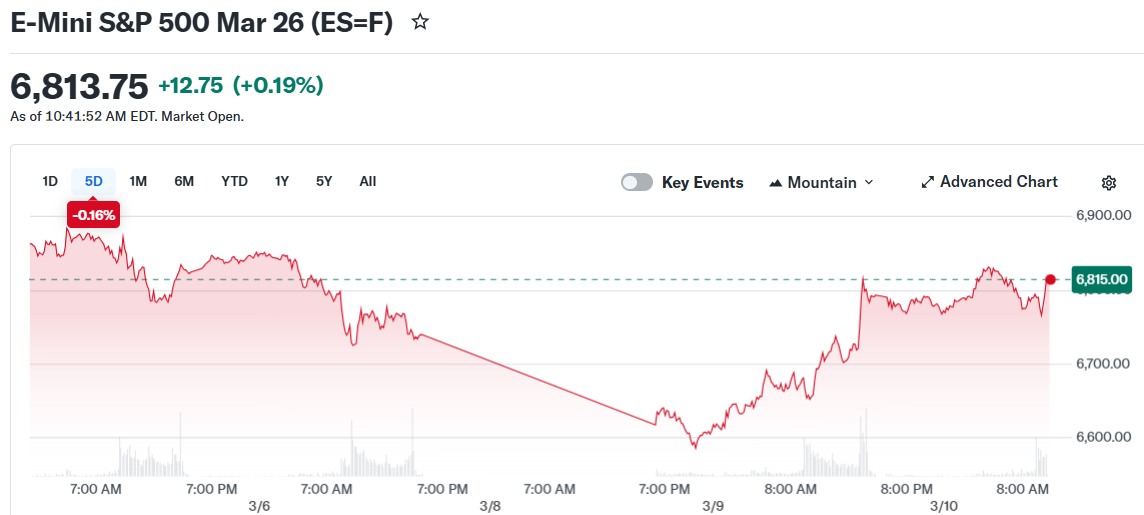
The Dow Jones Industrial Average and S&P 500 each fell about 0.5%. The Nasdaq Composite was down roughly 0.3%. This followed a turbulent Monday session that ended with modest gains.
The market mood worsened after Iran state media reported an oil tanker explosion near Abu Dhabi. That news cast doubt on earlier optimism from President Trump, who said the conflict could end “very soon.”
BREAKING: Iranian officials have "ruled out" any plans for a ceasefire or negotiations with Israel and the US, per FT.
Details include:
1. The statement comes as Israel's Prime Minister Netanyahu said they are "not done yet"
2. US Defense Secretary Hegseth said today would be…
— The Kobeissi Letter (@KobeissiLetter) March 10, 2026
Trump told Republican lawmakers the US had hit 5,000 targets in Iran, cutting the country’s missile capability to about a tenth of what it was. He described the military objectives as “pretty well complete.”
But Defense Secretary Pete Hegseth struck a different tone at a Tuesday press conference. He said the US was carrying out its “most intense” day of strikes on Iran and would “not relent” until the Islamic Republic is defeated.
Oil Prices and Global Supply Under Pressure
Israeli Prime Minister Benjamin Netanyahu said the offensive was “not done yet” and launched a new wave of strikes on Tehran on Tuesday. Iran responded with drone and missile attacks across the Middle East, including strikes that affected the UAE, Bahrain, and Kuwait.

The biggest oil refinery in the UAE, located at Ruwais, halted operations after a drone strike caused a fire nearby. Abu Dhabi National Oil Co. was assessing damage at the site.
Brent crude had climbed to nearly $120 a barrel early Monday before easing to around $91 after Trump’s comments. West Texas Intermediate traded near $89. Both remain more than 50% above their levels at the start of the year.
Saudi Arabia, Iraq, the UAE, and Kuwait have cut their combined output by up to 6.7 million barrels per day — about 6% of global supply. Saudi Aramco’s CEO called the disruption “the biggest crisis the region’s oil and gas industry has faced.”
Trump said the US Navy would escort tankers through the Strait of Hormuz to keep oil flowing. He also said he could waive certain oil-related sanctions to help bring prices down, though he gave no details.
Iran’s New Leadership and Path Forward
Iran chose Mojtaba Khamenei as its new supreme leader on Sunday. His father, Ali Khamenei, was killed when US-Israeli strikes began on February 28. The younger Khamenei has strong ties to the Islamic Revolutionary Guard Corps.
Iranian President Pezeshkian said Iran was open to scaling back the conflict, but only if neighboring countries stop allowing their territory to be used for attacks on Iran. Iran’s foreign minister said talks with the US were not “on our agenda.”
The conflict has now lasted 11 days. More than 1,300 Iranians have been killed, along with seven US service members, two Israeli soldiers, and several others in Gulf countries.
Two major US inflation reports are due this week — CPI on Wednesday and PCE on Friday — but neither will capture the recent jump in oil prices.
Considering a new stock? You may want to see what’s on our watchlist first.
Our team at Knockout Stocks follows top-performing analysts and market-moving trends to spot potential winners early. We’ve identified five stocks gaining quiet attention that could be worth watching now. Create your free account to unlock the full report and get ongoing stock insights.Get 3 Free Stock Ebooks
Discover top-performing stocks in AI, Crypto, and Technology with expert analysis.
- Top 10 AI Stocks - Leading AI companies
- Top 10 Crypto Stocks - Blockchain leaders
- Top 10 Tech Stocks - Tech giants



