






TLDR
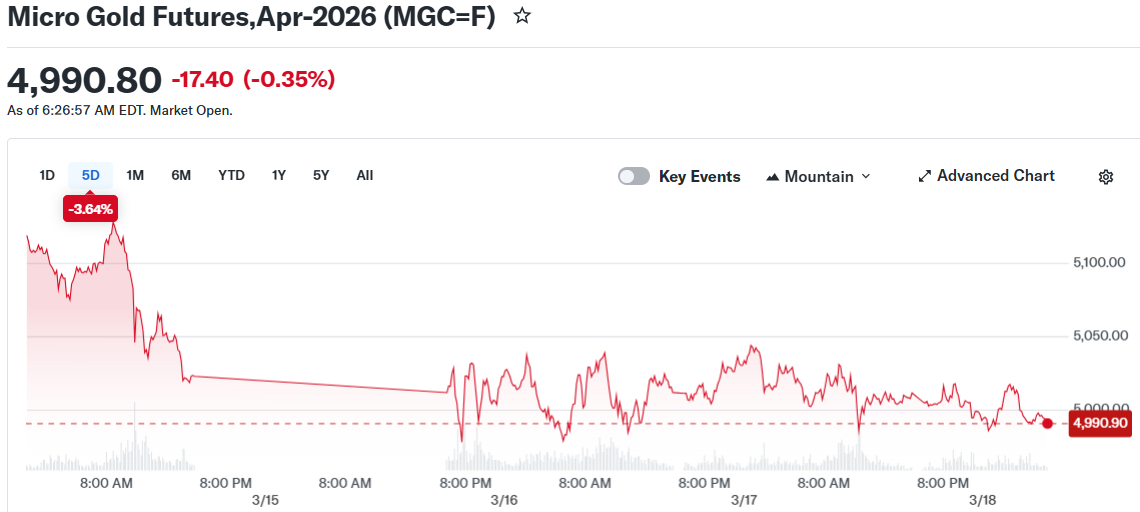
- Gold is trading near $5,000 an ounce, up 18% year-to-date, after hitting a four-week low of $4,967 on March 16
- The Federal Reserve is expected to hold rates at 3.50–3.75% today, with markets pricing a 99.2% probability of no change
- Gold surged to $5,423 on February 28 after U.S. and Israeli strikes on Iran, but gave back most gains within days due to dollar strength and rising rate expectations
- Iran has launched missile and drone attacks on UAE, Saudi Arabia, and Kuwait; shipping through the Strait of Hormuz remains nearly halted
- Banks including J.P. Morgan and Deutsche Bank have year-end 2026 gold targets of $6,300 and $6,000 respectively
Gold is hovering near $5,000 an ounce as investors wait for the Federal Reserve’s rate decision and press conference later today. The outcome of that meeting — not the rate itself — is what traders say will move the price.
The Fed is widely expected to hold rates steady at 3.50–3.75%. CME FedWatch puts the probability at 99.2%. What matters more is what Fed Chair Jerome Powell says about inflation, the labor market, and the path of future cuts.
Gold hit a high of $5,423 on February 28 after U.S. and Israeli forces struck Iranian targets. That rally lasted about three days before fading. By March 16, spot gold had dropped to $4,967, a four-week low.
Two forces have been pushing gold lower since that spike. First, the U.S. dollar strengthened as investors sought safe-haven assets, making gold more expensive for buyers using other currencies. Second, rising oil prices — Brent crude stayed above $100 per barrel — pushed inflation expectations higher, reducing the likelihood of near-term rate cuts.
How the Middle East Conflict Is Affecting Markets
The conflict has kept energy markets under pressure. Iraq signed a deal to resume oil exports via Turkey, easing some supply concerns and sending oil lower on Wednesday. But shipping through the Strait of Hormuz remains nearly halted.
Iran confirmed the death of national security chief Ali Larijani following overnight strikes. Tehran then launched fresh missile and drone attacks targeting the UAE, Saudi Arabia, and Kuwait.
The energy crunch has pushed inflation expectations up at a time when the Fed’s preferred gauge, core PCE, was already running at 3.1% in January. March and April CPI data — which would show how much of the oil shock has passed through — have not yet been published.

What the Fed Could Signal for Gold
Markets currently price just one rate cut in 2026, expected in December. At the start of the year, multiple cuts were expected.
The Fed’s dot plot, released at 2:00 p.m. ET today, will show where policymakers see rates heading. If the median dot shows zero or one cut, that would tighten rate expectations further and weigh on gold. Two or more cuts would ease that pressure.
Powell’s press conference starts at 2:30 p.m. ET. It is his second-to-last before his term ends in May.
Gold’s technical picture shows the $4,996 support level has held on a closing basis since mid-March. The RSI sits at roughly 47, neutral territory. The next key resistance is at $5,053.
Central banks have bought close to 1,000 tons of gold annually since 2022. J.P. Morgan has a year-end 2026 target of $6,300. Deutsche Bank’s target is $6,000.
Spot gold was at $5,012.29 as of early Wednesday afternoon in Singapore. Silver gained 0.6% to $79.75. The next major data point after today’s Fed decision is the March CPI release on April 10.
🚨 Our April Stock Picks Are Live!
A new month means new opportunities. Our analysts have just released their top stock picks for April, highlighting companies with strong momentum that rank highly on our KO Score algorithm. We’re also now sharing trade ideas for both long-term and short-term investors, giving you more ways to spot potential opportunities in the market.
Sign up to Knockout Stocks today and get 50% off to unlock the full list and see which stocks made the cut.
Use coupon code Special50 for your exclusive discount!
Get 3 Free Stock Ebooks
Discover top-performing stocks in AI, Crypto, and Technology with expert analysis.
- Top 10 AI Stocks - Leading AI companies
- Top 10 Crypto Stocks - Blockchain leaders
- Top 10 Tech Stocks - Tech giants



