





TLDR
- The 10-year U.S. Treasury yield rose to around 4.54%, near its highest level in a year, driven by surging oil prices.
- Brent crude futures climbed above $108 per barrel, on track for a 6.7% weekly gain, as Middle East tensions persist.
- Global stocks fell sharply, with Europe’s STOXX 600 down 1.37% and Asia-Pacific shares dropping over 2.5%.
- Traders now see a roughly 50% chance U.S. interest rates will end the year higher than current levels, up from 14% a week ago.
- The U.S. dollar posted its strongest weekly gain in two months, while sterling hit a five-week low amid a UK political crisis.
Global stock markets fell on Friday as rising oil prices sparked fresh inflation concerns, pushing bond yields higher and resetting expectations around interest rates. Investors who had spent the week buying up equities — including a 4% surge in Nvidia — shifted their focus back to macro risks.
The STOXX 600 in Europe dropped 1.37%. MSCI’s Asia-Pacific index outside Japan fell 2.54%, and Japan’s Nikkei lost nearly 2% after data showed the country’s wholesale inflation hit 4.9% in April — the fastest pace in three years.
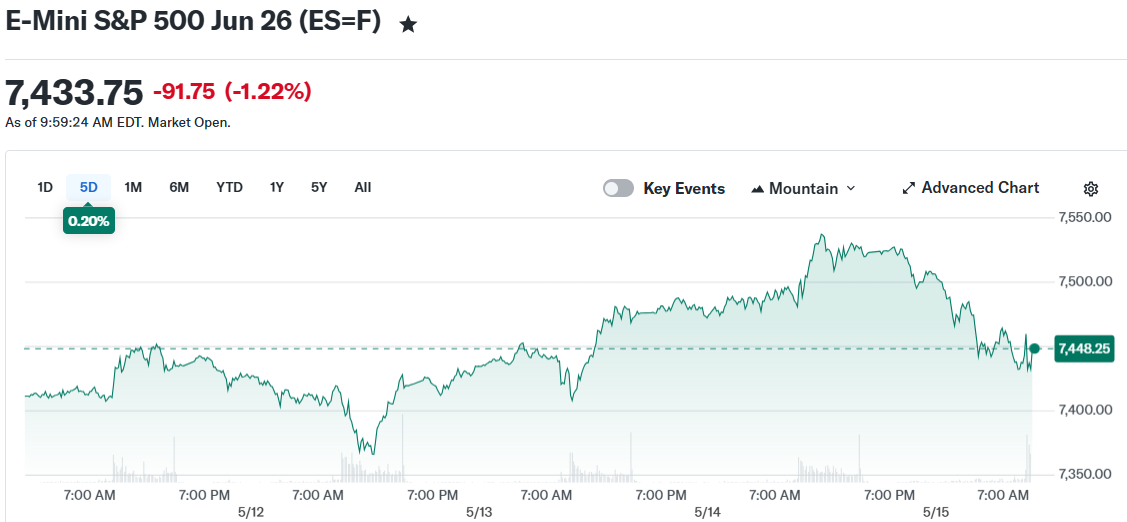
In the U.S., Nasdaq futures fell 1.32% and S&P 500 futures slipped around 0.9%.
Bond Yields Climb on Inflation Fears
At the center of the market turmoil is a rise in oil prices tied to the ongoing war in Iran, which began in late February. Brent crude futures climbed to over $108 per barrel on Friday, putting the commodity on track for a weekly gain of 6.7%.
The 10-year U.S. Treasury yield topped 4.54%, near its highest point since May of last year. The two-year note also climbed, rising to around 4.05%.
The Bank of Japan reported producer prices rose 4.9% year-over-year in April, driven largely by oil and petroleum products. Japanese bond yields hit record highs in the session.
German 10-year bond yields — the eurozone’s benchmark — rose over 7 basis points to around 3.12%.

Investors Reprice Rate Expectations
The shift in oil prices has directly affected how traders see monetary policy playing out for the rest of the year. According to CME Group data, investors now see about a 50% chance that U.S. rates will be higher at year-end than they are now. Just a week ago, that figure stood at roughly 14%.
Analysts at ING said the central issue is inflation that has already been delivered into the system. The firm said it expects bond yields to be tested higher in the weeks ahead.
“I think if anything is enough to create a pullback, it is what’s happening in rate markets,” said Tim Graf of State Street Markets.
President Trump concluded a state visit to Beijing on Friday. After meeting Chinese President Xi Jinping, Trump said both leaders want the Iran war to end and agree Iran must not be allowed to develop a nuclear weapon. However, the summit yielded no concrete steps toward ending the conflict.
The dollar rose for a fourth day, heading for a 1.4% weekly gain — its best in two months. The yen weakened past 158 per dollar. Sterling fell to a five-week low at $1.3360, after UK health minister Wes Streeting resigned, deepening the country’s political uncertainty.
UK gilt yields also climbed as traders speculated about a potential leadership challenge to Prime Minister Keir Starmer.
Stop guessing and start investing with confidence. KnockoutStocks gives you the AI insights, market intelligence, and stock research you need to spot opportunities, cut through the noise, and make smarter investment decisions — all in one powerful platform.
Sign up today and get 50% OFF full access to our premium stock picks.
Simply use coupon code SPECIAL50 at checkout to claim your exclusive discount.
Get 3 Free Stock Ebooks
Discover top-performing stocks in AI, Crypto, and Technology with expert analysis.
- Top 10 AI Stocks - Leading AI companies
- Top 10 Crypto Stocks - Blockchain leaders
- Top 10 Tech Stocks - Tech giants



