






TLDR
- Bitcoin is down ~26% over the past year despite a more crypto-friendly U.S. policy environment and spot ETF launches
- Adam Back, cited in Bitcoin’s original 2008 white paper, says the drop fits the historical four-year market cycle
- Gold and silver have rallied while Bitcoin has struggled, with capital flowing into traditional safe havens
- ETF holders are considered “stickier” investors than retail traders, who often run out of capital during downturns
- Blockstream could acquire up to 21,000 BTC (~$800M), with a possible 13,000 BTC purchase being speculated
Adam Back, one of the earliest figures in Bitcoin’s history and the CEO of Blockstream, says the current price decline is nothing new. He made the comments at the iConnections conference in Miami Beach on Tuesday.
🚨 LATEST: Blockstream CEO Adam Back has issued a "Macro Sensitivity Report," characterizing the recent Bitcoin decline as a transient, short-term phenomenon.
“In the short term bitcoin falls along, in the long term it’s de-correlated.” pic.twitter.com/xBycXGsT2i
— Nathan Jeffay (@NathanOnCrypto) February 24, 2026
Back was cited in the original Bitcoin white paper written by Satoshi Nakamoto in 2008. He now runs Blockstream and the Bitcoin Standard Treasury Company, known by the ticker BSTR.
Bitcoin has fallen roughly 26% over the past year. This happened even as the U.S. government became more friendly toward crypto and spot Bitcoin ETFs launched for investors.
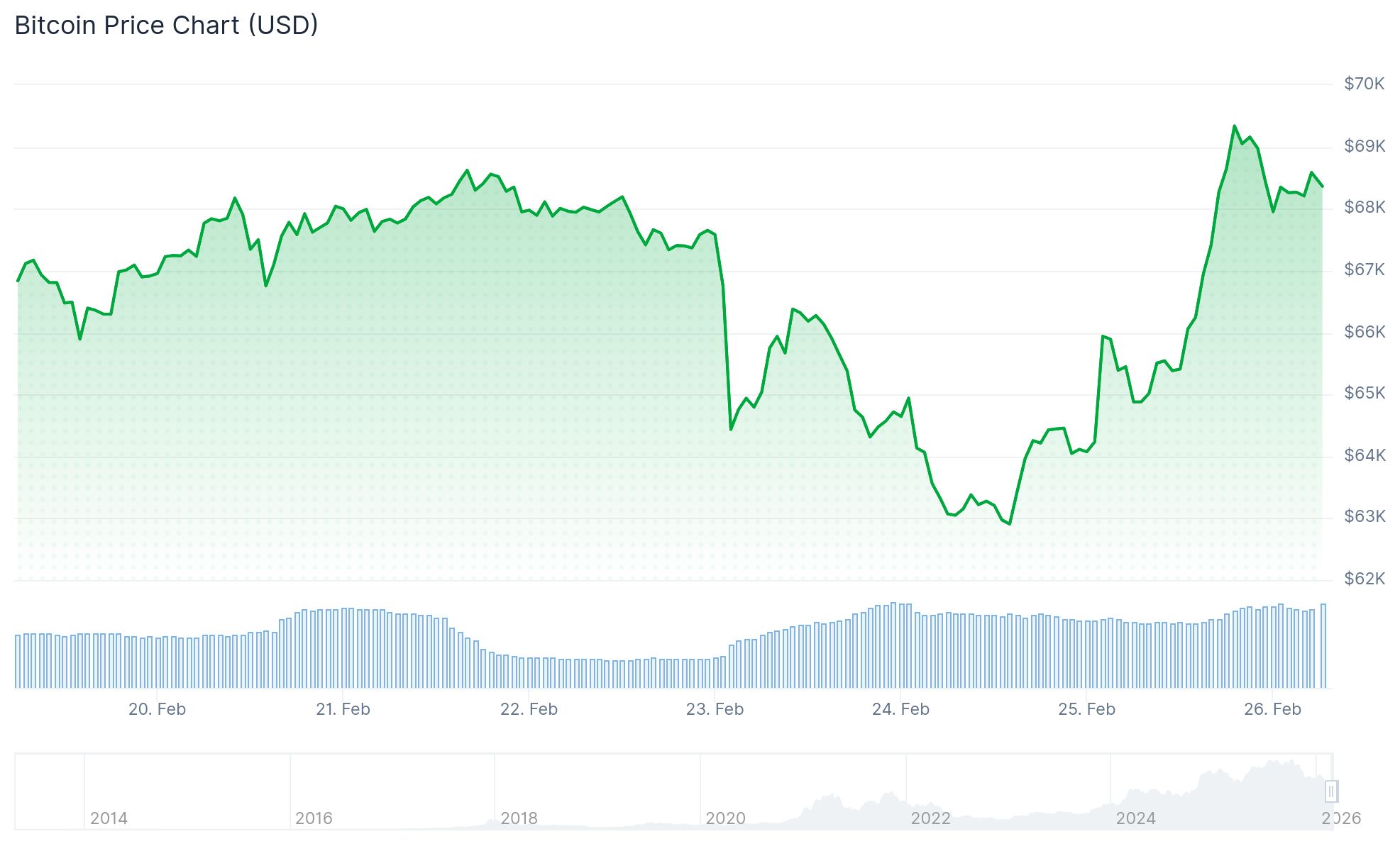
Back said this is consistent with past four-year market cycles. He pointed out that price drops at this stage of the cycle have happened before.
“Bitcoin is generally volatile,” Back said. “In the previous four-year market cycles, this has been about a time in a cycle where price runs lower.”
He suggested some traders may be following that historical pattern rather than reacting to news or fundamentals.
Meanwhile, gold has climbed to all-time highs and silver has hit multi-year peaks. Investors looking for protection from inflation and geopolitical risk appear to have moved into metals instead of digital assets.

Bitcoin was expected to benefit from those same conditions. Its core case is built on scarcity and acting as a hedge against currency weakness. But so far in this cycle, that case has not played out in price terms.
ETF Holders vs. Retail Traders
Back drew a line between retail and institutional Bitcoin holders. He said retail investors often put in most of their money during price rallies and have little left to buy during dips.
ETF holders, by contrast, are more stable. “The ETF holders are more sticky investors than the retail bitcoin exchange traders,” he said. Institutions can rebalance across different assets.
Still, Back was clear that institutional money is still in early stages. “I think there isn’t that much institutional capital yet,” he said.
Bitcoin Compared to Early Amazon Stock
Back compared Bitcoin’s current phase to early Amazon stock, which also had large price swings before stabilizing. He said rapid adoption naturally brings volatility with it.
He believes that as more institutions, companies, and governments buy Bitcoin, the swings will get smaller. He expects it could eventually trade more like gold.
Back also said Bitcoin’s market cap is roughly 10 to 15 times smaller than gold’s today. He sees that gap as room for growth if Bitcoin continues to be used as a store of value.
On the corporate side, Back’s firm Blockstream has hinted at a large Bitcoin purchase. Reports suggest Blockstream could acquire up to 21,000 BTC, with speculation around a 13,000 BTC buy worth roughly $800 million.


