






TLDR
- Gold dropped nearly 5% Tuesday then rebounded up to 2% Wednesday as dip-buyers returned
- A stronger US dollar, up ~1.5% this week, is capping gold’s recovery
- The US-Iran conflict is driving safe-haven demand but also pushing oil prices higher
- Rising oil prices are stoking inflation fears, reducing expectations for Fed rate cuts
- Traders now price in 80% odds of more than one rate cut this year, down from two cuts priced in last Friday
Gold prices fell sharply Tuesday then bounced back Wednesday morning as investors weighed safe-haven demand against a stronger US dollar.
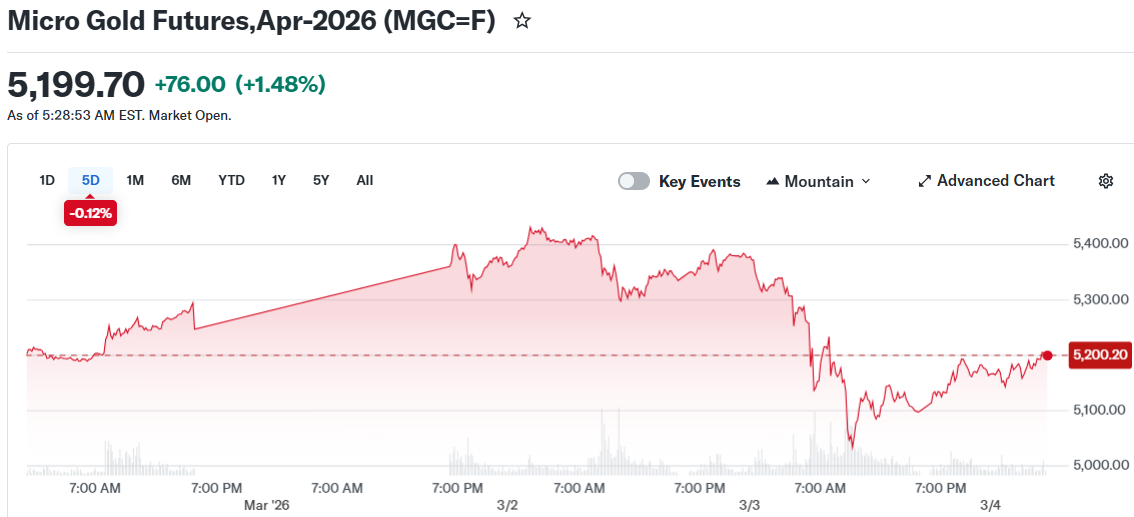
Spot gold rose 1.6% to $5,171.89 an ounce by late morning in London. That came after a 4.5% drop the previous session, one of the steeper single-day falls in recent months.
The metal hit an all-time high above $5,595 an ounce in late January. It has gained nearly 20% so far this year.
Tuesday’s selloff was driven by a surge in the US Dollar Index, which jumped nearly 1.5% over two days to reach six-week highs. A stronger dollar makes gold more expensive for buyers using other currencies.
Some investors also had to sell gold to cover losses in other parts of their portfolios, adding to the pressure.
Silver dropped more than 8% Tuesday before recovering 4.1% to $85.38 on Wednesday. Platinum fell 10% then climbed 2.8% to $2,148.50 an ounce.
Iran Conflict Drives Safe-Haven Demand
The US-Israeli war on Iran is now in its fifth day. Israel struck Tehran again Tuesday and hit a building in Qom where clerics were meeting to choose a successor to Supreme Leader Ayatollah Ali Khamenei, according to Israel’s Kan News. Iran’s semi-official Mehr news agency confirmed the building was hit but said it was not in use at the time.

The conflict has rattled global markets and is keeping investors on edge. Fears about broader regional instability are growing as Iran has issued retaliatory threats following US strikes on Iranian-linked targets.
Traffic through the Strait of Hormuz, through which around one-fifth of global oil and gas passes, has nearly halted. President Trump said the US will provide naval escorts and insurance for oil tankers through the waterway, though the shipping industry called it only a partial fix.
Rising Oil Prices Complicate Rate Cut Expectations
Higher oil prices are pushing inflation expectations up. That is making central banks, including the Federal Reserve, less likely to cut rates soon.
Traders have now priced in 80% odds of more than one quarter-point Fed rate cut this year. As recently as last Friday, markets were fully pricing in two cuts.
Higher interest rates are a headwind for gold because the metal pays no interest.
Money managers’ net long positions in gold have fallen since late January to near their lowest level in a decade, according to CFTC data. Analysts say this low positioning could limit how far gold falls from here.
In China, official PMI data showed factory activity in contraction, while a private survey showed above-expectation expansion, pointing to mixed signals in the world’s second-largest economy.
Stop guessing and start investing with confidence. KnockoutStocks gives you the AI insights, market intelligence, and stock research you need to spot opportunities, cut through the noise, and make smarter investment decisions — all in one powerful platform.
Sign up today and get 50% OFF full access to our premium stock picks.
Simply use coupon code SPECIAL50 at checkout to claim your exclusive discount.
Get 3 Free Stock Ebooks
Discover top-performing stocks in AI, Crypto, and Technology with expert analysis.
- Top 10 AI Stocks - Leading AI companies
- Top 10 Crypto Stocks - Blockchain leaders
- Top 10 Tech Stocks - Tech giants



