






TLDR
- European natural gas prices fell 9.5% on Wednesday after Iran signaled it was ready for peace talks with the U.S.
- Prices had surged 54% this week after U.S. and Israeli strikes on Iran disrupted the Strait of Hormuz shipping lane.
- Qatar halted LNG production at two facilities following Iranian drone attacks, tightening global supply.
- U.S. LNG stocks Cheniere Energy and Venture Global fell in premarket trading on the price drop.
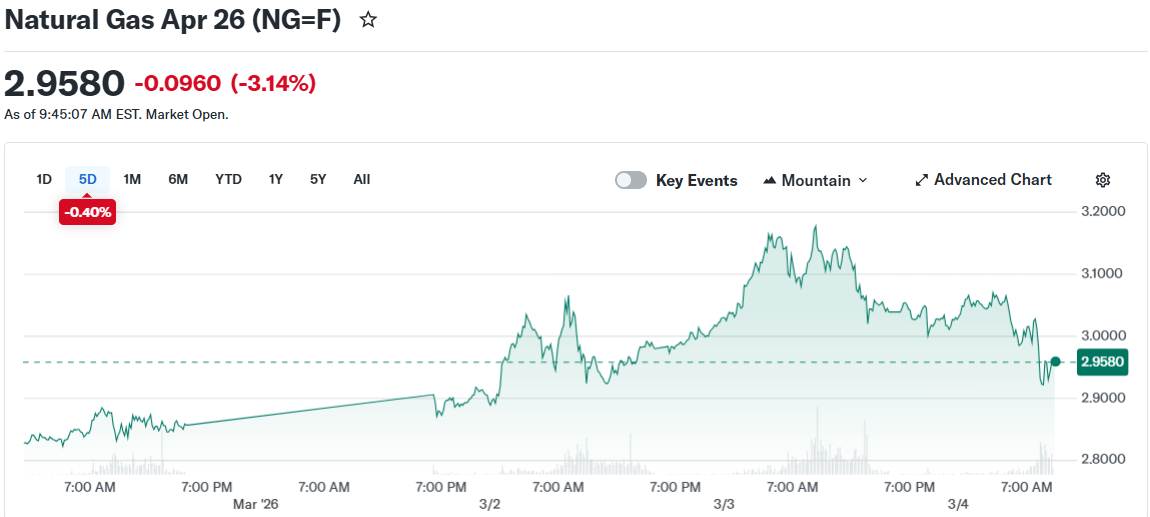
- U.S. natural gas futures also retreated below $3, with analysts saying the domestic market is largely insulated from global supply disruptions.
European natural gas prices spiked dramatically this week after military strikes on Iran disrupted one of the world’s most important energy corridors. But by Wednesday, hopes of a ceasefire had traders selling fast.
The benchmark Dutch TTF Gas contract dropped 9.5% to 49 euros ($57) per megawatt hour on Wednesday. The contract is still up 54% on the week.
The surge began after U.S. and Israeli strikes on Iran sparked a wider conflict that disrupted shipping through the Strait of Hormuz. That corridor is critical to global energy flows.
BREAKING: US stock market futures surge as the New York Times reports that Iran made a "secret" offer to the US to negotiate a deal to end the war.
Potential terms include:
1. Iran to abandon or drastically curtail its ballistic missile and nuclear programs
2. Iran to abandon… https://t.co/IsF3saWl1A
— The Kobeissi Letter (@KobeissiLetter) March 4, 2026
Qatar, the world’s third largest LNG exporter, halted production at its Ras Laffan facility after Iranian drone attacks hit two plants. That raised fears of a serious supply crunch.
The Asian LNG market reacted sharply. The JKM-TTF spread, which tracks the price gap between Asian and European gas markets, exceeded $6 per million British thermal units.
More than 80% of Persian Gulf LNG flows to Asia. Nearly 90% of LNG passing through the Strait of Hormuz is destined for Asian buyers.

Europe does not rely directly on Persian Gulf LNG, but it is still exposed to global spot pricing. Any tightening in supply anywhere pushes up benchmark prices.
The rally reversed sharply after the New York Times reported that Iran had reached out to Washington through secret service channels. Iran signaled it was ready to hold talks to end the fighting.
U.S. Defense Secretary Pete Hegseth and Chairman of the Joint Chiefs Gen. Dan Caine were scheduled to hold a Pentagon press conference Wednesday morning, according to the Wall Street Journal.
LNG Stocks Fall on Price Drop
The drop in natural gas prices weighed on U.S. LNG producers. Cheniere Energy slid 0.4% and Venture Global dropped 3.1% in premarket trading Wednesday.
Both companies are major exporters of U.S. liquefied natural gas to global markets. Higher global prices generally support their earnings outlook.
U.S. Market Largely Shielded
U.S. natural gas futures fell below $3, dropping 4.1% to $2.929 per million British thermal units for April delivery. Analysts say the domestic market is mostly insulated.
“Nymex natural gas — fundamentally insulated near-term from global supply outages with LNG exports already at maximum capacity — may be on the verge of decoupling lower from oil,” said Eli Rubin of EBW Analytics.
Warmer temperatures are forecast through next week, reducing heating demand. A cold snap is expected to return in mid-March, which could lift prices again.
For context, European gas prices surged 293% between February and August 2022 after Russia’s invasion of Ukraine. Wednesday’s drop to 49 euros per megawatt hour comes after TTF hit a three-year high in the previous session.
Dutch TTF was off 13% by mid-morning Wednesday, while U.S. Nymex gas futures were down 4.1%.
Stop guessing and start investing with confidence. KnockoutStocks gives you the AI insights, market intelligence, and stock research you need to spot opportunities, cut through the noise, and make smarter investment decisions — all in one powerful platform.
Sign up today and get 50% OFF full access to our premium stock picks.
Simply use coupon code SPECIAL50 at checkout to claim your exclusive discount.
Get 3 Free Stock Ebooks
Discover top-performing stocks in AI, Crypto, and Technology with expert analysis.
- Top 10 AI Stocks - Leading AI companies
- Top 10 Crypto Stocks - Blockchain leaders
- Top 10 Tech Stocks - Tech giants



