





TLDR
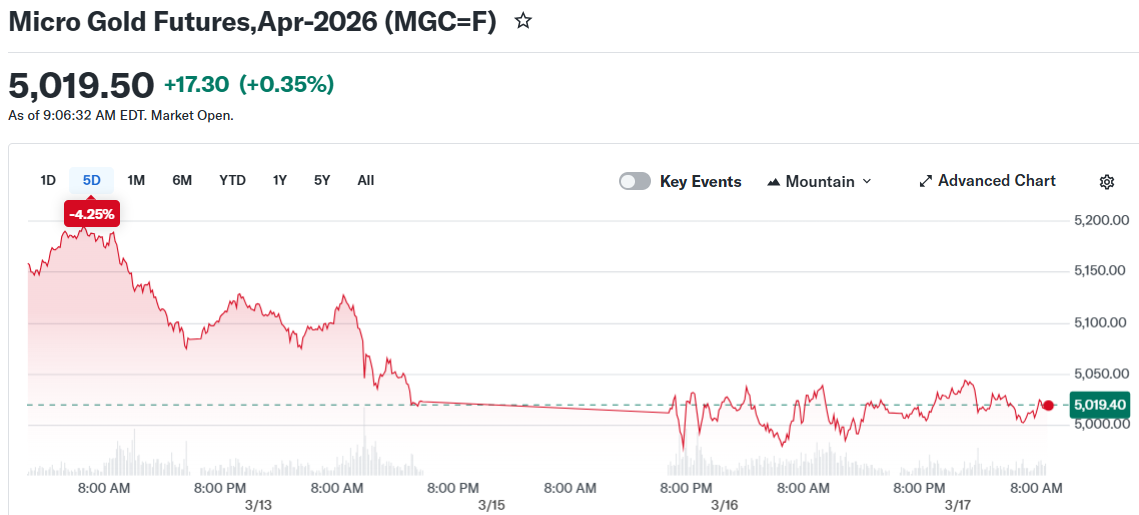
- Gold futures rose to around $5,025 per ounce on Tuesday, up roughly 0.5% on the day.
- S&P 500 futures fell 0.3% while Brent crude surged 3.3% to $103.53 a barrel.
- The US-Israeli war against Iran has kept the Strait of Hormuz largely shut, pushing oil above $100.
- The Federal Reserve begins its two-day meeting Tuesday and is expected to hold rates at 3.5%–3.75%.
- Futures markets are now pricing in 26 basis points of rate cuts by December, up slightly from the day before.
Gold prices moved higher on Tuesday morning as investors watched two major events at once: the ongoing US-Israeli war against Iran and the start of the Federal Reserve’s two-day policy meeting.
Gold futures rose 0.5% to $5,025.10 a troy ounce. Spot gold climbed 0.7% to $5,023.53. Earlier in the session, continuous gold futures were up a more modest 0.2% at $5,010.41 per ounce.
At the same time, S&P 500 futures fell 0.3%, signaling some caution in equity markets. Brent crude futures jumped 3.3% to $103.53 a barrel, keeping oil firmly above the $100 mark.
The rise in oil prices is tied directly to the conflict. The US-Israeli war against Iran has kept the Strait of Hormuz largely shut, disrupting a key shipping route for global oil supply.
Gold had a rough start to the week. Prices pulled back in the first 24 hours of trading on Monday after Iran’s foreign minister made comments that markets read as positive. Stocks rose, yields dipped, and the dollar gave back some recent gains.
“That seems to echo the markets’ positive response to Iran’s foreign minister’s comments,” said Ilya Spivak, head of global macro at Tastylive. “Crude oil pulled back, yields ticked lower, and the US dollar gave back some recent gains as stocks rose.”
But oil stayed above $100, and gold found its footing again by Tuesday morning.
Fed Meeting in Focus
The Federal Reserve starts its two-day meeting on Tuesday. It is widely expected to leave interest rates unchanged in the 3.5% to 3.75% range for a second consecutive meeting, with a decision due Wednesday.

Futures markets are now pricing in 26 basis points of rate cuts by the December meeting, up 2.4 basis points from the day before, according to Deutsche Bank strategist Jim Reid.
Gold is a non-yielding asset, meaning it tends to do better when interest rates are expected to fall. Lower rate expectations reduce the cost of holding gold compared to interest-bearing assets.
Gold’s Role as a Safe Haven
Since the start of hostilities in Iran, gold has actually fallen 6.1%, according to FactSet data. That drop raised questions about whether gold was still acting as a safe haven.
Tuesday’s gains may suggest it is starting to reassert that role. Analysts are watching closely.
“Gold may weaken if the central bank strikes a relatively hawkish tone,” Spivak warned. The Fed’s tone on Wednesday could move prices in either direction.
The US Federal Reserve is expected to hold rates steady, but any surprise language around future hikes could put pressure on gold again.
Gold futures were trading at $5,021.10 as of Tuesday morning, up $18.90 on the day.
Stop guessing and start investing with confidence. KnockoutStocks gives you the AI insights, market intelligence, and stock research you need to spot opportunities, cut through the noise, and make smarter investment decisions — all in one powerful platform.
Sign up today and get 50% OFF full access to our premium stock picks.
Simply use coupon code SPECIAL50 at checkout to claim your exclusive discount.
Get 3 Free Stock Ebooks
Discover top-performing stocks in AI, Crypto, and Technology with expert analysis.
- Top 10 AI Stocks - Leading AI companies
- Top 10 Crypto Stocks - Blockchain leaders
- Top 10 Tech Stocks - Tech giants



