






TLDR
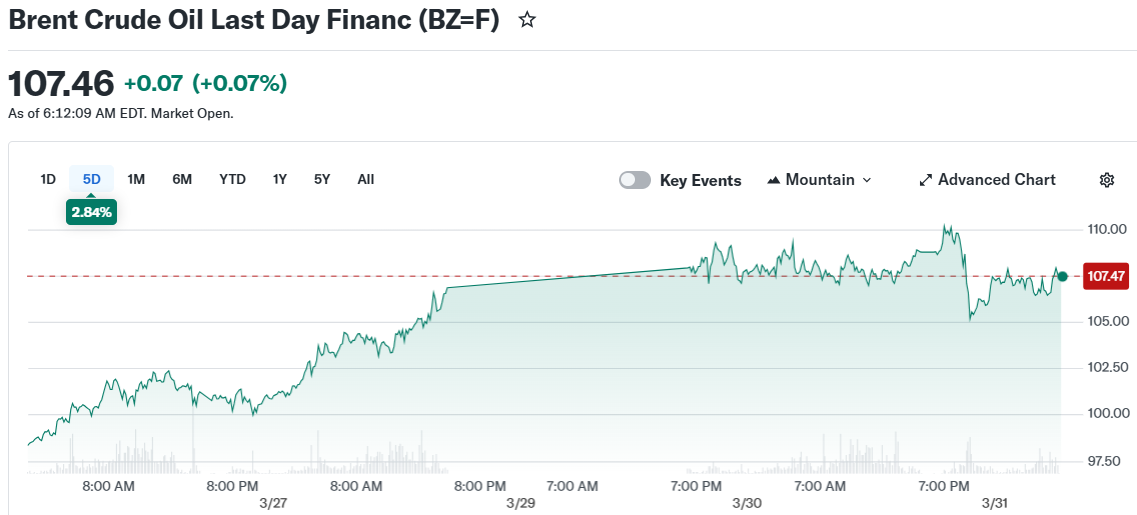
- Brent crude rose to $112.87 a barrel on Tuesday; WTI sat at $102.49
- A Kuwaiti tanker was set on fire near Dubai in an attack blamed on Iran
- Trump is reportedly willing to end military operations even if the Strait of Hormuz stays closed
- Brent and WTI are on track for a 50–54% gain in March, one of the biggest monthly rises on record
- Gas prices at the pump topped $4 a gallon for the first time since August 2022
Oil prices hovered above $110 a barrel on Tuesday as fighting in the Middle East kept global energy markets on edge.
Brent crude, the global benchmark, rose 0.1% to $112.87 a barrel. West Texas Intermediate dipped slightly to $102.49. Both benchmarks are on track to finish March up between 50% and 54%, one of the biggest monthly gains on record.
Gas prices at the pump crossed $4 a gallon for the first time since August 2022, according to AAA data.
Prices initially jumped after a Kuwaiti oil tanker was set ablaze near the port of Dubai. The ship’s owner said Iran was responsible for the attack.
JUST IN: 🇺🇸🇮🇷 President Trump tells aides he's willing to end Iran war even if Strait of Hormuz remains closed, WSJ reports. pic.twitter.com/gXBqJ3hZ25
— BRICS News (@BRICSinfo) March 31, 2026
Markets then pulled back slightly after the Wall Street Journal reported that President Trump told aides he is willing to end the military campaign against Iran, even without fully reopening the Strait of Hormuz.
Trump and his advisers concluded that reopening the strait would take much longer than his initial four-to-six week timeline. The plan is to wind down U.S. operations after hobbling Iran’s navy and missile capabilities, then pressure Tehran diplomatically.

Why the Strait of Hormuz Still Matters
Before the war, roughly 20% of the world’s oil and natural gas passed through the Strait of Hormuz. That corridor remains at least partially blocked.
Iran’s parliament has approved a plan to collect tolls on vessels traveling through the waterway, Iranian state media reported.
As long as the strait stays blocked, triple-digit oil prices could continue, which puts pressure on the broader stock market.
Countries in Asia that depend heavily on Gulf crude have already started cutting energy use. Bangladesh shut down universities. Pakistan and the Philippines introduced shorter workweeks.
Other Fronts Keeping Markets Nervous
Yemen’s Houthi group entered the conflict over the weekend, attacking Israel. The Houthis have previously shown the ability to strike ships in the Red Sea, raising fears of a second front in the war.
Iran has largely denied holding any direct talks with the U.S., contradicting statements from Washington that negotiations were going well.
The U.S. has deployed thousands of troops to the region. Trump has repeated threats to target Iran’s energy and water infrastructure if the Strait is not reopened by April 6.
Pakistan offered to host ceasefire talks in Islamabad. Defense Secretary Pete Hegseth and the Chairman of the Joint Chiefs were scheduled to hold a press conference Tuesday morning.
Several Gulf nations halted oil production and shipments over the past month due to the conflict.
Stop guessing and start investing with confidence. KnockoutStocks gives you the AI insights, market intelligence, and stock research you need to spot opportunities, cut through the noise, and make smarter investment decisions — all in one powerful platform.
Sign up today and get 50% OFF full access to our premium stock picks.
Simply use coupon code SPECIAL50 at checkout to claim your exclusive discount.
Get 3 Free Stock Ebooks
Discover top-performing stocks in AI, Crypto, and Technology with expert analysis.
- Top 10 AI Stocks - Leading AI companies
- Top 10 Crypto Stocks - Blockchain leaders
- Top 10 Tech Stocks - Tech giants



