






TLDR
- Hoskinson says Cardano prioritizes decentralization and security.
- He says Ethereum and Solana cannot structurally kill Cardano.
- ADA is trading near long-term support around $0.240.
- Cardano remains below its descending 50-day EMA.
- A break below $0.240 could shift focus to $0.220 support.
Cardano founder Charles Hoskinson has defended the network’s long-term approach, saying Cardano will be recognized over time for prioritizing decentralization, security, and blockchain reliability, even as rival networks continue to show faster adoption.
Charles Hoskinson said Cardano has followed the core principles of cryptocurrency by placing decentralization at the center of its design. He argued that some competing blockchain projects have chosen faster growth by accepting trade-offs in security, uptime, or network structure.
His comments come as Cardano’s ADA token trades near an important support area around $0.240. Market analysts are watching whether buyers can defend that level or whether a break lower could extend the current downward structure.
Hoskinson Defends Cardano’s Long-Term Model
During a recent livestream, Charles Hoskinson said Cardano has taken a slower but more deliberate development path. The network has relied on peer-reviewed research, decentralized governance, and secure consensus design as part of its strategy.
He said this approach has often caused Cardano to move more slowly than rivals such as Ethereum and Solana. However, he argued that the slower process was intentional and designed to reduce long-term technical risk.
Hoskinson criticized rival blockchain projects for taking what he described as shortcuts to increase throughput, attract users, or expand developer activity. He said such decisions may support near-term growth but could create structural problems if decentralization and reliability are weakened.
Cardano has avoided major network downtime and large protocol-level failures, while some competing chains have faced outages or security events. Despite that record, Cardano continues to trail Ethereum and Solana in developer activity, decentralized finance usage, and wider ecosystem adoption.

Ethereum and Solana Competition Remains in Focus
Charles Hoskinson said Ethereum and Solana cannot directly “kill” Cardano because the network’s survival depends more on its own community and technical foundation than on rival ecosystems.
He said the greater risks to Cardano would come from internal division, weakening conviction, or loss of community support. In his view, Cardano already has the technology required to remain active over the long term, provided its supporters remain aligned around the project’s goals.
Ethereum remains the largest smart contract platform by activity and developer presence, while Solana has gained attention for high-speed transactions and expanding consumer-facing applications. Cardano has continued to emphasize research-based development and governance as its points of distinction.
Hoskinson said the industry may eventually reward networks that remain closer to crypto’s original principles. He maintained that decentralization and security will become more important as blockchain systems mature and handle more financial activity.
ADA Price Tests Key Support Zone
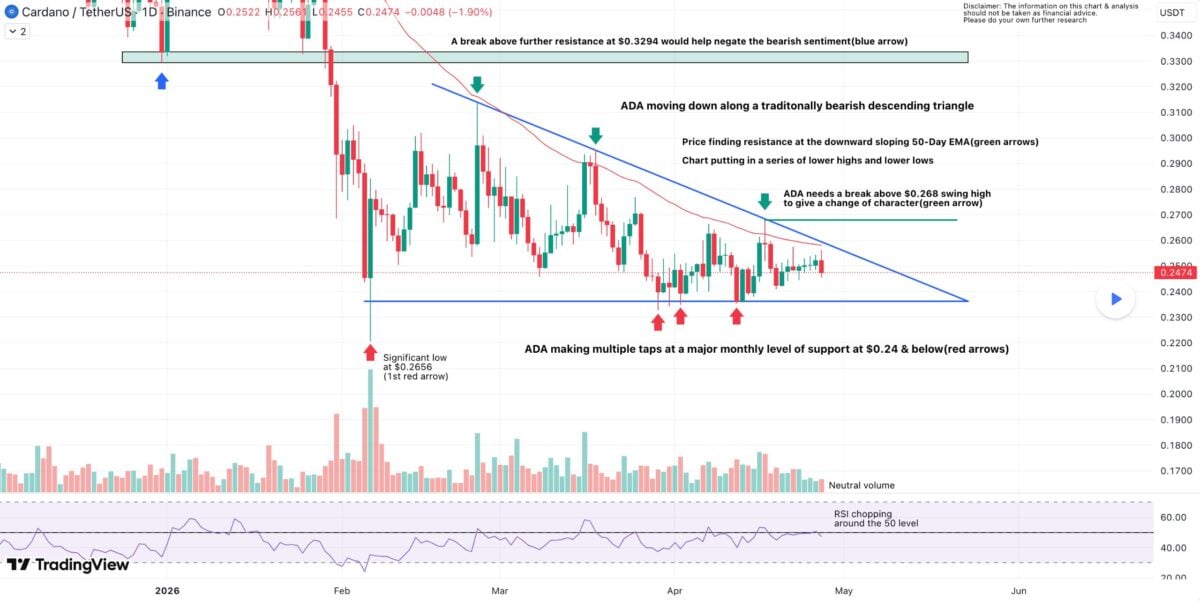
Cardano’s ADA token is trading near a long-standing support zone around $0.240, a level that has been watched since late 2022. The price recently reached an intraday high near $0.256 before renewed selling pressure pushed it back toward support.
Technical analysis shows ADA moving within a descending structure, with lower highs forming since late February. The token has struggled to sustain rebounds, suggesting sellers have been entering the market at progressively lower levels.
 Source: TradingView
The 50-day exponential moving average is also acting as resistance, limiting attempts to regain upward momentum. ADA’s relative strength index is near the middle range, showing no clear directional control between buyers and sellers.
If ADA holds above the $0.240 area, analysts see room for a short-term rebound toward descending resistance. A clear move below that zone could confirm the current downward pattern and place attention on the next support area near $0.220.


