



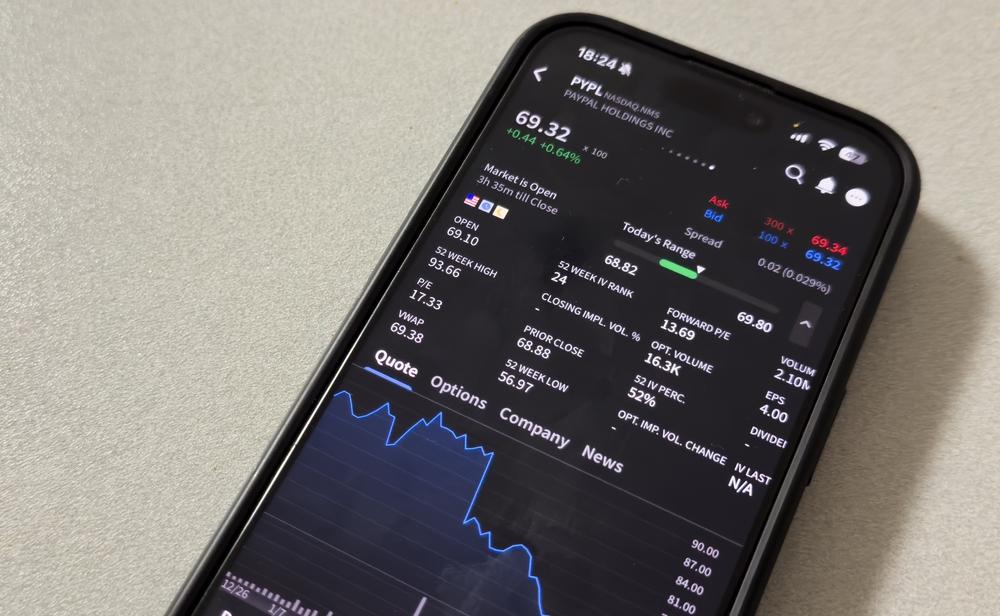


PayPal has lost roughly 80% of its value since its 2021 peak. The stock trades at a single-digit forward P/E — a fraction of the S&P 500 average — while generating billions in free cash flow each year. That kind of gap between price and fundamentals raises an obvious question: is PayPal a good stock to buy, or has the market already priced in a structural decline?
The answer depends on how one reads the tension between PayPal’s legacy dominance in digital payments and the competitive forces reshaping the industry. The earnings trajectory, the valuation math, the competitive landscape, and the analyst consensus each tell a different part of the story.
|
Metric |
Value |
|
Stock price (PYPL) |
~$41 |
|
Forward P/E |
~8x |
|
Free cash flow (TTM) |
~$6.8 billion |
|
Annual revenue |
~$33 billion |
|
Dividend yield |
~1.4% |
|
Analyst consensus |
Hold |
|
Average price target |
~$52–56 |
|
Total payment volume (TPV) |
~$1.7 trillion annually |
What recent earnings reveal about PYPL’s trajectory?
PayPal’s quarterly results paint a mixed picture. The company has consistently beaten adjusted EPS estimates, yet the stock has struggled to hold gains after each report. A closer look at the key metrics helps explain why.
Revenue and profit signals
The top-line numbers look stable on the surface, but the margin story underneath tells a more nuanced tale.
- Revenue growth has remained in the mid-single digits, with total payment volume rising around 10–11% year over year
- Adjusted EPS has beaten consensus in recent quarters, driven partly by aggressive share buybacks (~$6 billion annually)
- GAAP earnings have lagged adjusted figures, reflecting restructuring charges tied to an ongoing cost reduction program (~$1.5 billion in targeted savings)
-
Operating margins remain under pressure, with transaction margins compressing as unbranded (Braintree) processing grows faster than higher-margin branded checkout
The gap between adjusted beats and GAAP misses is worth watching. Buybacks can mask underlying earnings quality — a company shrinking its share count by roughly 10% annually will show EPS growth even if net income stays flat.
Branded checkout: the core concern
PayPal’s branded checkout — the “Pay with PayPal” button — is the company’s highest-margin product. Growth here has slowed to low single digits, while the lower-margin Braintree processing business grows at double-digit rates. That mix shift explains why revenue can grow while margins compress.
Under its current leadership, PayPal has reorganized into three segments (consumer, merchant, Venmo) and launched Fastlane, a one-click guest checkout tool designed to win back branded share. Early adoption data from merchants has been encouraging, but the revenue impact remains modest so far.
PYPL valuation breakdown: cheap for a reason?
The valuation debate around PayPal comes down to a simple disagreement: is the stock cheap because the market is wrong, or cheap because the business is deteriorating?
The bull case
Several metrics suggest PayPal trades well below its intrinsic value.
- A forward P/E near 8x for a company generating $33 billion in revenue and $6.8 billion in free cash flow is unusually low for a large-cap fintech
- The company initiated its first-ever dividend in 2025, signaling management confidence in sustained cash generation
- Share buybacks at current prices offer high accretion — every dollar spent retiring shares at $41 buys more earnings per share than at $80
-
Analyst price targets cluster around $52–56, with some intrinsic value models estimating fair value closer to $80
If branded checkout stabilizes and Fastlane gains traction, a re-rating toward even 12–15x earnings would represent significant upside from today’s price.
The bear case
The compression in PayPal’s multiple did not happen in a vacuum. Several structural headwinds explain the discount.
- Apple Pay and Google Pay have captured mobile wallet share, particularly among younger users who never formed a PayPal habit
- Stripe and Adyen dominate merchant-side processing, pushing Braintree into a margin race
- Branded checkout erosion may not be cyclical — if consumers increasingly prefer native wallet solutions embedded in their devices, PayPal’s button loses relevance regardless of product improvements
-
At least one major bank (Morgan Stanley) has maintained a sell-equivalent rating, with a price target well below the current share price
The bear thesis does not require PayPal to fail. It only requires the company to become a low-margin processing utility rather than a high-margin consumer brand — and the current trajectory supports that reading.
Where PayPal fits in the evolving payments landscape?
PayPal’s reach extends far beyond its checkout button. The platform processes payments across freelance marketplaces, subscription services, peer-to-peer transfers through Venmo, cross-border remittances via Xoom, in-app purchases, streaming platforms, Canadian online casinos that accept PayPal, and sports betting operators. That breadth of use cases — spanning e-commerce, gig economy, entertainment, and financial services — is part of what makes the valuation debate complex.
The stablecoin bet
PayPal launched PYUSD, its own stablecoin, and has expanded it to over 70 markets. The logic is straightforward: stablecoins can reduce transaction costs for cross-border payments, a segment where PayPal currently charges significant fees through Xoom.
The risk is cannibalization. If stablecoin rails become the standard for international transfers, PayPal’s existing fee structure on cross-border transactions — one of its higher-margin businesses — faces compression. The company is essentially betting that owning the stablecoin (and the wallet infrastructure around it) will offset the margin loss on legacy rails.
Competitive positioning
PayPal sits in an unusual spot: too large to be disrupted overnight, but too slow-growing to command a premium multiple. The company processes roughly $1.7 trillion in annual payment volume, a scale that provides negotiating leverage with merchants and a data moat that smaller competitors cannot easily replicate.
The question is whether scale alone justifies the current valuation, or whether the market needs to see evidence that new products (Fastlane, PYUSD, the revamped Venmo monetization strategy) can actually bend the margin curve upward.
What are analysts and the market saying?
Wall Street remains divided on whether PayPal is a good stock to buy. The consensus rating sits at Hold, with over 40 analysts covering the stock. Price targets range from the low $30s to above $100, reflecting genuine disagreement about PayPal’s trajectory.
The average price target sits around $52–56 depending on the source — roughly 30–35% above the current share price. Some valuation models push fair value estimates closer to $80, nearly double the current price. That gap between model-derived value and market price typically signals either a deep value opportunity or a situation where the market has priced in risks that quantitative models have not yet captured.
For a stock trading below 8x earnings with $33 billion in annual revenue and a growing stablecoin business, the risk-reward profile leans asymmetric — but only for those willing to accept that the margin recovery thesis may take more than a quarter or two to materialize.


