





TLDR
- Gold is on track for its biggest weekly drop in six weeks, falling over 3%
- Middle East strikes between the U.S. and Iran are pushing oil prices up sharply
- Fed officials say interest rates will stay high, which is bad for gold
- Brent crude is heading for a 12% weekly gain as Strait of Hormuz traffic is disrupted
- Technical analysts see support around $4,000 and potential upside to $4,500 by Q3
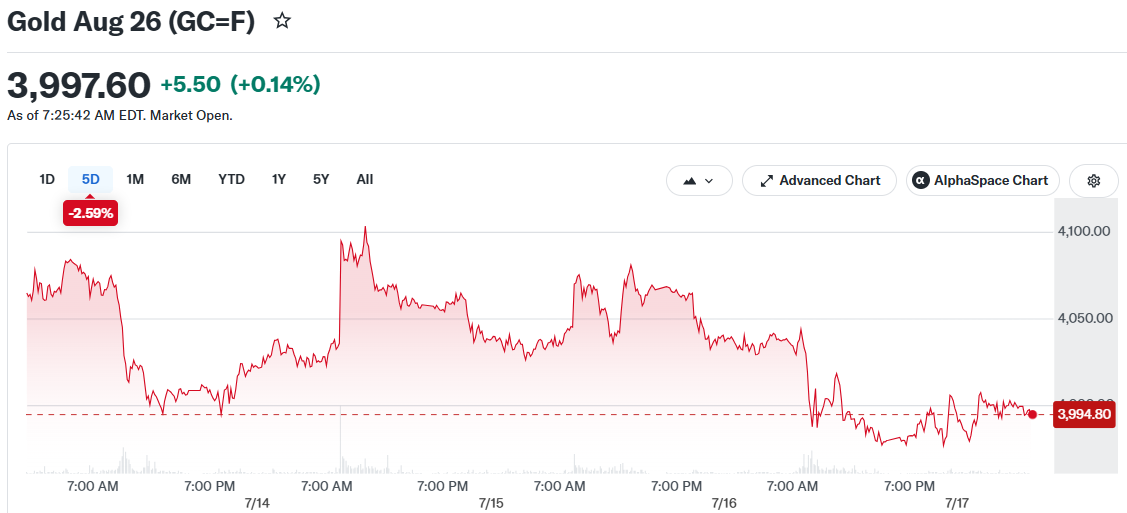
Gold prices edged up slightly on Friday morning but are still heading for a rough week. Spot gold climbed 0.5% to around $3,997 an ounce, while futures ticked up to just over $4,000. Despite the small Friday bounce, bullion has fallen more than 3% over the past week.
The drop comes as tensions in the Middle East have escalated sharply. The U.S. military carried out a sixth consecutive night of strikes on Iranian military sites. Iran responded with fresh air attacks on U.S. facilities in the region.
Iranian media reported that recent U.S. strikes hit civilian infrastructure, including five bridges and a railway station.
Oil Prices Surge as Hormuz Traffic Stalls
The fighting has thrown the Strait of Hormuz back into uncertainty. Tanker traffic through the key waterway has been disrupted again, ending hopes of a return to normal shipping flows after a brief ceasefire period.
BREAKING: The US has begun major strikes on Iranian infrastructure, hitting the Bandar Khamir overpass bridge connecting Bandar Abbas to Lar, the Gariveh Bridge, a third bridge in Hormozgan Province, and a major railway station west of Bandar Abbas connecting to the Shahid Rajaei…
— The Hormuz Letter (@HormuzLetter) July 16, 2026
Brent crude futures are on pace for a weekly gain of more than 12% as a result. Higher oil prices raise inflation concerns, which in turn affects how investors think about interest rates.
Federal Reserve officials have made clear they are not ready to cut rates. Chair Kevin Warsh, Governor Christopher Waller, and New York Fed President John Williams all pointed to sticky inflation as a reason to keep borrowing costs elevated.

Fed Holds Firm, Dollar Strengthens
Neil Welsh, Head of Metals at Britannia Global Markets, said that even though June inflation data came in softer than expected, hawkish Fed comments suggest rates will stay high to fight persistent price pressures.
A stronger dollar has also weighed on gold. When the dollar rises, gold becomes more expensive for buyers using other currencies, which can reduce demand.
Gold is a non-yielding asset, meaning it pays no interest. When rates stay high, investors often prefer assets that do generate a return.
Despite the recent pain, some analysts see reasons for optimism. Technical charts show gold has support at the $4,000 level, which could form a double bottom pattern.
Bullish momentum indicators suggest the selling pressure may be fading. The RSI indicator made a higher low in June and July even as prices fell lower, a sign that downside momentum is weakening.
One analyst targets $4,500 for gold by the end of Q3, which would represent about 11% upside from current levels.
Gold has fallen around 30% from its January high of $5,626.80. But analysts note the longer-term uptrend remains intact, with the secular bull market seen as a healthy reset rather than a reversal.
Volume during the selloff remained relatively low, suggesting institutional sellers have not been driving the decline in force.
Stop guessing and start investing with confidence. KnockoutStocks gives you the AI insights, market intelligence, and stock research you need to spot opportunities, cut through the noise, and make smarter investment decisions — all in one powerful platform.
Sign up today and get 50% OFF full access to our premium stock picks.
Simply use coupon code SPECIAL50 at checkout to claim your exclusive discount.
Get 3 Free Stock Ebooks
Discover top-performing stocks in AI, Crypto, and Technology with expert analysis.
- Top 10 AI Stocks - Leading AI companies
- Top 10 Crypto Stocks - Blockchain leaders
- Top 10 Tech Stocks - Tech giants



