






TLDR
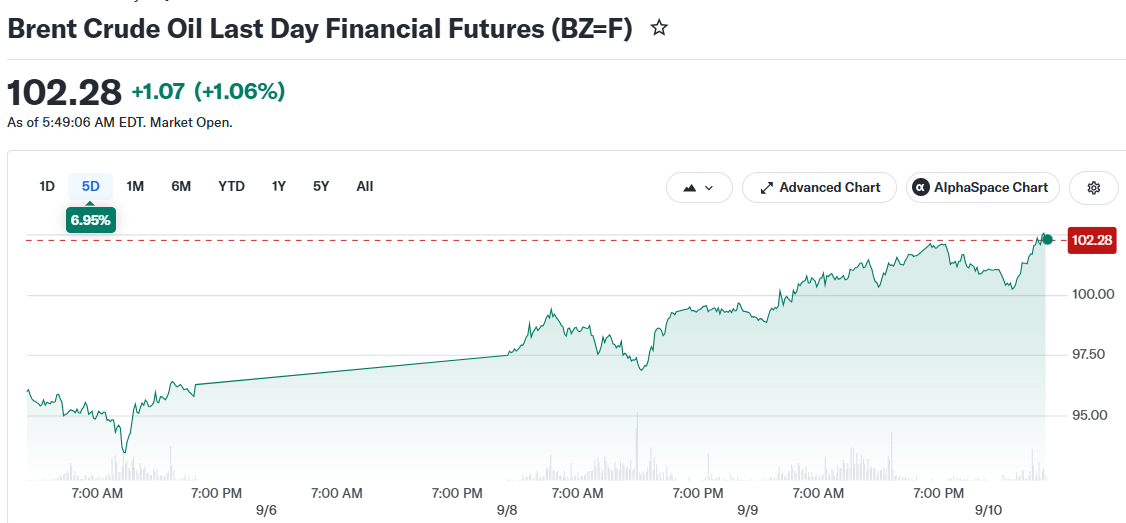
- Brent crude broke above $100 per barrel for the first time since late July after fresh U.S.-Iran military exchanges
- The U.S. reported sinking five Iranian oil tankers; Iran struck 10 ships near the Strait of Hormuz
- Crude flows through Hormuz have fallen to below 2 million barrels per day, down from 8-9 million bpd before fighting resumed
- Yemen’s Houthis attacked Saudi energy infrastructure this week, including the Jizan refinery
- Global oil inventories dropped by 69 million barrels in July, with the IEA reporting 8.3 million bpd of Middle East output shut in
Brent crude broke above $100 per barrel on Wednesday as renewed fighting between U.S. and Iranian forces pushed fears of a long-term oil supply disruption to new highs. West Texas Intermediate also moved higher, trading around $96 a barrel.
The latest round of conflict saw Iran strike 10 ships in and around the Strait of Hormuz. The U.S. responded by sinking five Iranian oil tankers in the Persian Gulf. Iran then struck a U.S. base in Jordan.
Crude flows through the Strait of Hormuz have taken a sharp hit. Before fighting resumed, daily outflows ran between 8 and 9 million barrels. That number has now dropped to below 2 million barrels per day, according to data from Rystad Energy cited by Reuters.
JUST IN: Trump says gasoline will fall BELOW $2 a gallon "right after the election" as oil trades above $100.
"Oil prices are going to be tumbling downward."
"For gasoline, we'll get 'em below $2 a gallon."
Gas is currently $4.22 a gallon, with diesel at a record $5.94, per… pic.twitter.com/9qkXWE8fSR
— Coin Bureau (@coinbureau) September 10, 2026
According to shipping data firm Kpler, not a single very large crude carrier has exited the strait since September 2.
Middle East Supply Routes Under Pressure
Some Middle Eastern producers have rerouted crude through pipelines to ports outside Hormuz. The UAE is using a pipeline to the port of Fujairah. Iraq is sending oil through a pipeline to Turkey. Saudi Arabia reversed flows on its East-West pipeline to reach the Red Sea port of Yanbu.
But those alternative routes are now under threat too. Yemen’s Houthi group, backed by Iran, attacked Saudi energy infrastructure this week. The Jizan refinery was hit in the latest strike. Other refineries on the Arabian Peninsula have also come under attack.

ANZ analysts said in a note that tit-for-tat attacks suggest oil flows from the Persian Gulf are likely to remain disrupted for the foreseeable future.
Inventories Falling as War Drags On
The International Energy Agency’s latest monthly report said 8.3 million barrels per day of Middle East oil production remained shut in as of July. Global oil inventories fell by 69 million barrels that same month, an average daily draw of 2.7 million barrels.
Several physical crude benchmarks are already above $100. Murban crude, DME Oman, the OPEC basket, and the Indian basket are all trading above that level. Brent futures have now joined them.
President Trump told reporters on Wednesday the war will end after the midterm elections in November. However, a Wall Street Journal report said Trump’s top advisers warned the conflict could continue through the rest of his term.
There are no reports of peace negotiations between Washington and Tehran. Demand for crude typically rises in the final quarter of the year, which could push prices higher if supply remains constrained.
Brent was trading at $101.22 a barrel as of Thursday morning.
Stop guessing and start investing with confidence. KnockoutStocks gives you the AI insights, market intelligence, and stock research you need to spot opportunities, cut through the noise, and make smarter investment decisions — all in one powerful platform.
Sign up today and get 50% OFF full access to our premium stock picks.
Simply use coupon code SPECIAL50 at checkout to claim your exclusive discount.
Get 3 Free Stock Ebooks
Discover top-performing stocks in AI, Crypto, and Technology with expert analysis.
- Top 10 AI Stocks - Leading AI companies
- Top 10 Crypto Stocks - Blockchain leaders
- Top 10 Tech Stocks - Tech giants



