





TLDR
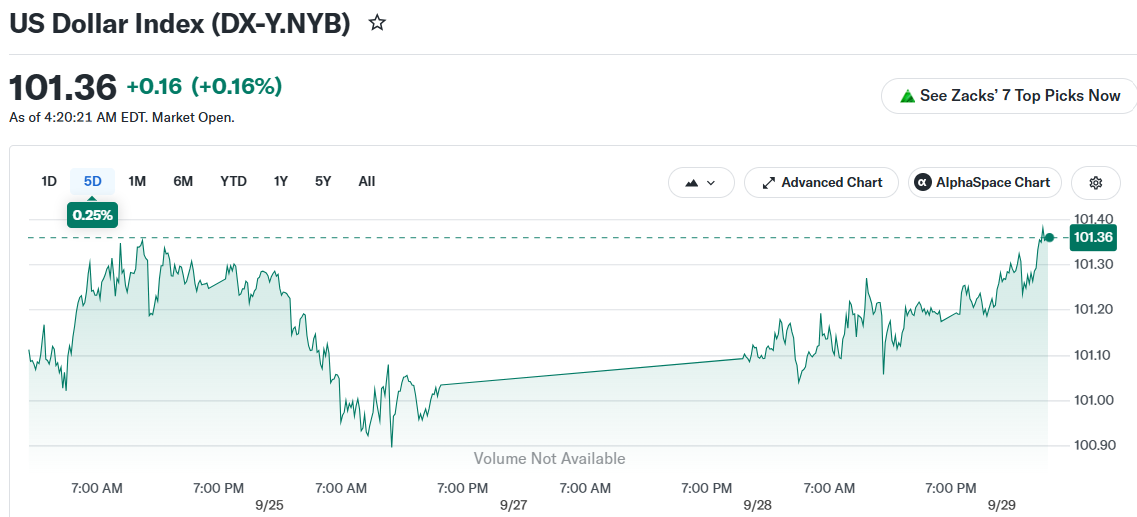
- The dollar index hovered near a two-month high on Tuesday, on track for a 1.9% gain this month.
- The euro and pound traded near multi-month lows as the ECB signaled a slow approach to inflation.
- US Treasury yields hit fresh highs, with the 10-year at its highest since 2007 and the 30-year at its highest since 2004.
- The Reserve Bank of Australia raised its cash rate to 4.60%, a 15-year high, its fourth hike this year.
- Traders are watching US PCE data Wednesday and nonfarm payrolls Friday for clues on the Fed’s next move.
The US dollar edged higher on Tuesday, sitting near a two-month peak. Rising oil prices and climbing Treasury yields gave the currency support.
The dollar index, which tracks the greenback against a basket of other currencies, stood at 101.27. It is on pace to gain about 1.8% to 1.9% this month, its best month since June.
The euro traded near $1.1360, close to its weakest level in three months. This came after the European Central Bank’s chief pointed to slow, careful steps to bring down inflation.
The British pound also slipped, down 0.1% at $1.3242. That put it near its own three-month low against the dollar.
Oil prices moved higher too. Brent crude futures rose above $107 a barrel as doubts grew over ending the conflict in Iran. President Donald Trump rejected a ceasefire proposal from Tehran, adding to the uncertainty.
Meanwhile, a selloff in US government bonds pushed yields to new multi-year highs. The 10-year Treasury yield reached its highest point since 2007. The 30-year yield climbed to its highest since 2004.
The two-year yield, which tends to track Fed policy expectations, also rose. It moved closer to the 5% mark.

“I think the US dollar is just going to keep growing a little bit higher,” said Joseph Capurso, head of foreign exchange at the Commonwealth Bank of Australia. He added that stronger US economic data could keep pushing interest rates, and the dollar, upward.
Fed Rate Hike Odds Rise
Investors are now focused on two upcoming reports. The PCE price index comes out Wednesday, followed by nonfarm payrolls on Friday.
Both reports are expected to support the case for another Fed rate hike. Markets now see more than a 70% chance of a hike by the end of October. That is up from 57% just a week earlier.
Australia and Japan Currency Moves
Australia’s central bank raised its cash rate to 4.60% on Tuesday, a 15-year high. The decision was unanimous and marks the fourth hike this year.
The bank pointed to inflation still running too high, with underlying inflation at 3.6%. Higher energy costs and weak productivity were also named as risks.
The Australian dollar briefly touched $0.7029 after the announcement before giving back gains. It later fell 0.4% to $0.6989, dropping below the $0.70 level.
The Japanese yen weakened to around 157.4 per dollar. This gave back much of Monday’s gain, when the currency had strengthened after a warning from Japan’s top currency official, Atsushi Mimura.
Mimura said markets should take heed of a “very clear” message from Japan and the US regarding yen weakness. Japan’s Prime Minister Sanae Takaichi and Finance Minister Satsuki Katayama had made similar comments.
Katayama and US Treasury Secretary Scott Bessent spoke by phone last Friday. They agreed the yen was undervalued and pledged closer cooperation on currency matters.
Elsewhere, the New Zealand dollar traded near $0.5675. The offshore yuan held steady at 6.71 per dollar following last week’s US-China summit, while the South Korean won and Singapore dollar showed only small moves.
Stop guessing and start investing with confidence. KnockoutStocks gives you the AI insights, market intelligence, and stock research you need to spot opportunities, cut through the noise, and make smarter investment decisions — all in one powerful platform.
Sign up today and get 50% OFF full access to our premium stock picks.
Simply use coupon code SPECIAL50 at checkout to claim your exclusive discount.
Get 3 Free Stock Ebooks
Discover top-performing stocks in AI, Crypto, and Technology with expert analysis.
- Top 10 AI Stocks - Leading AI companies
- Top 10 Crypto Stocks - Blockchain leaders
- Top 10 Tech Stocks - Tech giants



