






TLDR
- The US dollar dipped slightly on Wednesday but remains on track for its best month since June.
- New York Fed President John Williams said there is “no need for urgency” for another rate hike, cooling bets on an October increase.
- The Japanese yen rose 0.3% against the dollar as officials repeated warnings about disorderly currency moves.
- The Australian dollar fell to a nine-week low after weaker than expected inflation data.
- The euro is set for its largest monthly drop against the dollar in 14 months, pressured by energy costs and French political tension.
The US dollar slipped on Wednesday, pulling back slightly from its highest level in almost two months. Despite the small dip, the dollar is still headed for its strongest month since June.
The dollar index, which measures the currency against six major rivals, fell 0.2% to 101.22. The move came after a top Federal Reserve official signaled less urgency around future rate hikes.
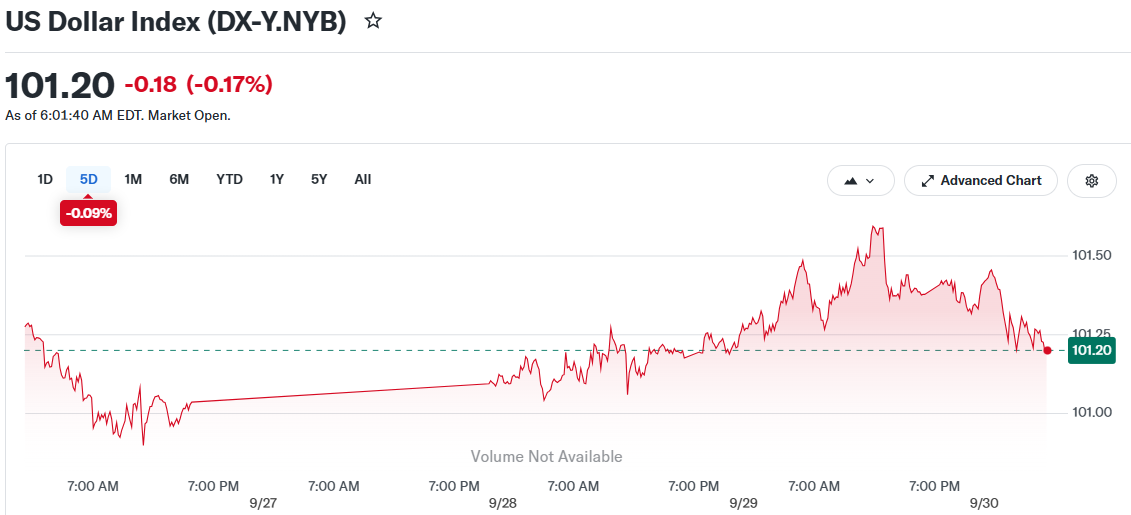
New York Fed President John Williams said there was “no need for urgency” to raise interest rates further. His comments led traders to lower their bets on an October rate increase.
Fed Comments Cool Rate Hike Expectations
Before Williams spoke, markets had priced in more than a 70% chance of an October rate hike. After his remarks, that probability dropped to around 50%.
The odds of an October rate hike have now plunged below 50% 🚨🚨 https://t.co/nJN7Mb6blx pic.twitter.com/ibIKB34xw8
— Barchart (@Barchart) September 30, 2026
Traders are now waiting for Friday’s US jobs report and the Personal Consumption Expenditures price index. The PCE index is the Fed’s preferred measure of inflation.
Two-year Treasury yields fell about 3.5 basis points following the comments. This reflects lower expectations for near-term rate hikes.

The Japanese yen was the strongest performer among major currencies on Wednesday. It rose 0.3% against the dollar, trading at 156.77 yen per dollar.
Japan’s currency officials issued fresh warnings about the yen’s weakness. Atsushi Mimura, Japan’s top currency diplomat, said Prime Minister Sanae Takaichi and Finance Minister Satsuki Katayama are coordinating with Washington on the issue.
Japanese economic data released this week showed mixed signals. Retail sales for August came in weaker than expected, and industrial output unexpectedly shrank.
Still, minutes from the Bank of Japan’s July meeting showed policymakers believe inflation is moving toward their 2% target. This keeps expectations alive for future rate increases in Japan.
Australian Dollar Slides on Weak Inflation Data
The Australian dollar dropped 0.3% to $0.6900, falling below the $0.70 mark. This puts the currency at its lowest level in nine weeks.
The drop followed monthly inflation data that came in below forecasts. This happened just one day after the Reserve Bank of Australia raised its cash rate by 25 basis points to 4.60%, a 15-year high.
Because markets had already priced in Tuesday’s rate hike, the currency could not hold its ground once the softer inflation number arrived. Commonwealth Bank of Australia’s Joe Capurso said another hike could come as soon as November, but that this is already priced into the market.
The euro edged up slightly to $1.1354 on Wednesday. However, the currency is still set for its largest monthly decline against the dollar in 14 months.
Energy prices in Europe spiked earlier this month to their highest level since 2022. French political gridlock ahead of next year’s presidential election has also weighed on investor confidence.
The gap between French and German bond yields has widened to its largest since 2012. This reflects growing concern about France’s fiscal position.
In Asia, the Chinese yuan held steady at around 6.71 per dollar. Official data showed China’s manufacturing sector returned to growth in September, with a reading of 50.1.
The yuan is on track for its seventh straight quarterly gain against the dollar. Markets in China will be closed for the October 1-7 holiday period starting this week.
Sterling touched a three-month low on Tuesday and last traded near $1.3227. The New Zealand dollar hit its lowest level since November, trading around $0.5638.
Stop guessing and start investing with confidence. KnockoutStocks gives you the AI insights, market intelligence, and stock research you need to spot opportunities, cut through the noise, and make smarter investment decisions — all in one powerful platform.
Sign up today and get 50% OFF full access to our premium stock picks.
Simply use coupon code SPECIAL50 at checkout to claim your exclusive discount.
Get 3 Free Stock Ebooks
Discover top-performing stocks in AI, Crypto, and Technology with expert analysis.
- Top 10 AI Stocks - Leading AI companies
- Top 10 Crypto Stocks - Blockchain leaders
- Top 10 Tech Stocks - Tech giants



