






The gap between how young and old Americans view cryptocurrency is wide and growing. Survey after survey points in the same direction: younger investors are far more likely to own, trust, and actively use crypto than their parents and grandparents.
This article draws on data from Coinbase, OKX, YouGov, Pew Research, Cerulli Associates, Vanguard, FINRA, and a peer-reviewed academic study published in 2025. It covers who owns crypto, why they own it, how much they invest, and what the coming transfer of trillions in wealth could mean for digital asset markets.
The data covers Gen Z (born 1997-2012), Millennials (born 1981-1996), Gen X (born 1965-1980), and Baby Boomers (born 1946-1964).
Crypto Ownership Rates by Generation
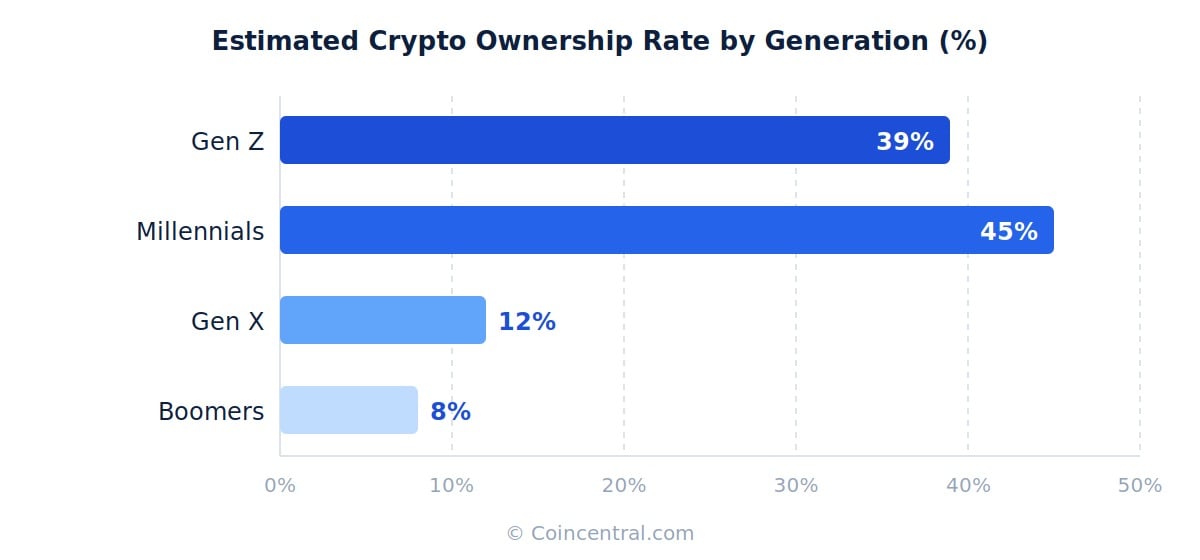
The clearest finding across all major surveys is that younger generations own crypto at far higher rates than older ones.
Coinbase estimates that 45% of Millennials and 39% of Gen Z adults in the United States own some form of cryptocurrency. Gen X sits at roughly 10-15%, and Baby Boomers trail at just 5-10%.
YouGov data (2025) offers a striking comparison: 42% of Gen Z investors own crypto, while only 11% hold a retirement account. That gap reflects a fundamental difference in how this generation thinks about building wealth.
Pew Research found that 28% of adults aged 18-29 have invested in, traded, or used crypto, compared to just 8% of those aged 50 and older. That is a ratio of more than three to one.

Across five major surveys compiled by CoinCentral, Millennials show crypto adoption rates averaging five times higher than Baby Boomers. Even the most conservative individual survey estimates show a ratio of at least 3.5 to one.
Entry points into crypto differ by generation. Gen Z tends to discover crypto through gaming, NFTs, and social media platforms. Millennials typically enter through direct exchanges. Boomers increasingly arrive via financial advisers or Bitcoin ETFs after the SEC approved spot Bitcoin ETFs in January 2024.
| Generation | Birth Years | Est. Crypto Ownership | Multiple vs. Boomers | Primary Entry Point |
|---|---|---|---|---|
| Gen Z | 1997-2012 | 39-42% | ~4.5x | Social media, gaming, NFTs |
| Millennials | 1981-1996 | 36-45% | ~5.0x | Crypto exchanges, DeFi |
| Gen X | 1965-1980 | 10-15% | ~1.5x | ETFs, brokerage platforms |
| Baby Boomers | 1946-1964 | 5-10% | Baseline | Financial advisers, Bitcoin ETFs |
Sources: Coinbase, YouGov (2025), Pew Research (2023), multiple surveys compiled by CoinCentral. Ranges reflect variation across surveys.
Trust and Confidence in Crypto Platforms
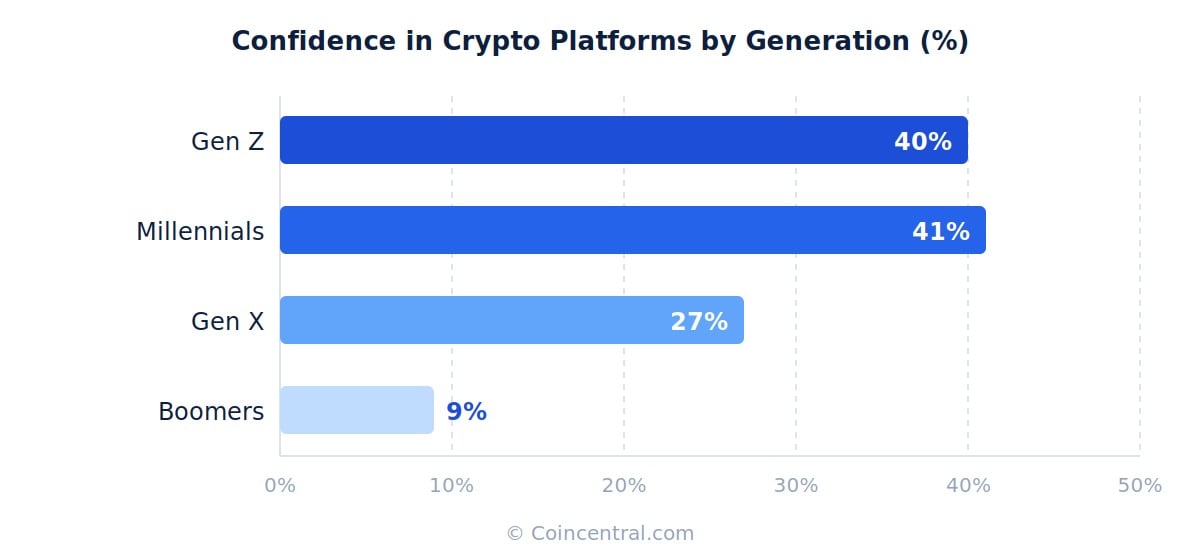
Owning crypto and trusting the platforms that hold it are two different things. A January 2026 survey sponsored by OKX, with 1,000 participants, asked how confident each generation feels about crypto platforms.
40% of Gen Z respondents and 41% of Millennials said they feel confident in crypto platforms. Gen X came in at 27%. Baby Boomers dropped to just 9%.
Year-over-year data shows confidence is growing faster among younger cohorts. Between 2025 and 2026, 36% of Gen Zers said their trust in cryptocurrency increased. For Millennials, that figure was 34%. Only 16% of Gen Xers and 6% of Baby Boomers reported the same.
Younger investors point to constant accessibility and easy-to-use apps as the main reasons they trust crypto platforms. Older investors cite security concerns and the lack of consumer protections like FDIC insurance as reasons they hold back.
Forbes reporting found that half of young, wealthy investors have considered switching or have already switched financial advisers because those advisers would not support crypto investment.
71% of Baby Boomers believe banks will remain a primary part of the financial system. More than half of Gen Z respondents, by contrast, say they expect banks to eventually be surpassed by crypto.
| Generation | Confident in Crypto Platforms | Trust Increased (2025-2026) | Believe Banks Are Permanent |
|---|---|---|---|
| Gen Z | 40% | 36% | <50% |
| Millennials | 41% | 34% | <50% |
| Gen X | 27% | 16% | Majority |
| Baby Boomers | 9% | 6% | 71% |
Source: OKX sponsored survey, January 2026 (n=1,000). Year-over-year trust comparison covers 2025-2026.
The Great Wealth Transfer and Crypto
The biggest potential shift in crypto markets may not come from new retail investors. It may come from inherited wealth moving from Baby Boomers into the hands of younger, crypto-friendly generations.
Cerulli Associates projects that $84.4 trillion will be transferred from Baby Boomers and older generations to younger heirs through 2045. Baby Boomers alone are expected to pass on $53 trillion. The Silent Generation will contribute an estimated $16 trillion over the next decade.
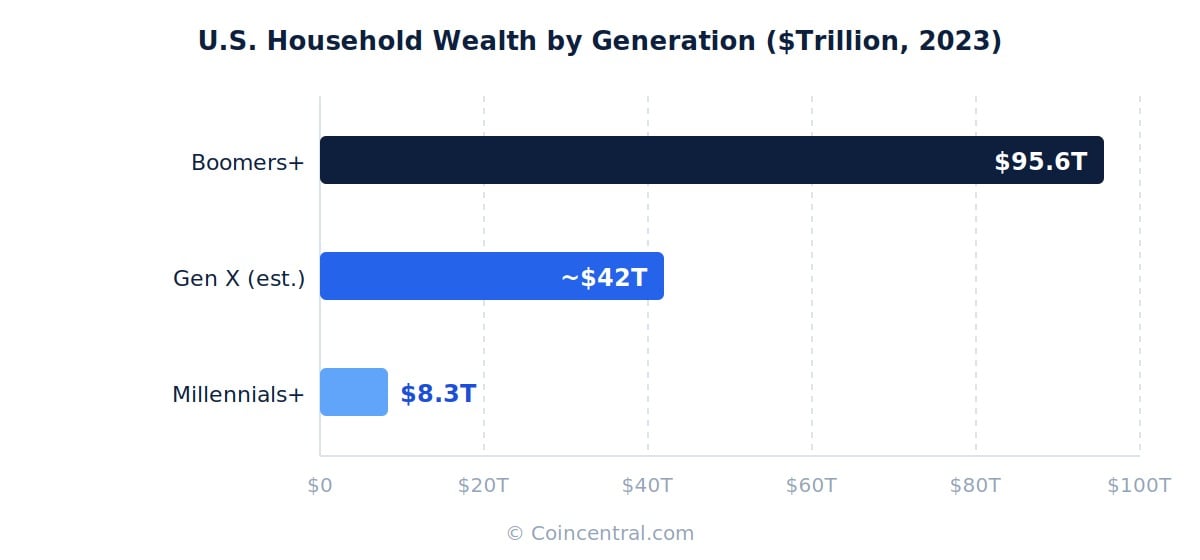
As of the second quarter of 2023, Baby Boomers and older Americans held $95.6 trillion in wealth. That is roughly two-thirds of all U.S. household wealth, despite making up less than one-third of the adult population.
Millennials and younger generations collectively hold just $8.3 trillion, about 5.7% of the total. That is roughly 11.5 times less than what Boomers hold, and about 15.5 times less on a per-capita basis.
CoinCentral’s analysis estimates that if the wealth transfer happened today, between $160 billion and $225 billion would flow into crypto markets. This is based on the 3.5 to 5 times higher crypto adoption rates of younger generations compared to Baby Boomers.
Over the 20-year transfer window, that translates to an estimated $20 million to $28 million in daily buying pressure across the crypto market.
A BNY Mellon survey found that younger wealthy investors commit an average of 5% of their portfolios to crypto, compared to just 1% for North American family offices. As wealth moves to younger hands, those portfolio allocation differences could drive large-scale demand.
Still, the wealth transfer will not reach all Millennials equally. Cerulli estimates that 42% of all transfers will come from households in the top 1.5% by wealth. University of Pennsylvania research found that the top 5% of households by income receive inheritances four to twelve times larger than those in the bottom 80%.
A Federal Reserve study found that recent inheritance recipients received an average of $46,200, compared to an expected $72,200. For those in the bottom half of wealth, the gap was even larger.
| Generation | Current U.S. Wealth Held | Share of Total | Expected Wealth Transfer Role |
|---|---|---|---|
| Silent Gen + Boomers | $95.6 trillion | ~65.5% | Primary senders: $53T (Boomers) + $16T (Silent Gen) |
| Gen X (est.) | ~$42 trillion | ~28.8% | Partial receivers and senders |
| Millennials + Gen Z | $8.3 trillion | ~5.7% | Primary recipients; projected 5x wealth by 2030 |
Sources: Federal Reserve Survey of Consumer Finances (Q2 2023), Cerulli Associates, Coldwell Banker. Gen X figure estimated by subtraction from total U.S. household wealth of $146T.
Personality Traits, Age, and Gender in Crypto Investment
A peer-reviewed study published in Personality and Individual Differences (Honold and Oh, 2025) surveyed 208 U.S. adults to examine how personality traits predict willingness to invest in cryptocurrency.
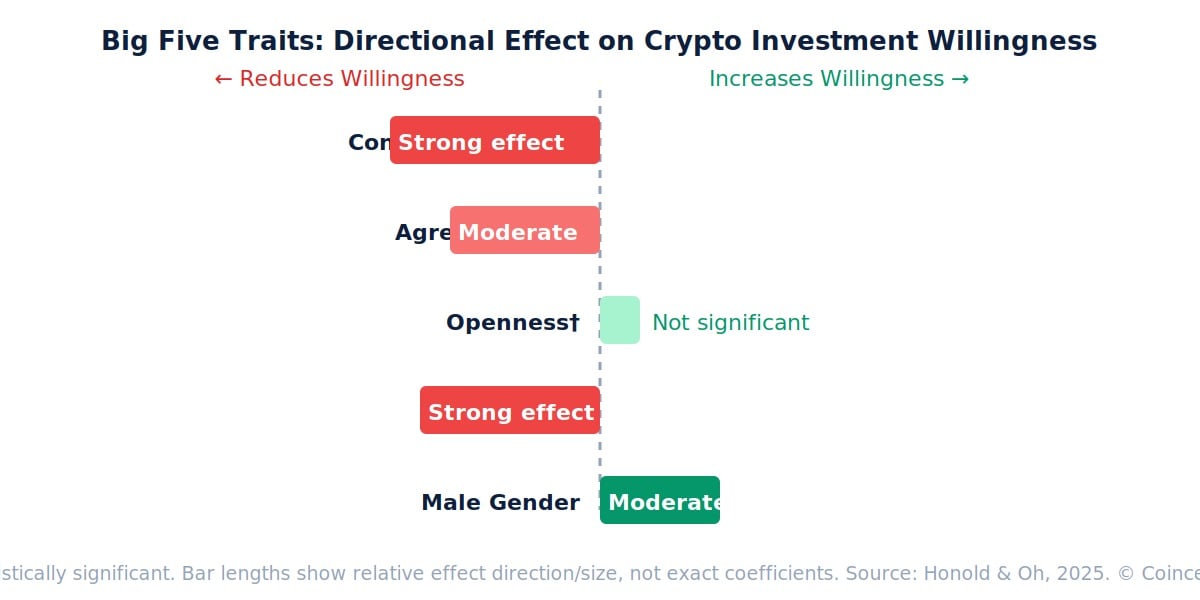
The researchers focused on three traits from the Big Five personality model: openness to new experiences, conscientiousness, and agreeableness. They also looked at the role of age and gender.
Conscientiousness showed the strongest negative relationship with crypto investment willingness. People who score high in conscientiousness tend to plan carefully, avoid risk, and prefer stable, regulated investments. Cryptocurrency’s volatility pushes these investors away.
Agreeableness also predicted lower investment willingness. Highly agreeable people tend to align with social norms and skepticism around speculative markets. The volatile and largely unregulated nature of crypto conflicts with their preferences.
Openness to experience was expected to predict higher willingness to invest, but the effect did not reach statistical significance in this study.
Age was a strong independent predictor: older participants showed much lower willingness to invest in crypto regardless of their personality scores.
Gender moderated the age-investment relationship in a specific way. Men’s enthusiasm for crypto declined more sharply with age than women’s. Women showed more consistent patterns across age groups. Men are still more than three times as likely as women to invest in cryptocurrency overall, a gap linked to higher financial risk tolerance and overconfidence among male investors.
| Factor | Direction of Effect on Crypto Investment Willingness | Significance | Interpretation |
|---|---|---|---|
| Conscientiousness | Negative | Significant | Careful planners avoid high-risk assets |
| Agreeableness | Negative | Significant | Social conformers avoid speculative markets |
| Openness | Positive | Not significant | No confirmed relationship in this study |
| Older Age | Negative | Significant | Younger investors show stronger inclination toward crypto |
| Male Gender | Higher overall willingness | Significant | Men 3x+ more likely to invest; declines more sharply with age |
Source: Honold, S.E. and Oh, N. (2025). Personality and Individual Differences. Survey of 208 U.S. participants, data collected May 2024.
How Each Generation Invests in Crypto
Different generations do not just own different amounts of crypto. They use it in completely different ways, with different assets, platforms, and goals.
Gen Z trades frequently and chases trends. They favor memecoins, NFTs, gaming tokens, and altcoins. Their investment decisions are shaped by communities on Discord, Reddit, and TikTok. For many in this group, owning specific tokens is a statement of cultural identity as much as a financial decision.
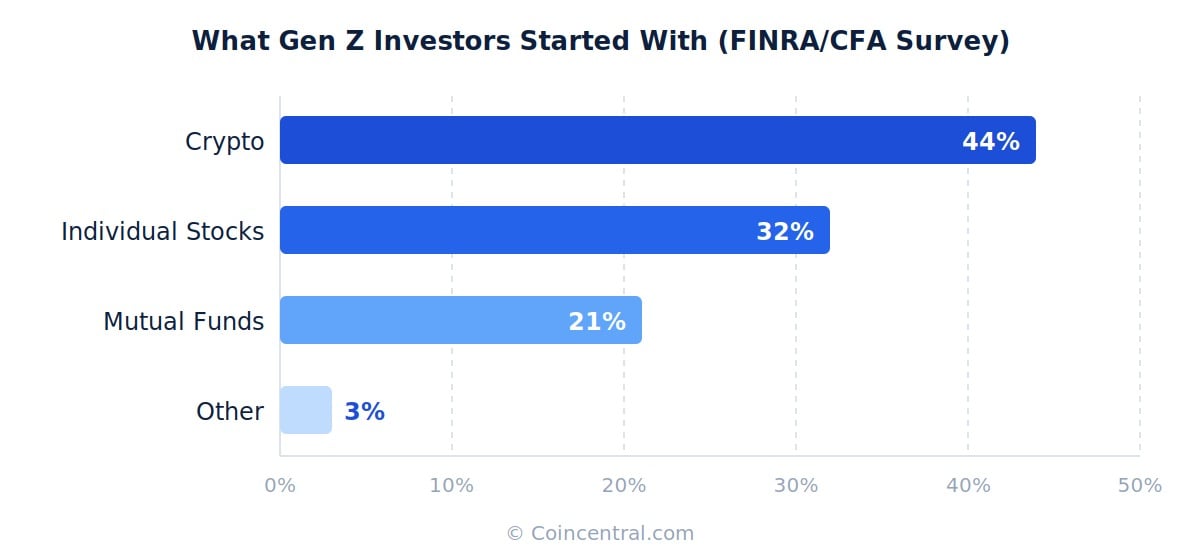
A FINRA and CFA survey found that 44% of Gen Z investors started their investing journey through crypto, ahead of individual stocks at 32% and mutual funds at 21%. The same study found that Gen Z reported a median of $1,000 invested in crypto, roughly one-fourth of their total median investment holdings of $4,000.
Millennials take a longer view. They hold Bitcoin and Ethereum as core positions and add selective exposure to DeFi protocols, staking, and altcoins. Having survived the 2008 financial crisis and multiple crypto market downturns, they balance long-term positions with tactical participation.
An Investopedia survey found that 38% of Millennials held investments in crypto, compared to 37% who held individual stocks. That near-equal split shows how mainstream crypto has become for this generation.
Baby Boomers focus almost entirely on Bitcoin. Their primary goals are wealth preservation and inflation protection, not speculation or yield. Most prefer custodial solutions or ETFs over managing their own private wallets. Their entry into crypto is rooted in economic pragmatism, not ideology.
Across all groups, financial literacy plays a key role. An Investopedia survey found that 69% of Millennials reported having intermediate to advanced understanding of digital currency, compared to just 23% of Boomers.
| Generation | Preferred Assets | Trading Style | Primary Motivation | Typical Platform |
|---|---|---|---|---|
| Gen Z | Memecoins, NFTs, altcoins, gaming tokens | Frequent, trend-driven | Community, identity, speculation | Mobile-first apps, social platforms |
| Millennials | BTC, ETH, DeFi, staking | Long-term hold with tactical additions | Wealth building, financial independence | Full-featured exchanges, DeFi protocols |
| Gen X | BTC, ETH, regulated products | Buy-and-hold, ETF exposure | Diversification, tech-adjacent growth | Brokerage accounts, ETFs |
| Baby Boomers | Bitcoin (primarily) | Buy-and-hold | Wealth preservation, inflation hedge | Custodial platforms, financial advisers |
Sources: FINRA/CFA Gen Z investor survey; Investopedia generational surveys; CoinCentral analysis of JPMorganChase Institute, Digitap, and survey data.
Retirement Savings: Gen Z Is Starting Earlier
Despite high levels of debt and living costs, Gen Z is starting to save for retirement earlier than any previous generation. The data paints a more complex picture than the common narrative of financial struggle.
JPMorganChase Institute research found that more than one-third of 25-year-olds in 2024 had moved money into an investment account since turning 22, up from just 6% in 2015. That is a major shift in investment behavior among young adults.
The average Gen Z worker started saving for retirement at age 24. The average Baby Boomer started at age 34. That 10-year difference gives Gen Z a substantial head start on compounding growth.
Gen Z workers already have an average 401(k) balance of $13,500, according to Investopedia. Researchers link this partly to declining trust in Social Security, which projections suggest could face funding shortfalls by 2034.
Only 5% of Gen Z respondents expect Social Security to be their main source of retirement income. 58% of Gen Z and Millennial respondents say they plan to rely on personal retirement accounts instead.
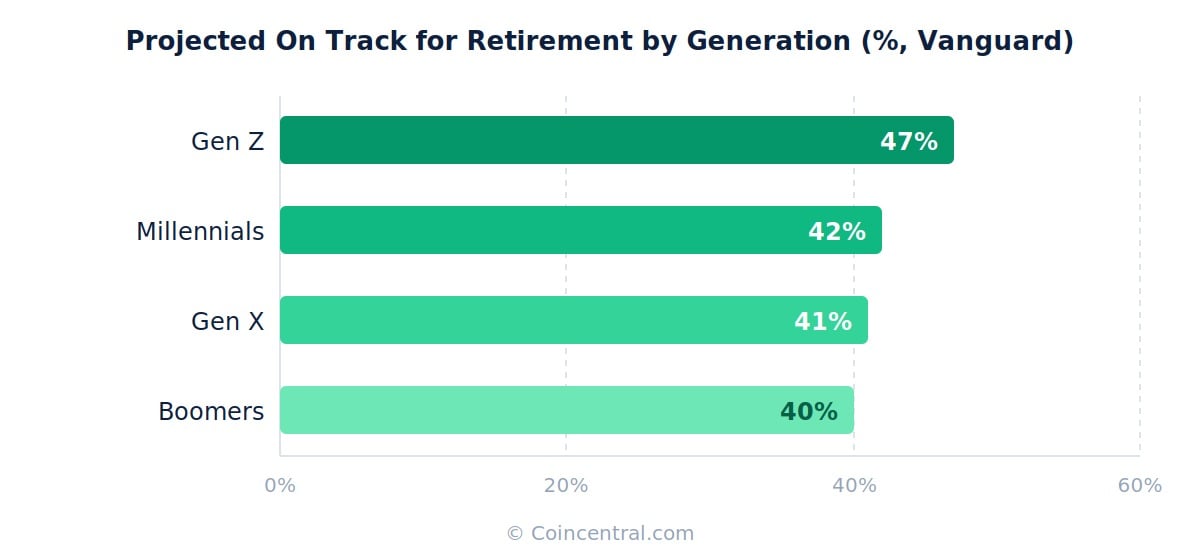
Vanguard projections give Gen Z the highest likelihood of retiring on track. 47% of Gen Z respondents said they expect to maintain their current lifestyle in retirement. Millennials follow at 42%, Gen X at 41%, and Baby Boomers at 40%.
That finding runs against the common image of Gen Z as financially unprepared. Their earlier start and willingness to invest across multiple asset classes, including crypto, may give them a structural long-term advantage.
| Generation | Avg. Retirement Savings Start Age | Projected On Track for Retirement | Expect Social Security as Main Income |
|---|---|---|---|
| Gen Z | Age 24 | 47% | 5% |
| Millennials | ~Age 28 | 42% | Low |
| Gen X | ~Age 31 | 41% | Mixed |
| Baby Boomers | Age 34 | 40% | Higher |
Sources: Vanguard retirement projections; Investopedia (2026); JPMorganChase Institute; Transamerica Institute survey. Millennial and Gen X start ages are approximations.
What the Data Means for Crypto Markets
The generational data points in one direction: crypto adoption is set to grow as wealth shifts between generations.
As Baby Boomers pass assets to Millennials and Gen Z, more of that capital is likely to enter digital asset markets. Even a small shift in portfolio allocation across trillions of dollars could reshape crypto market dynamics at a scale that retail buying pressure alone cannot explain.
Academic research confirms that younger investors are drawn to crypto by both psychology and economics. They have less trust in traditional financial institutions, more comfort with digital tools, and higher tolerance for market volatility. These factors do not change quickly.
At the same time, Baby Boomers entering crypto through regulated ETF products bring a stabilizing demand profile. Their buy-and-hold approach, focused on wealth preservation rather than speculation, creates a different type of buyer than the high-frequency traders of Gen Z.
Boomers are also indirectly pushing regulators toward clearer rules around digital assets. Their demand for consumer protection and oversight is helping legitimize the asset class in the eyes of regulators and institutional investors.
The result is a market shaped by competing forces. Gen Z adds volatility and cultural energy. Millennials add infrastructure and long-term capital. Boomers add legitimacy and regulatory pressure. Each generation contributes something different to crypto’s market structure.
For crypto companies, the data also shows that no single product will serve all three groups. Gen Z wants social features, community tools, and gamified experiences. Millennials want DeFi, staking, yield products, and transparent developer communities. Boomers want simplicity, regulated custodians, and phone support.
Companies that understand those differences and build products accordingly are best positioned to capture the most market share as generational wealth continues to shift. The transition is already underway.
Sources
- Coinbase. America’s Crypto Landscape: Generational Adoption Rates.
- Cerulli Associates. U.S. High-Net-Worth and Ultra-High-Net-Worth Markets 2023: The Great Wealth Transfer.
- Pew Research Center (2023). Majority of Americans Aren’t Confident in the Safety and Reliability of Cryptocurrency.
- OKX / Leibowitz, C., Feldstein, J. and Walker, A. (2026). “Generation Z trusts crypto while saving money in 401(k) plans.” The Hill.
- YouGov for Coinbase (2025). Gen Z Crypto vs. Retirement Ownership Survey.


